Besides angling and cast netting, as described in an earlier article on this website, mid-sized fish are also caught with pole spears in the fast-flowing waters of the Perak rainforests. Together with Shaik Reismann, I spent time with the Temiar Orang Asli people and learned a variety of bushcraft techniques from them. Pole spear fishing near Kampung Orang Asli Beswok at Pos Yum was one of them. Kampung Beswok is the uppermost village of the Yum Creek valley; beyond, only dense rainforest stretches with no further permanent human habitation.
Location and fish species caught with pole spears
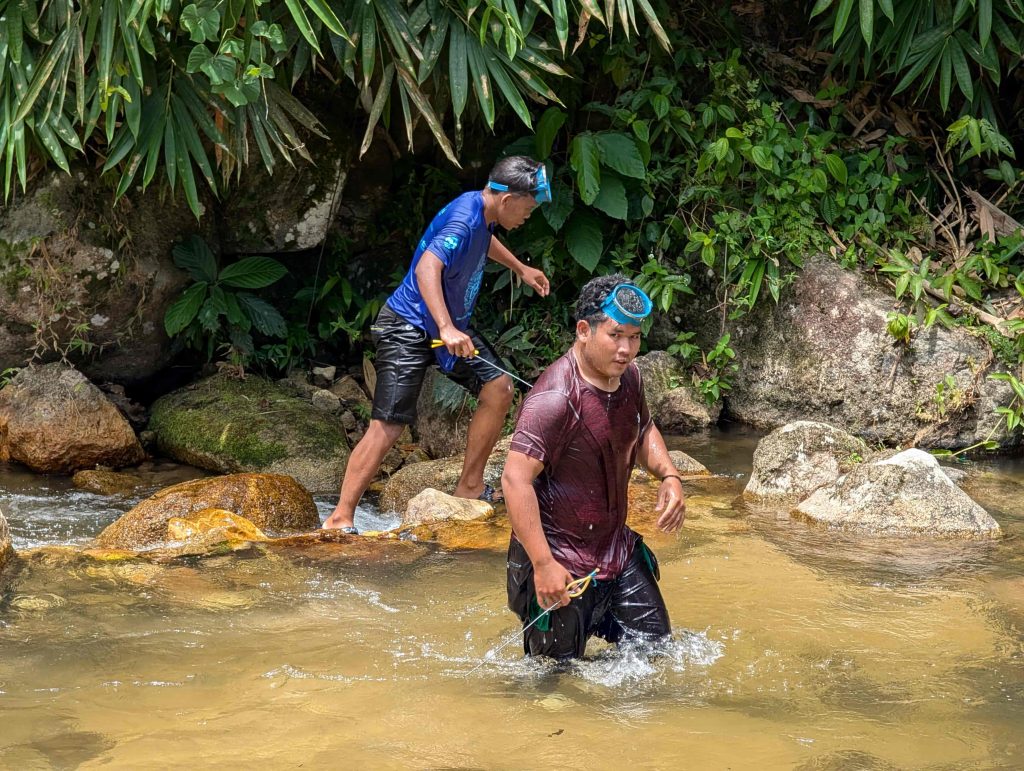
The mountain creeks in Perak state are characterized by fast-flowing, oxygen-rich, cool waters that run over and around boulders. In our case, these were the headwaters of the Yum Creek. The species of fish caught in these streams are few and very specific.
Copper Mahseer
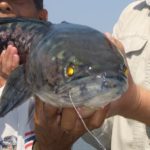
The single most important species is Ikan Tengas, also known as the Copper Mahseer (Neolissochilus soroides). These fish are highly adapted to these waters, reach a size suitable for pole-spearing, and taste delicious. Due to heavy fishing pressure and the creek’s small size, there are no large specimens left. But mid-sized fish are found under the boulders and rock ledges and are the primary target for pole spearing. The larger the fish, the deeper they hide during daylight in the shade of the boulders.
Small fish species
Various species of Rasboras and Minnows occur in the same waters. These species, however, are too small for pole spearing.
Fish species further down the creek
Not at the headwaters of Yum Creek, but further down the valley, Ikan Sebarau or Hampala Barb (Hampala macrolepidota), and Ikan Kelah, or the Malayan Mahseer (Tor tambroides), are found in wider and deeper pools of the creek. Together with various catfish species (Ikan Baung) and snakeheads (Channa species).
Fishing tools
The necessary equipment for pole spearing consists of a spear and a pair of underwater goggles.
The pole spears itself
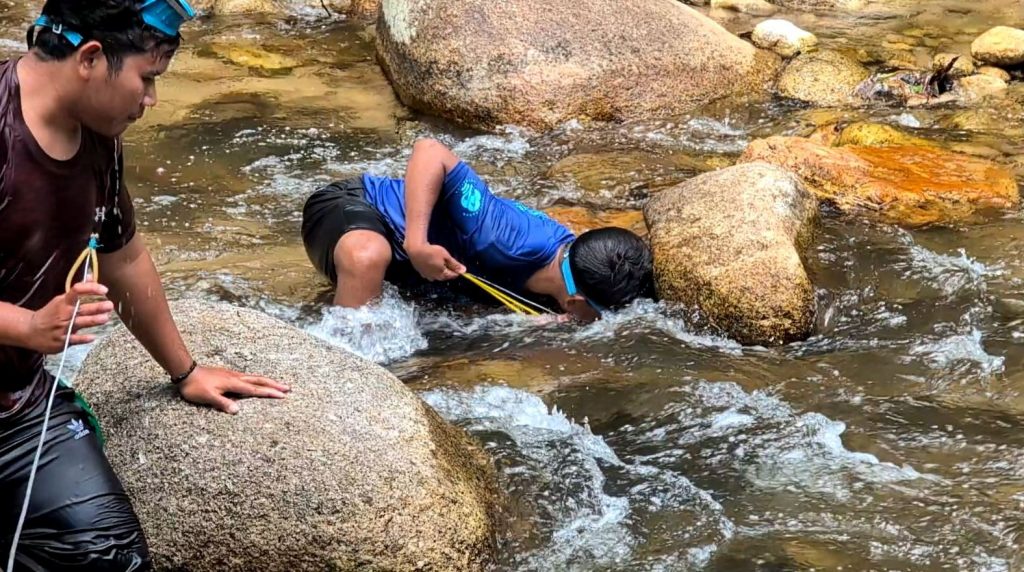
I use the term ‘pole spear’ in this article, as it is used in literature most commonly. But it would be better to call it a ‘sling dart’. It is not a pole, nor a spear, but a somewhat larger dart, which is propelled forward by a rubber sling. This sling or loop is attached directly to the rod’s rear end. In Bahasa (Indonesian and Malay), it is called Panah Ikan (literally “fish arrow”) or simply Paser.
The shaft of the dart is normally about 70 cm or 27,5 inches long with a diameter of about 5 mm or 0.2 (13/64) inches. It is often made from thick stainless-steel wires, but all kinds of metal scrap from motorbikes, bicycles, or construction materials are also used. Such alternative materials could include spokes from umbrellas or bicycles. Shapes and materials can therefore vary widely. The front side of the dart will be filed to a needle-sharp point. Behind the point, sometimes a backward-facing notch will be filed as a kind of barb, to hold the dart within the thrashing fish body after impact.
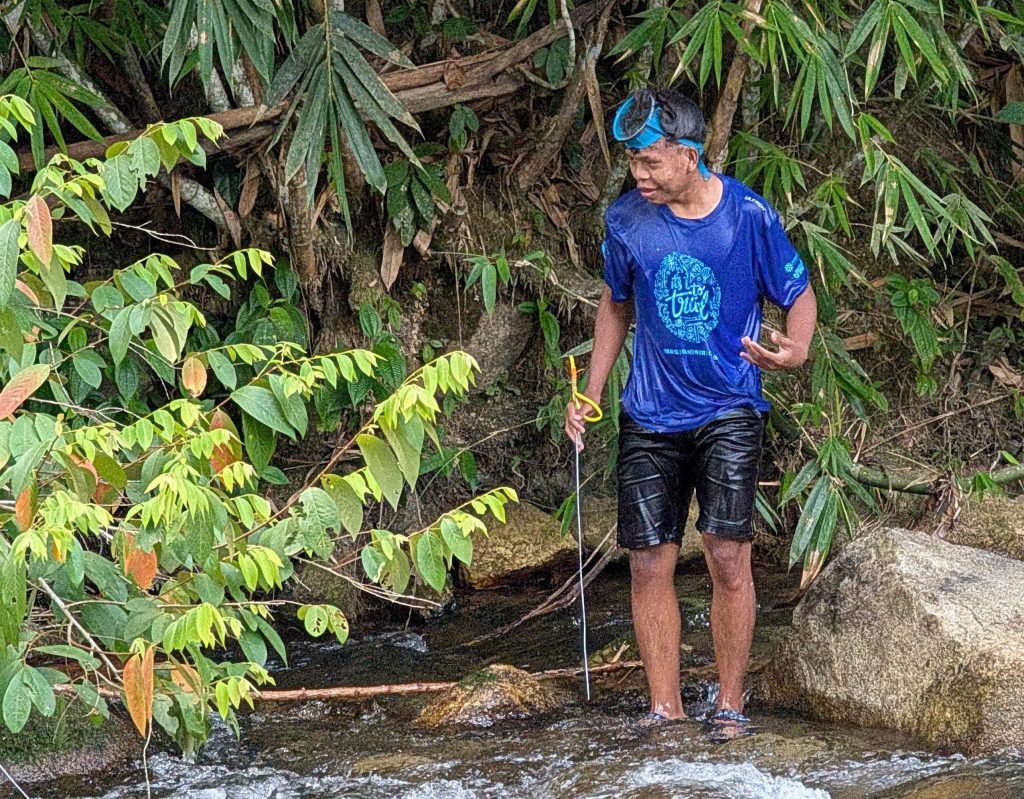
Commonly, the rubber sling is also made from scrap material, such as sections of motorcycle inner tubes, bicycle tubes, latex tubing from medical facilities, and similar items. This rubber sling will be secured to the back end of the shaft with wires or other secure bindings.
Underwater goggles
These goggles are typically cheap snorkel masks purchased from local traders that offer a wide field of view. Unlike scuba diving, where the air volume within the mask should be kept to a minimum, in this fishing application an unrestricted, wide view is required. Due to the easy availability of these snorkel masks, it is no longer common to craft improvised goggles.
Fishing technique
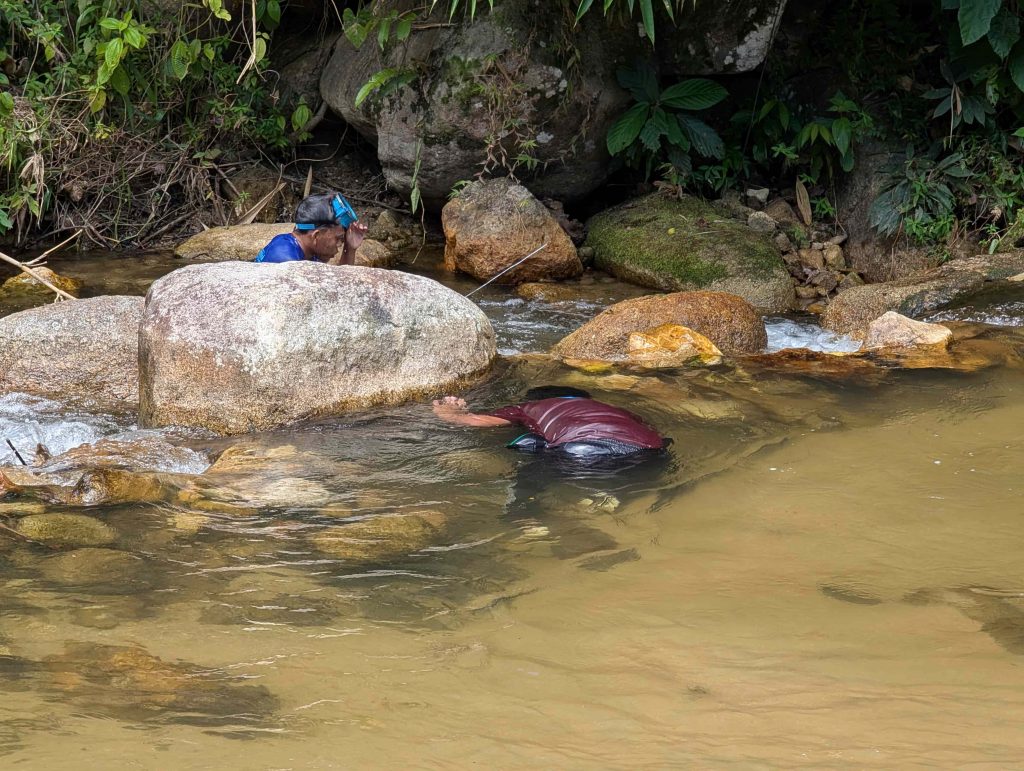
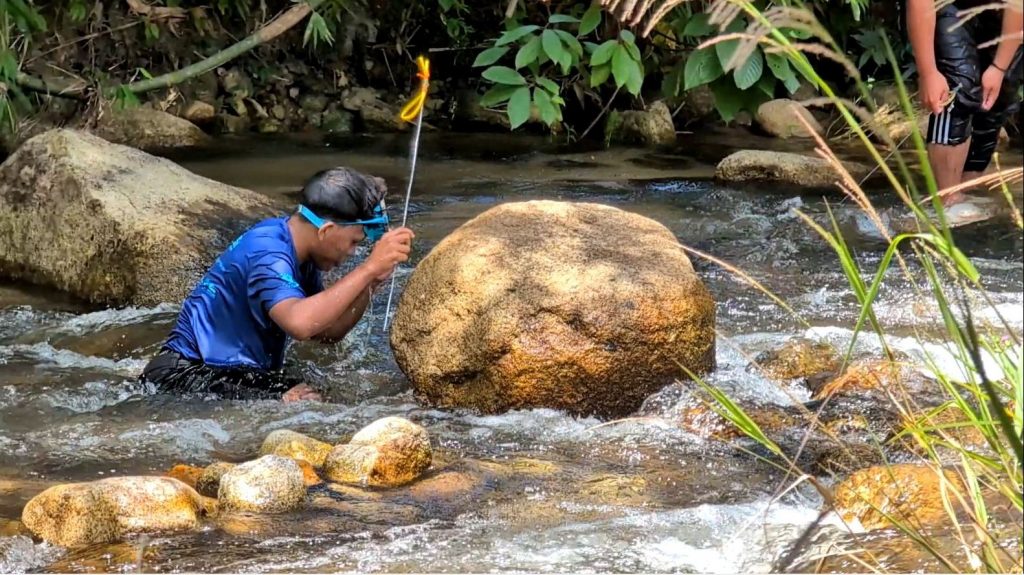
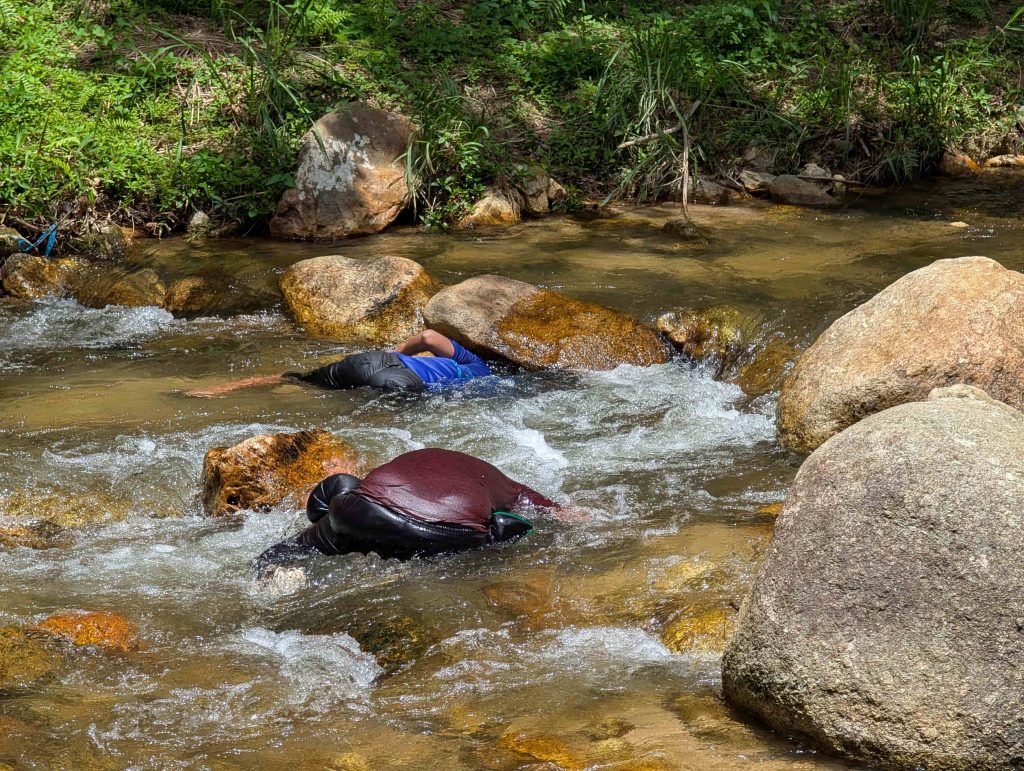
Boys and young men wade upstream through the clear and shallow water and check out nooks and crannies under every boulder on their way.
If they spot in a deep crevice beneath a boulder a flash of silver scales, they slip the tip of the steel pole spear inside. They draw back the heavy rubber band, which is looped around their wrist or thumb, and hold it at full tension. And when a flash of silver scales moves in the dark cavity, they release the rod at this target.
Because these mountain fish are strong and the spear lacks a holding mechanism (like a reel), the fisherman must instantly use the momentum of the strike to pin the fish against the riverbed or the backside of the cavity until they can reach in and grab it manually.
Cultural aspects
In the Yum Creek valley, this type of fishing isn’t just about putting food on the table; it is a rite of passage for the village boys and a social bonding activity of the local Temiar Orang Asli community. Successful pole spear fishing results in a riverside cookout (Makan-Makan), where the fresh catch is immediately scaled, seasoned with basic wild ginger, salt, and chilies, and then grilled over an open fire by the stream.
This type of spearfishing is highly selective, as only fish that can be seen will be shot. Nevertheless, local elders strongly discourage doing so during the heavy monsoon season to allow Tengas populations to spawn safely in the headwaters.
Lessons learned from catching Copper Mahseer with pole spears:
- In the headwaters of the Yum Creek, mainly Tengas are fished by pole spearing.
- For the shaft of the sling of a pole spear, often scrap materials are used.
- Pole spearing is a typical activity of male youths of the Temiar Orang Asli communities.