
Orang Asli
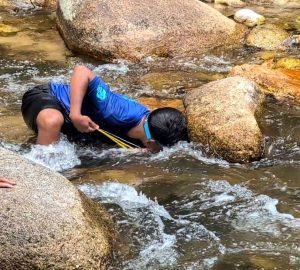
Traditional Pole Spear Fishing with the Temiar Orang Asli in Perak
Besides angling and cast netting, as described in an earlier article on this website, mid-sized fish are also caught with pole spears in the fast-flowing waters of the Perak rainforests. Together with Shaik Reismann, I spent time with the Temiar Orang Asli people and learned a variety of bushcraft techniques from them. Pole spear fishing near Kampung Orang Asli Beswok at Pos Yum was one of them. Kampung Beswok is the uppermost village of the Yum Creek valley; beyond, only dense rainforest stretches with no further permanent human habitation. Location and fish species caught with pole spears The mountain creeks…

Fishing for Copper Mahseer (Tengas) in the Malaysian rainforest
Description of the location My friend, Shaik Reismann, and I visited Kampung Yum in Perak state, Malaysia, to learn from the Temiar Orang Asli people’s traditional junglecraft skills and knowledge. Shaik himself also serves as the junglecraft trainer for the Community Rangers (Renjer Komuniti) of the RIMAU NGO, which specializes in preserving and protecting the last remaining Malayan tigers. And one of his Community Rangers is Bakri, our point of contact at Kampung Yum. This village (Kampung) is part of Pos Yum, which is about a one-hour drive from Sungai Siput in the Malaysian state of Perak. Within the eight…

Blowpipe darts of the Orang Asli people
A blowpipe without a dart is nothing more than a tube. It is the dart — the damak — that carries the outcome of the hunt. Among the Orang Asli of Peninsular Malaysia, dart-making is considered a craft that draws on specific forest materials and a refined understanding of physics honed over generations. The result is a projectile of exceptional simplicity and precision: typically, 20 to 30 cm long, weighing only a few grams, and capable of reaching speeds of up to 180 km/h when launched from the blowpipe. We have handled and examined darts from Jahai, Semai, and Temiar…

Orang Asli Bamboo Blowpipes: 5 Traditional Examples from My Collection
For many years, I’ve been teaching junglecraft and survival skills in the Malaysian jungles. In turn, I learned these skills and knowledge from close Orang Asli friends. For stealth hunting, their primary weapon is the blowpipe, but they also place considerable emphasis on trapping. Over the years, I acquired various blowpipes from the Semai, Jahai, and Temiar tribes, and I also manufactured them using traditional materials and methods. In the following, I will briefly present five blowpipes from my collection. Measurements of five blowpipes Inner pipe Outer pipeBlowpipe #Tribal originAcquisition yearTotal length (cm/feet)Outer diameter (mm/inch)Blowhole dia Mouthpiece (mm/inch)Blowhole dia Muzzle (mm/inch)Connection…

Discover Orang Asli Blowpipes: The Iconic Hunting Tool of Peninsular Malaysia
Blowpipes were traditionally the primary hunting weapon among the Orang Asli people in Peninsular Malaysia. Few sub-tribes still use them regularly nowadays, such as the Jahai and Bateq. But for most others, blowpipes are merely a relic of the past. Often, they are still used for ceremonial purposes or as a ‘Stone Age’ activity for schoolchildren. Other traditional hunting weapons used by hunter-gatherer societies, such as bows and arrows or lances, never achieved the same level of popularity as blowpipes. The information presented in this article is based on my various encounters with knowledgeable Jahai, Semai, Temiar, and Semelai people.…

Bamboo: The Orang Asli’s natural toolkit
If rattan is the skeleton of Orang Asli junglecraft, bamboo is the toolkit. From riverbanks to misty hill slopes, clusters of bamboo mark places where people have worked, cooked, travelled, and sheltered for countless generations. To an untrained eye, most bamboos look alike: tall, hollow, and green. But for Orang Asli communities in Peninsular Malaysia, each species is a different tool waiting to be used in the right way and at the right time. Mapping bamboo to the landscape Around 70 native bamboo species occur in Malaysia. The most important genera for junglecraft include Gigantochloa, Schizostachyum, and Dendrocalamus. Orang Asli…

Soapbush – a versatile junglecraft plant
Soapbush (Miconia crenata) is also called Koster’s curse, or, due to its former scientific name (Clidemia hirta), Hairy clidemia in English. It is a highly invasive plant in tropical climates, and many countries have developed eradication programs against this weed. For junglecraft, however, it is a beneficial plant that can be used for various purposes, as discussed below. Appearance Soapbush is easy to recognize due to its characteristic leaves. BioNET EAFRINET describes them as: ‘…The leaves … have a somewhat wrinkled (rugose) appearance and five distinct veins that run in an almost parallel fashion from the leaf bases to their tips….’.…

Rattan: Flexible raw material from the forests
Deep in the lowland dipterocarp forests of Peninsular Malaysia, long before you see rattan, you feel it. Hooks catch on shirt sleeves, flagella tug gently at your backpack, and the forest floor is littered with the thorny sheaths of climbing palms. For the Orang Asli, these plants are not a nuisance. They are one of the most important raw materials of their junglecraft: rattan. Where most outsiders just see “Rotan”, Orang Asli see a whole toolbox of distinct species, each with its own character, strengths, and proper use. Over generations, they have learned to read the forest like a catalogue…

Wild yam in Perak’s forests
When walking with Orang Asli people from the Jahai tribe in the forests near the Royal Belum State Park in Perak, Malaysia, they showed me their traditional favorite staple food source: wild yam tubers. These tubers can be eaten without any detoxification. Their only drawback is that they are long and slender and grow deep in the soil. It is therefore a laborious task to extract them, and often only pieces of tubers can be retrieved. Which species of wild yam did we harvest? Siti Nursyadiq Anuar researched the use of wild tubers among the Bateq people, who, like the…

Jahai Huts: How the Bamboo Sidewalls are Built
Jahai huts, characteristic of the Semang Orang Asli people, exemplify the widespread use of bamboo as a material for floors and sidewalls. The Jahai people settle in and near the area of the Royal Belum State Park in Perak, Malaysia, and they showed the author in this area how they built their huts. In this article, we will not focus on thatching the roof, but rather examine how they create the sidewalls. The Jahai people live in small clusters of homes in remote areas near the lake. Typically, each cluster (also referred to as a village) comprises between 6 and…

Red torch ginger fruits
Red torch ginger (Etlingera elatior) fruits are commonly eaten by Jahai Orang Asli people in the forests of the northern State of Perak in Malaysia. These fruits are not only consumed by the forest dwellers of Perak State, but also widely over Southeast Asia. They are gathered and sold on markets at least in parts of Peninsular Malaysia, and all over Borneo and the Indonesian archipelago. Due to this wide distribution, there are various common names, like Buah Kantan, Buah Kecombrang, Ketimba, and many other local names. Plant description and distribution The circumpolar distribution in tropical countries of Etlingera elatior…

Rattan Palm Hearts: A Jungle Snack of the Jahai in Malaysia
When walking with Jahai Orang Asli people near the Royal Belum State Park in Perak, Malaysia, they showed me some of their plant food sources in the forests. One of them was young rattan palm shoots. For the Jahai people, it was not important which exact rattan species it was, but the young rattan shoots had to have thumb-thick stems. Plant description The stems of the rattan palm shoots develop from rhizomes underground. Therefore, often, more than one stem develops from such a rhizome. The stems are heavily thorned, and additionally, flagella develop from these stems and will grab with…

Rattan palm fruits in Perak’s jungles
Rattan palm fruits are available from most of the 70 species of the Calamus genus in Malaysia. But also species of Daemonorps and Korthalsia rattan genera often carry edible fruits. We went with the Jahai Orang Asli people into the forests near Royal Belum State Park in Perak, and collected rattan palm fruits from two different species. One species seemed to be Calamus ornatus, and the other one resembled Calamus manan. All articles on this website are not the result of scientific research projects, but should explain in a popular-scientific way practical knowledge for simple living and survival situations. It…

Wild Ginger Stalks: Food and Remedy of the Jahai in Malaysia
When walking with the Orang Asli people of the Jahai tribe near the Royal Belum State Park in northern Malaysia, they showed me various edible plants in the rainforest that they ate regularly. One of them was a Zingiberaceae (Ginger) species, which they called ‘Lebek’. The names ‘Lebek’ or ‘Labek’ are used by them for various wild ginger species, which either provide rhizomes used medicinally or edible shoots and fruits. Plant description The large, alternate leaves of the plant shown grew in two ranks from a pseudostem, which is typical for gingers. The stalks were thick and upright, reaching heights…

Moon mushrooms at the Royal Belum State Park in Malaysia
Moon mushrooms (Gymnopus sp.) are one group of edible mushrooms found in the forests of Malaysia, and are locally called ‘Jamur bulan’. The other groups of edible mushrooms are colloquially known as wood ear mushrooms, oyster mushrooms, and shiitake mushrooms. This is a stark simplification, on which every mycologist will cringe, but it describes in practical and simple terms which mushrooms can often be eaten. When walking with Orang Asli people of the Jahai tribe in the forests of the Royal Belum State Park in Perak, Malaysia, they showed me these mushrooms as one of their food sources. Although this…

Blowpipe hunting with Orang Asli people in Malaysia
Blowpipe hunting is still prevalent in many Orang Asli communities in Malaysia. Although the government strictly enforces hunting rules and regulations, it is practically impossible to supervise all the remote small hamlets and villages. On the other hand, it is also practically impossible for the Orang Asli people to travel outside villages to buy meat. There are often no roads, only waterways, and the people are very poor. They, therefore, resort to what they have done since eternal times: they live from the products of forest and waters. A Malay friend of mine was, in turn, a friend of a…

Danger of Asian elephants – whether they are in musth or not
Asian elephants (Elaphas maximus) are smaller than their African cousins but not less dangerous when in musth. That danger was already described for African elephants in this article on this website. In the following, we briefly compare the differences between both genera. African elephants vs. Asian elephants Musth in Asian elephants Wild and tame male elephants experience a periodical manic disturbance called musth. During this period, the animal may have a bad temper and start fighting with other elephants. They will even try to attack any human they can reach, even their own Mahout or Caretaker. Before it starts to…