
Jahai
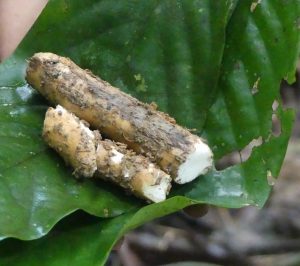
Wild yam in Perak’s forests
When walking with Orang Asli people from the Jahai tribe in the forests near the Royal Belum State Park in Perak, Malaysia, they showed me their traditional favorite staple food source: wild yam tubers. These tubers can be eaten without any detoxification. Their only drawback is that they are long and slender and grow deep in the soil. It is therefore a laborious task to extract them, and often only pieces of tubers can be retrieved. Which species of wild yam did we harvest? Siti Nursyadiq Anuar researched the use of wild tubers among the Bateq people, who, like the…
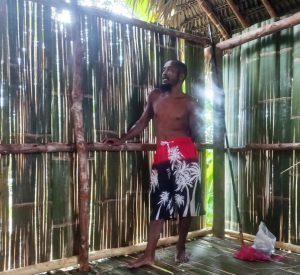
Jahai Huts: How the Bamboo Sidewalls are Built
Jahai huts, characteristic of the Semang Orang Asli people, exemplify the widespread use of bamboo as a material for floors and sidewalls. The Jahai people settle in and near the area of the Royal Belum State Park in Perak, Malaysia, and they showed the author in this area how they built their huts. In this article, we will not focus on thatching the roof, but rather examine how they create the sidewalls. The Jahai people live in small clusters of homes in remote areas near the lake. Typically, each cluster (also referred to as a village) comprises between 6 and…
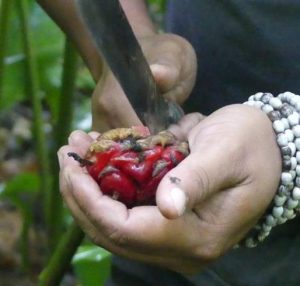
Red torch ginger fruits
Red torch ginger (Etlingera elatior) fruits are commonly eaten by Jahai Orang Asli people in the forests of the northern State of Perak in Malaysia. These fruits are not only consumed by the forest dwellers of Perak State, but also widely over Southeast Asia. They are gathered and sold on markets at least in parts of Peninsular Malaysia, and all over Borneo and the Indonesian archipelago. Due to this wide distribution, there are various common names, like Buah Kantan, Buah Kecombrang, Ketimba, and many other local names. Plant description and distribution The circumpolar distribution in tropical countries of Etlingera elatior…
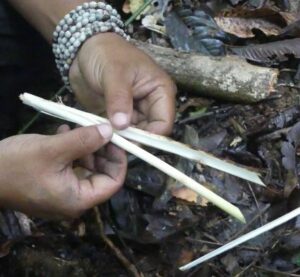
Rattan Palm Hearts: A Jungle Snack of the Jahai in Malaysia
When walking with Jahai Orang Asli people near the Royal Belum State Park in Perak, Malaysia, they showed me some of their plant food sources in the forests. One of them was young rattan palm shoots. For the Jahai people, it was not important which exact rattan species it was, but the young rattan shoots had to have thumb-thick stems. Plant description The stems of the rattan palm shoots develop from rhizomes underground. Therefore, often, more than one stem develops from such a rhizome. The stems are heavily thorned, and additionally, flagella develop from these stems and will grab with…
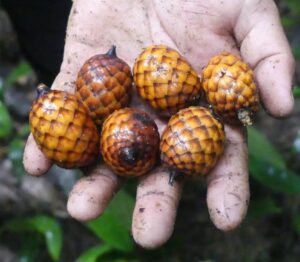
Rattan palm fruits in Perak’s jungles
Rattan palm fruits are available from most of the 70 species of the Calamus genus in Malaysia. But also species of Daemonorps and Korthalsia rattan genera often carry edible fruits. We went with the Jahai Orang Asli people into the forests near Royal Belum State Park in Perak, and collected rattan palm fruits from two different species. One species seemed to be Calamus ornatus, and the other one resembled Calamus manan. All articles on this website are not the result of scientific research projects, but should explain in a popular-scientific way practical knowledge for simple living and survival situations. It…
Wild Ginger Stalks: Food and Remedy of the Jahai in Malaysia
When walking with the Orang Asli people of the Jahai tribe near the Royal Belum State Park in northern Malaysia, they showed me various edible plants in the rainforest that they ate regularly. One of them was a Zingiberaceae (Ginger) species, which they called ‘Lebek’. The names ‘Lebek’ or ‘Labek’ are used by them for various wild ginger species, which either provide rhizomes used medicinally or edible shoots and fruits. Plant description The large, alternate leaves of the plant shown grew in two ranks from a pseudostem, which is typical for gingers. The stalks were thick and upright, reaching heights…
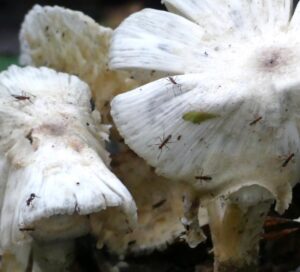
Moon mushrooms at the Royal Belum State Park in Malaysia
Moon mushrooms (Gymnopus sp.) are one group of edible mushrooms found in the forests of Malaysia, and are locally called ‘Jamur bulan’. The other groups of edible mushrooms are colloquially known as wood ear mushrooms, oyster mushrooms, and shiitake mushrooms. This is a stark simplification, on which every mycologist will cringe, but it describes in practical and simple terms which mushrooms can often be eaten. When walking with Orang Asli people of the Jahai tribe in the forests of the Royal Belum State Park in Perak, Malaysia, they showed me these mushrooms as one of their food sources. Although this…

Blowpipe hunting with Orang Asli people in Malaysia
Blowpipe hunting is still prevalent in many Orang Asli communities in Malaysia. Although the government strictly enforces hunting rules and regulations, it is practically impossible to supervise all the remote small hamlets and villages. On the other hand, it is also practically impossible for the Orang Asli people to travel outside villages to buy meat. There are often no roads, only waterways, and the people are very poor. They, therefore, resort to what they have done since eternal times: they live from the products of forest and waters. A Malay friend of mine was, in turn, a friend of a…