A blowpipe without a dart is nothing more than a tube. It is the dart — the damak — that carries the outcome of the hunt. Among the Orang Asli of Peninsular Malaysia, dart-making is considered a craft that draws on specific forest materials and a refined understanding of physics honed over generations. The result is a projectile of exceptional simplicity and precision: typically, 20 to 30 cm long, weighing only a few grams, and capable of reaching speeds of up to 180 km/h when launched from the blowpipe.
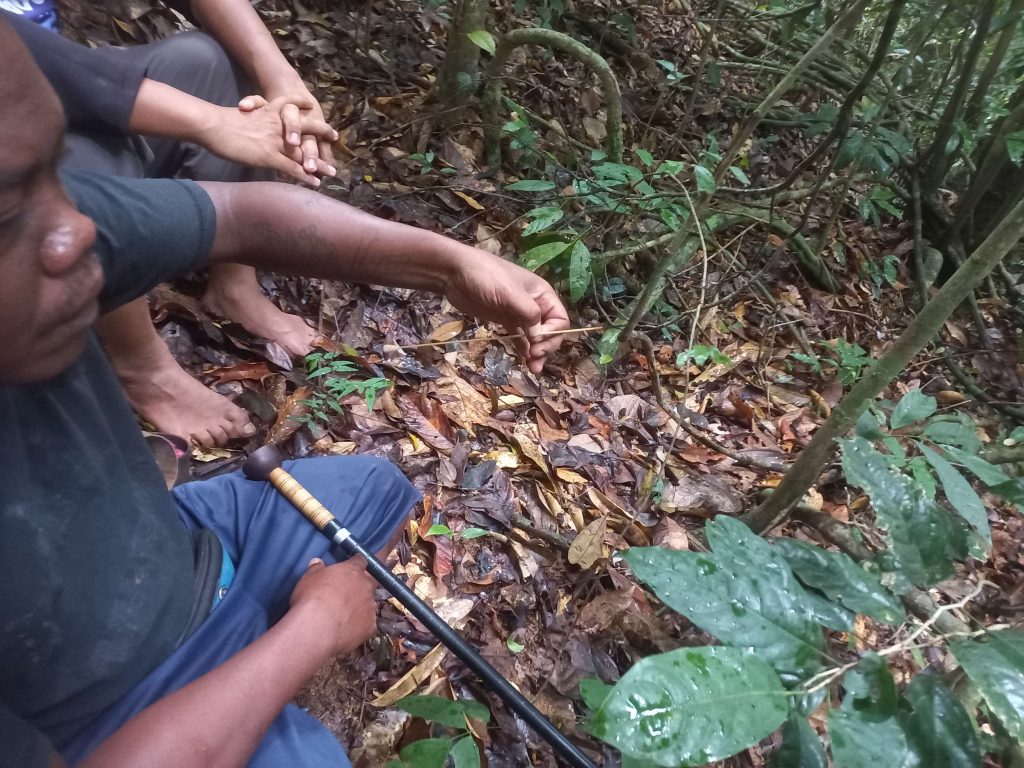
We have handled and examined darts from Jahai, Semai, and Temiar makers, and what strikes you first is not their size but their balance. Each dart sits nose-heavy in the hand, its weight deliberately distributed forward. That balance is not accidental — it is the result of careful construction and, in the hands of a skilled maker, rigorous testing before a single drop of poison is ever applied.
The shaft
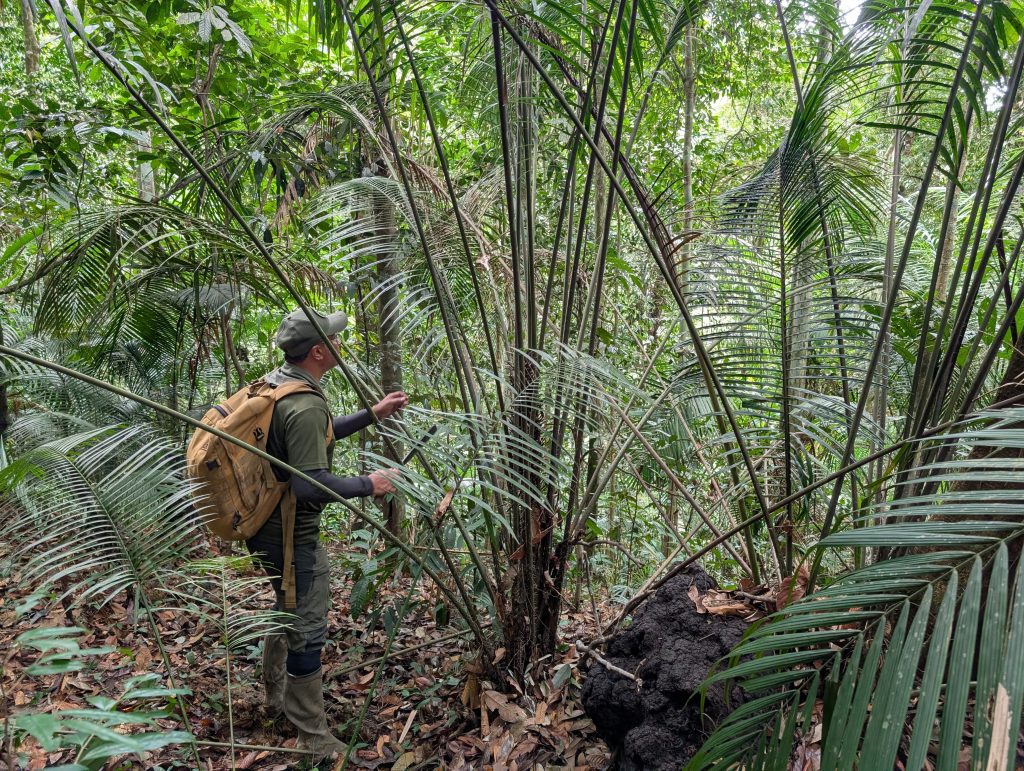
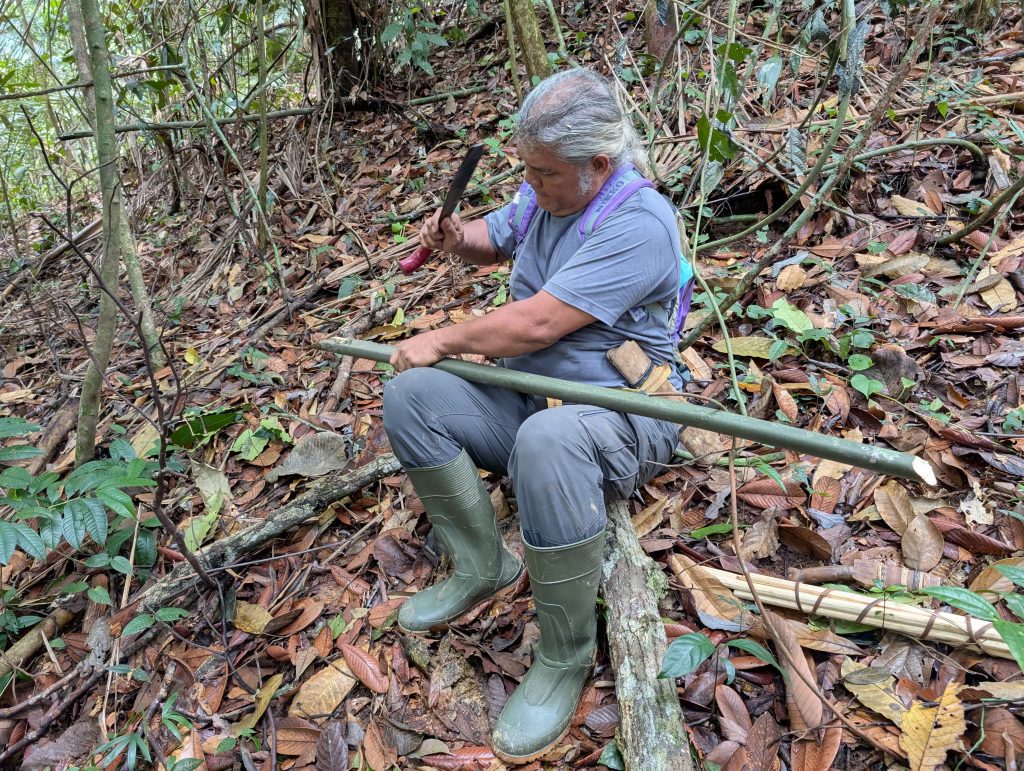
The shaft of the Orang Asli dart is preferably made from the leafstalk (petiole) of the Bertam palm (Eugeissona tristis), a common understorey palm in the forests of Peninsular Malaysia. Other raw materials are the leafstalks of Langkap palms (Arenga obtusifolia), or of Bemban/Oil palms (Elaeis guineensis),
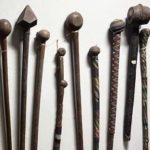
From left to right: Petioles of a Bertam palm, a Langkap palm, and a Bemban palm
- Bertam palm petioles have a green colour. About 3-4 cm-wide stalks will be dried for about 3 months and thereafter used to cut dart shafts.
- Langkap palm petioles show a greenish-brown colour. These stalks will first be cut into shafts and only afterward be dried, again for about three months. After drying, the wood would be too hard to cut for the shafts.
- Bemban palm leaf stalks are of a reddish-brown colour. Again, about 3-4 cm wide leaf stalks will be dried for three months and thereafter cut into dart shafts.
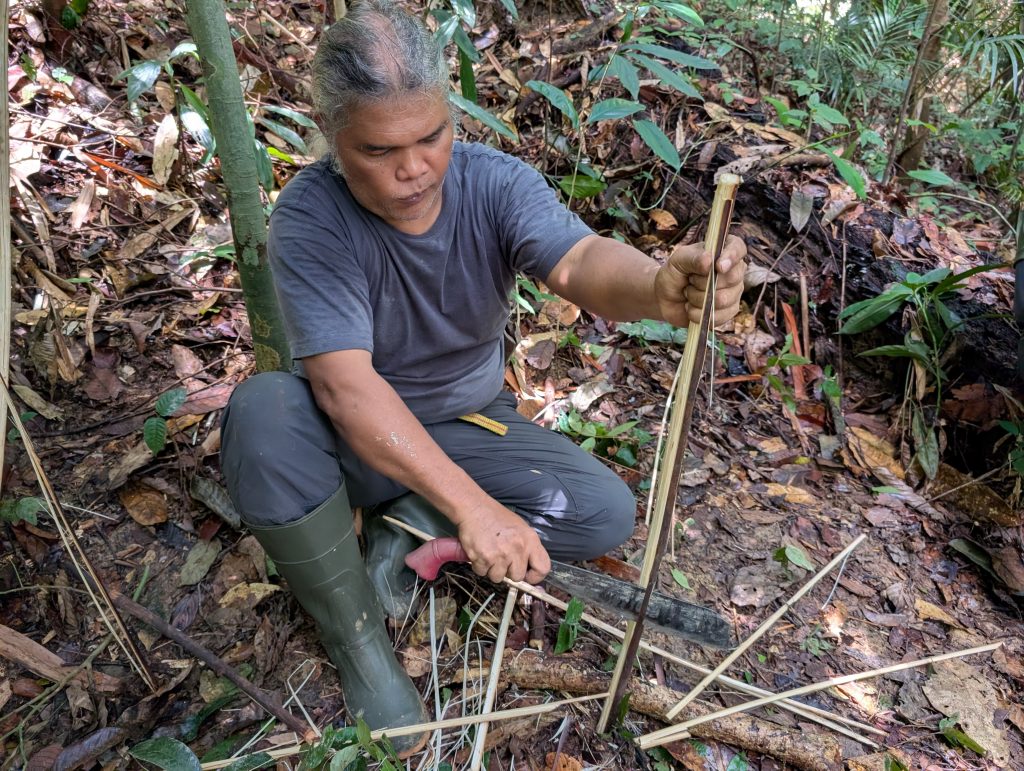
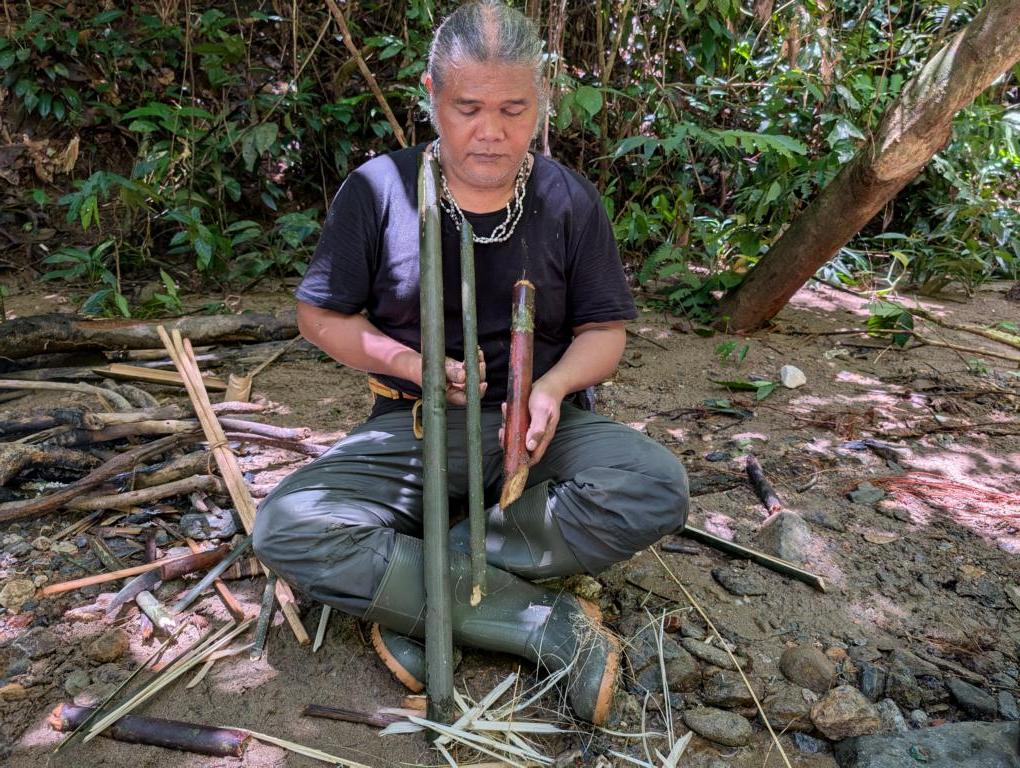
The length of the ready-cut leafstalks should be about the length of a forearm. When cutting, as much wood as possible from under the skin must remain, and the soft heartwood must be removed.
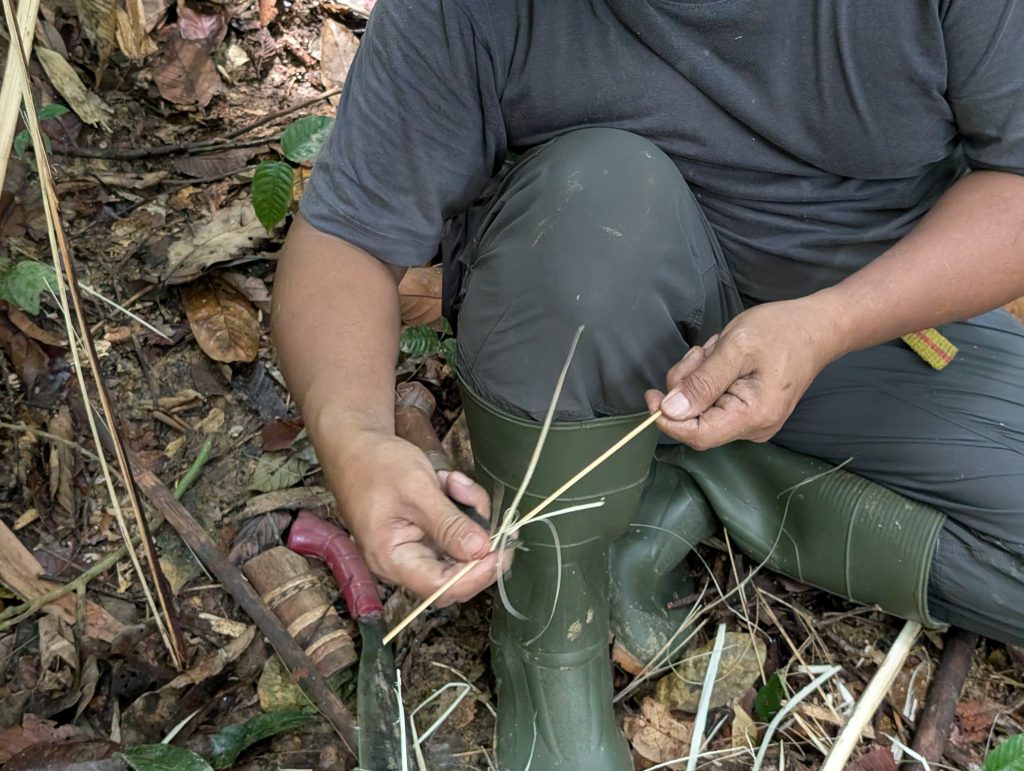
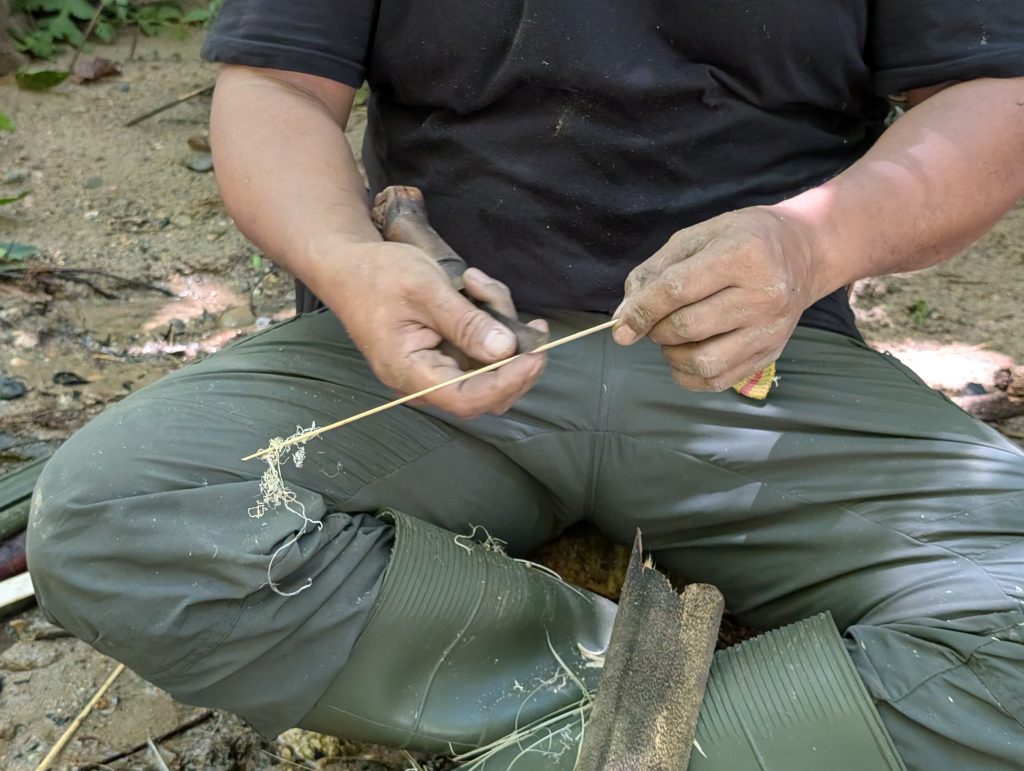
The stalks are shaved down by hand with a small knife until straight and smooth, roughly 3 mm in diameter, stiff, and extremely light. The finished, carved arrows should be round and taper slightly towards the rear in their final third. A point is carved at the front. Approximately 1 cm behind the tip, a spiral groove—about 3 cm in length—is cut into the wood to hold the poison.
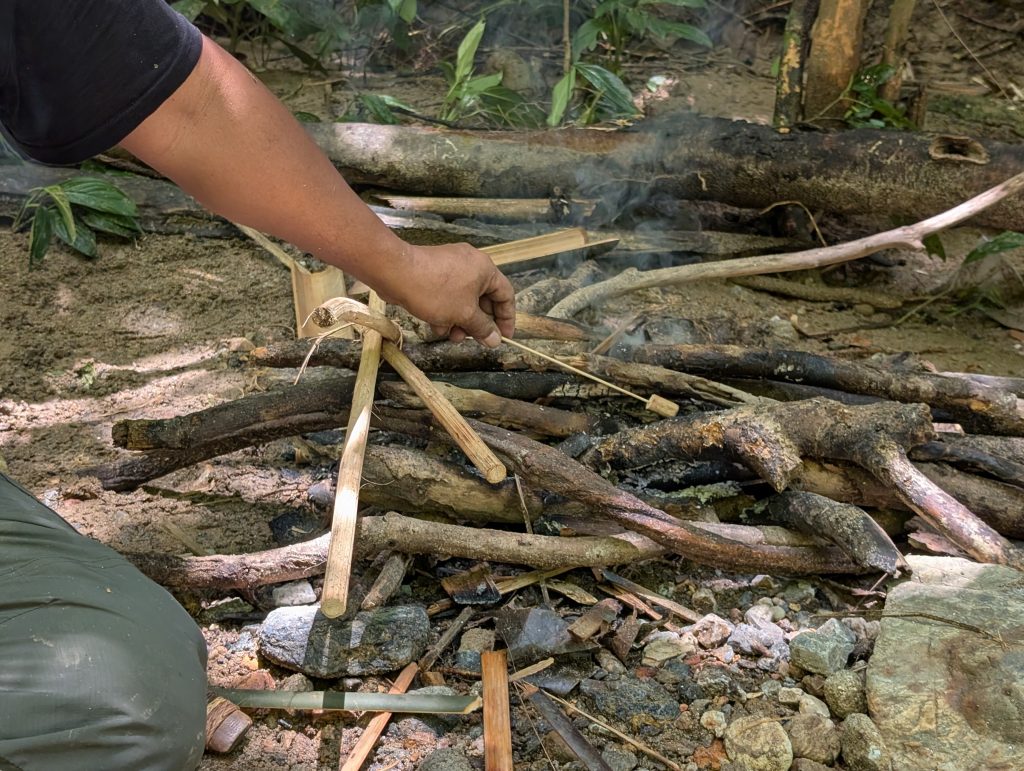
Once shaped, the shafts are lightly toasted over a fire. This step serves two purposes: it drives out residual moisture, which would otherwise cause warping in the humid forest environment, and it makes the wood slightly more brittle at the tip — a property that becomes important on impact.
The pith cone
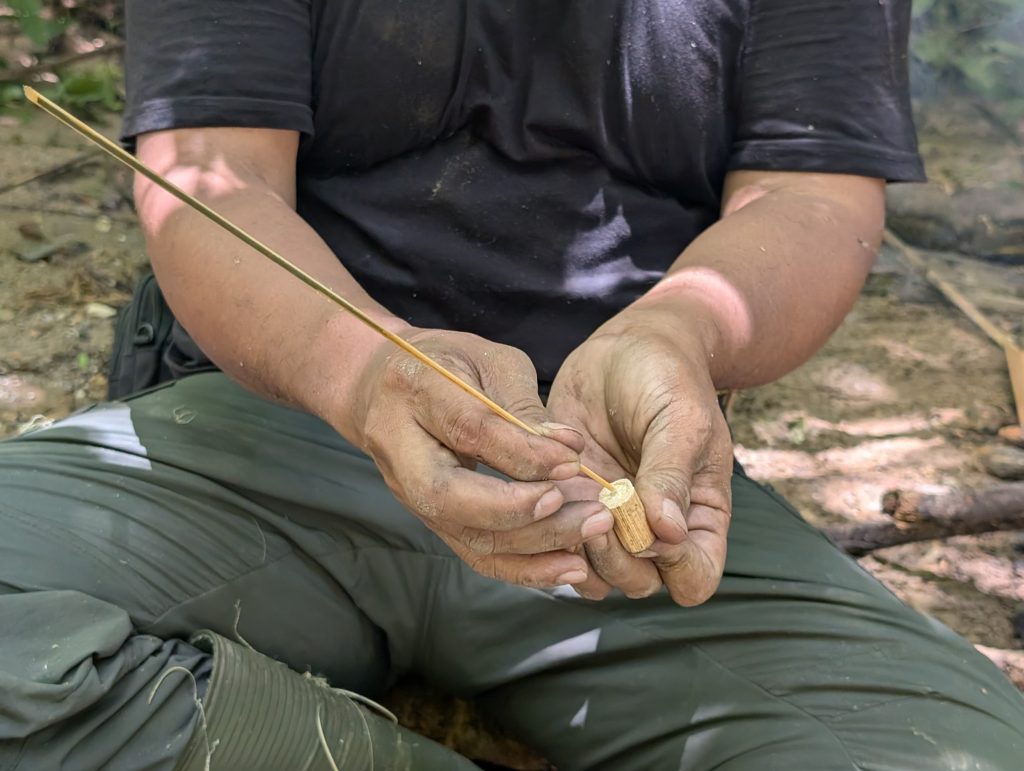
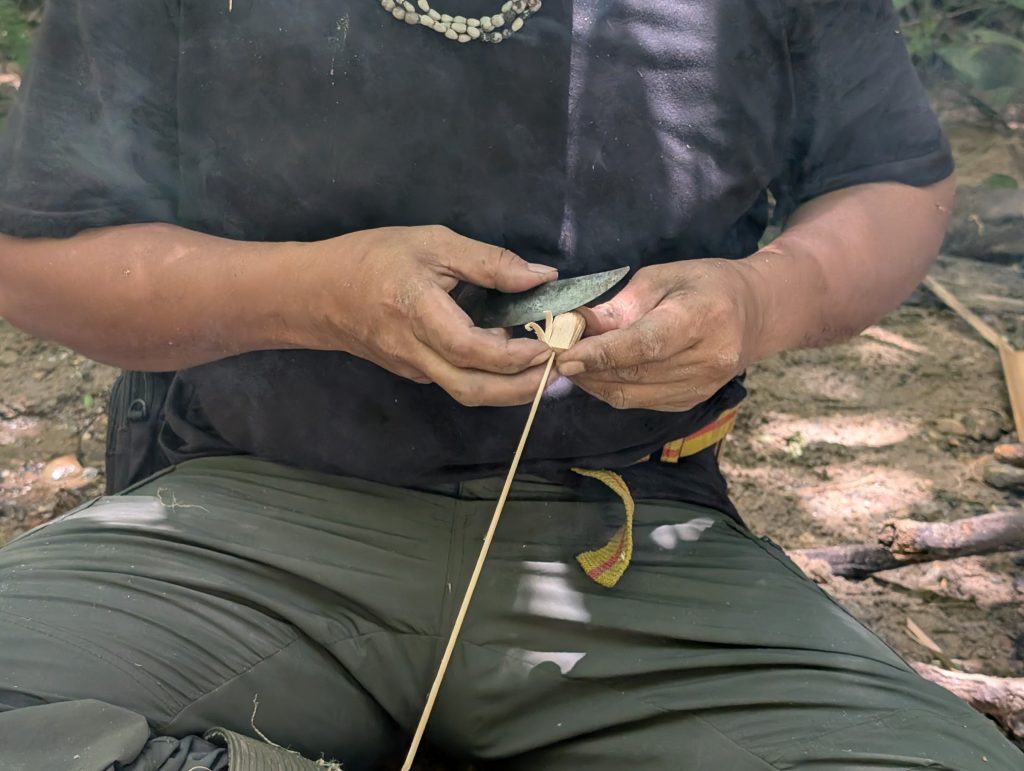
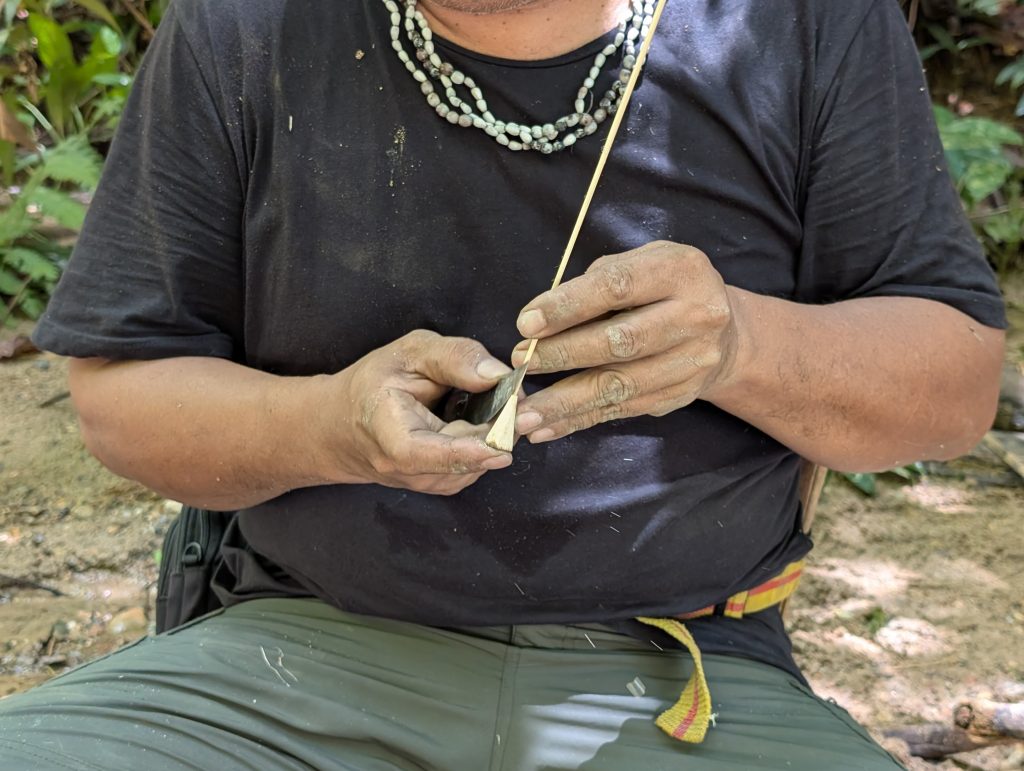
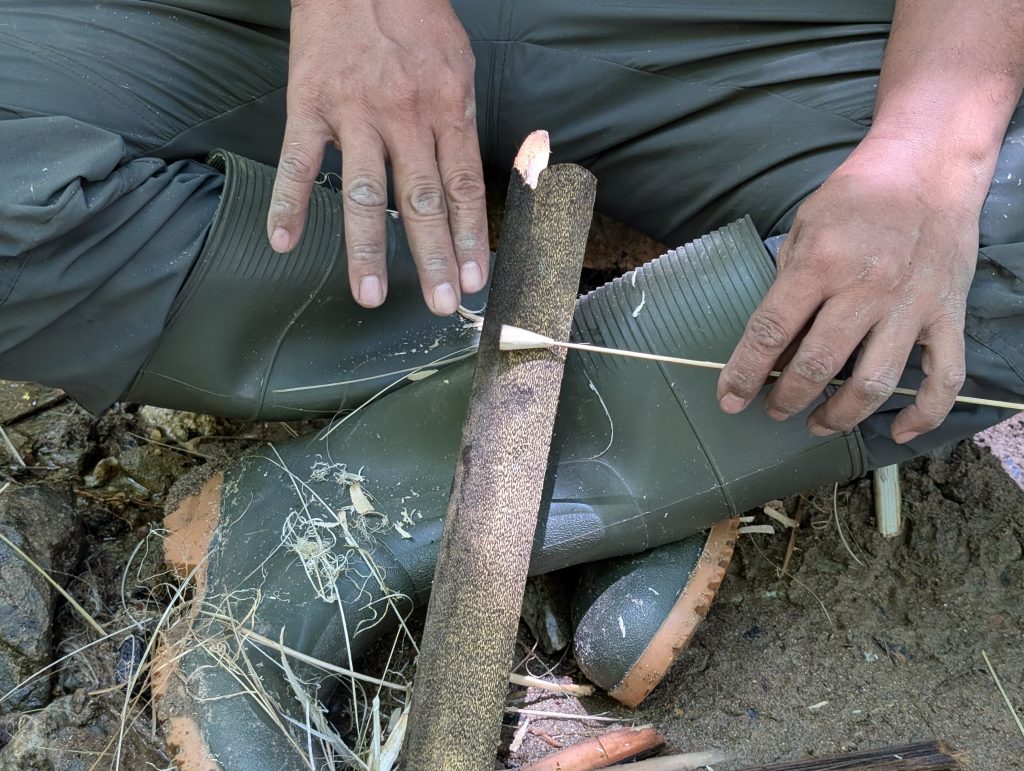
The rear of the dart carries a cone carved from the soft, spongy pith of either the Sago palm (Metroxylon sagu) or Rotan Mantan climbing palms. The shaft will be inserted into the pith cone and glued in place with a drop of resin.
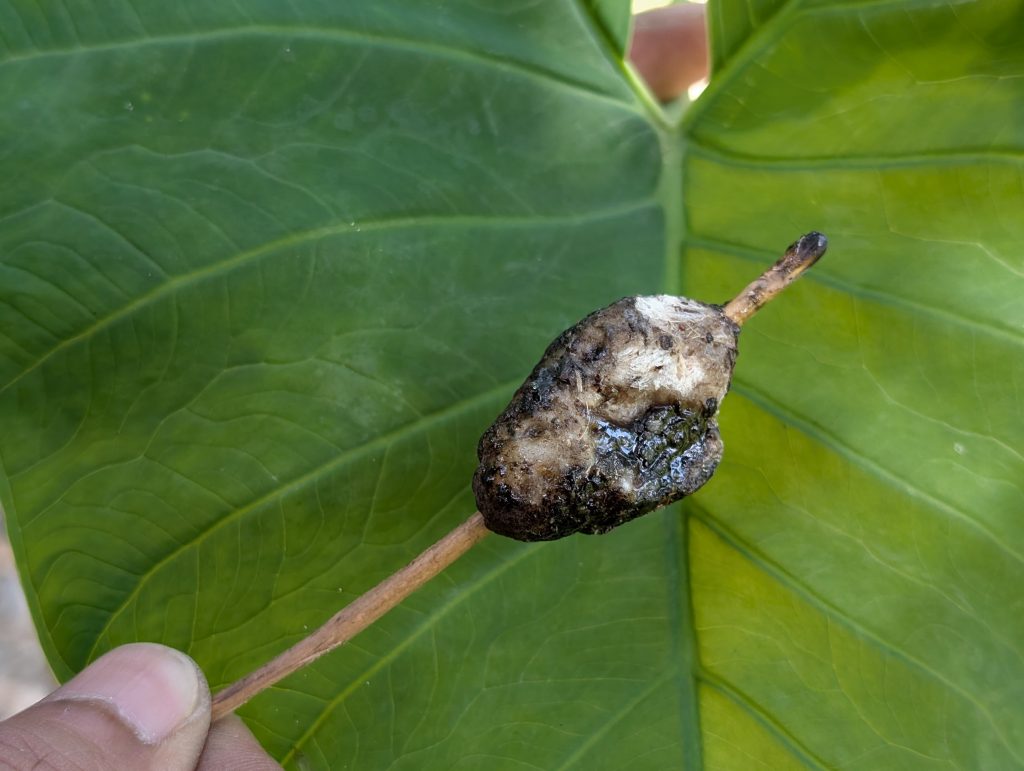
The adhesive used to connect the dart shaft to the spongy cone is resin from the Jelutong tree (Dyera costulata).
After connecting the shaft to the cone, the cone will be polished on the leafstalk of a certain palm species, which I couldn’t recognize. The physical appearance, however, can be seen in the following video.
The pith cone is the most critical to the shot’s physics. The cone must be roughly the same diameter as the inner bore of the blowpipe, so that when the dart is loaded from the muzzle, it slides down the tube easily but still centers the dart in the tube and only leaves a tiny gap, which is not airtight. A fluffy wad behind the cone as a seal will air-tighten it. Without this seal, the air pressure from the hunter’s breath would simply flow around the dart cone, and the shot would lose some force. With it, the full energy of a single sharp exhalation is transferred directly to the dart.
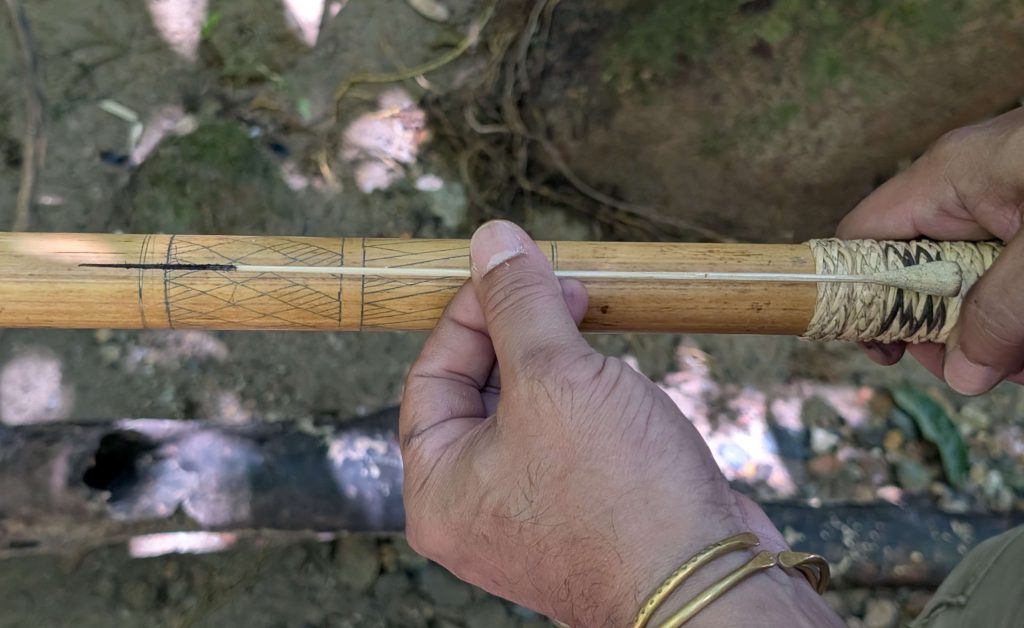
The cone also functions as the dart’s stabilizer in flight. Because it is wider than the shaft, it creates drag at the rear — keeping the dart flying nose-first in the same way a shuttlecock always orients heavy-end forward. In some cases, master makers introduce a subtle asymmetry into the cone’s shaving, causing the dart to rotate slowly in flight — a form of rifling that compensates for any microscopic bend in the shaft.
In certain Orang Asli groups, particularly when making larger darts intended for birds, a small amount of seed fluff — from the Pulai tree or Cogon grass — is wrapped around the rear of the shaft. This fluff expands within the bore to assist the seal, and once the dart exits the muzzle, it acts as a soft tail, providing additional stability in the wind.
The notch
A detail that is easy to miss on a first examination is a small, shallow circular cut made just a few millimetres behind the tip of the shaft. This notch is not decorative. Its purpose is to ensure that the poisoned tip remains in the animal’s body even if the prey attempts to remove the dart.
When a monkey or squirrel is struck, its instinct is to reach back and pull the dart free. Because of the notch, the shaft snaps cleanly at that point under tension, leaving the poisoned tip embedded in the muscle while the remainder of the dart falls away. The poison continues to enter the bloodstream. Death from a correctly prepared Ipoh dart follows within seconds.
The poison
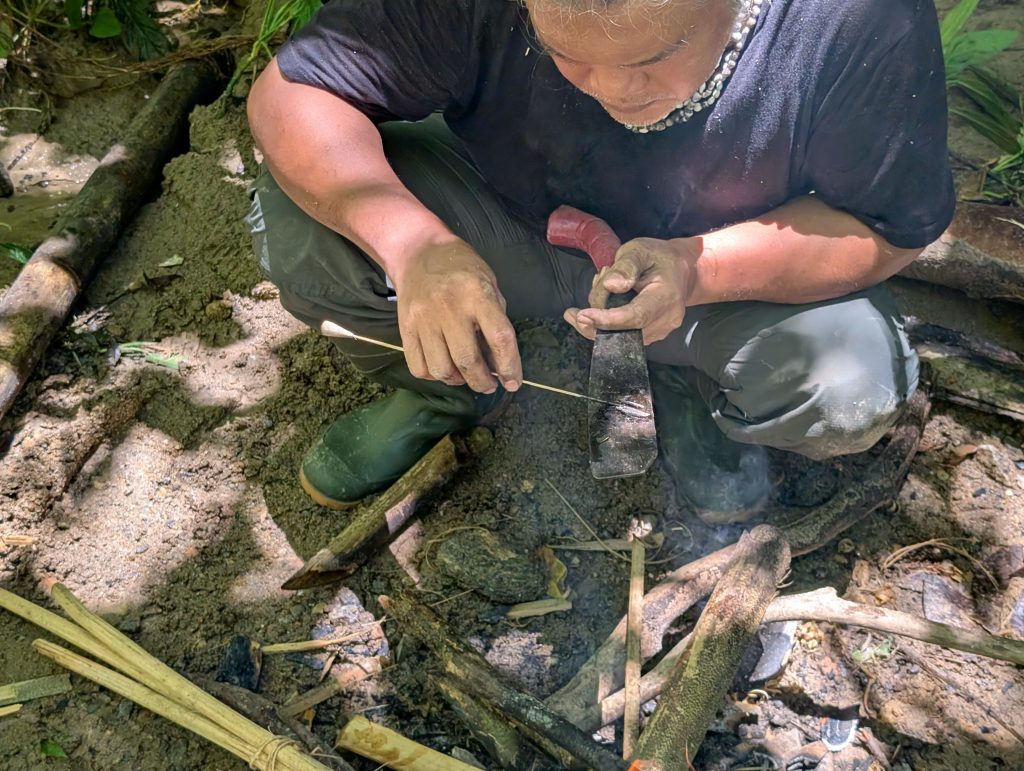
The tip of the dart is dipped in resin from the bark of the Ipoh tree (Antiaris toxicaria), prepared by mixing the raw resin with other compounds, using methods that vary across communities and are not widely disclosed. The resulting poison is a cardiac glycoside that rapidly attacks the circulatory system. Further specifics of Ipoh-poison and its preparation will be discussed in one of the next articles.
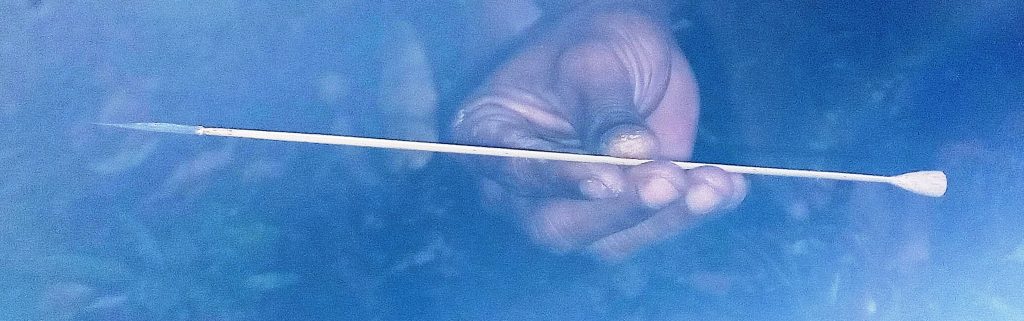
Practice darts are physically identical to hunting darts but are left unpoisoned. They are typically marked on the bottom of the pith cone so they cannot be mistaken for the lethal ones. Hunters fire several practice darts before a hunt to confirm that each shaft flies true.
Testing and quality control
The process of evaluating a finished dart is methodical and unhurried. A poorly balanced dart means a missed animal, a wasted dose of poison, or both.
The first check is the fingertip balance test. The hunter rests the shaft across the edge of a single finger. A hunting dart should be clearly nose-heavy, with the balance point well forward of the shaft’s midpoint. If the pith end is too heavy, material is shaved from the cone until the nose dips correctly.
The second check tests straightness. The hunter holds the dart vertically by the pith and drops it from roughly one meter onto a soft surface — a leaf or a patch of sand. A straight dart falls like a needle. Any wobble or spiral indicates a warped shaft or an asymmetrically carved cone, and the dart is reworked or discarded.
The third check is the bore-fit test. The dart is inserted into the blowpipe’s mouthpiece end. It should not fall through under its own weight but should slide forward with the lightest nudge of a finger.
Only after passing all three checks will the dart be taken to a soft-trunked tree — a banana stem or a bundle of leaves — and fired unpoisoned to confirm that it strikes the intended point of aim.
Storage
Darts are carried in a bamboo quiver, points facing downward into a bed of soft moss or dry fiber that protects the delicate tips. Hunters typically bundle their darts in small groups tied with thread, allowing a single dart to be drawn, loaded, and fired within seconds. Poisoned and practice darts are differently marked.
The quiver itself is a practical object — light, sealed against humidity, and sized to be carried quietly through dense forest without snagging. We will discuss quivers in more detail in one of the following articles.
The maker’s reputation
In an Orang Asli village, a man’s skill is partly measured by the quality of his darts. A maker whose darts fly consistently straight acquires a reputation, and his work is sought after by other hunters. Even where younger community members have access to modern tools, many still prefer hand-shaving the shaft and cone, as it allows them to feel the grain of the wood and the resistance of the pith in a way that machine cutting does not. The judgment involved is tactile as much as visual, and it is passed down through use rather than instruction.
Lessons learned about Orang Asli blowpipe darts:
- Orang Asli darts, known as damak, are made entirely from forest materials: Bertam palm spines for the shaft and Sago palm pith for the cone.
- The pith cone serves both as an airtight propulsion seal inside the bore and as an aerodynamic stabilizer in flight.
- A shallow notch just behind the tip ensures the poisoned point remains embedded in the animal even if the shaft is pulled or breaks on impact.
- Dart tips are coated with Ipoh tree resin, prepared with additional compounds; the poison attacks the circulatory system and acts within seconds.
- Each dart is tested unpoisoned — for balance, straightness, bore fit, and flight accuracy — before the poison is ever applied.
- Poisoned and practice darts are kept separate and are marked differently to prevent confusion.
- Dart-making skill is a valued craft; a maker known for consistently well-balanced darts holds a recognized standing in the community.
.