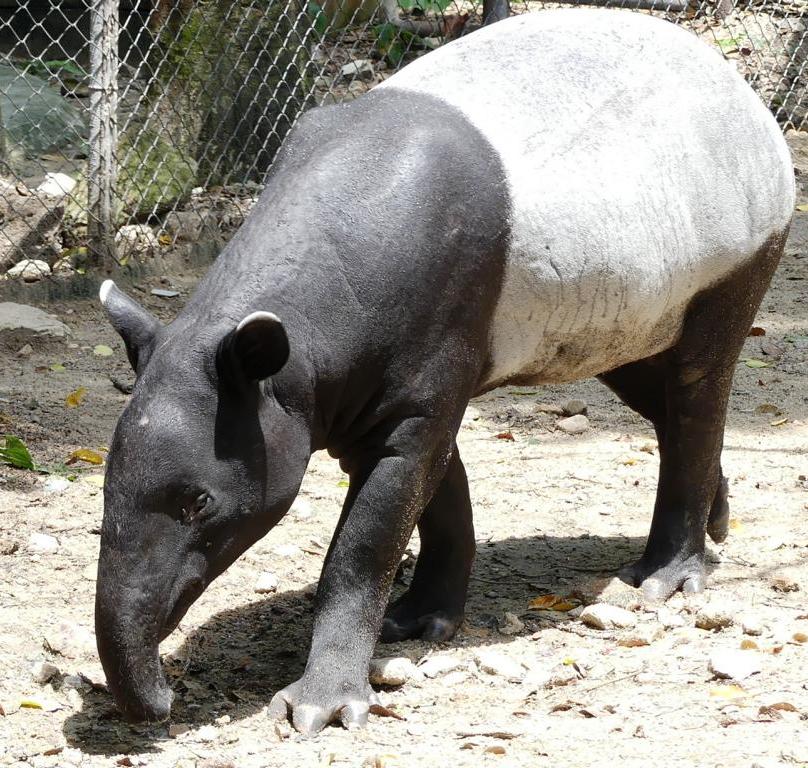
The Malayan tapir (Tapirus indicus) is the largest terrestrial mammal native to Peninsular Malaysia and one of the most ancient surviving members of the order Perissodactyla — a lineage that has changed little in tens of millions of years. Despite its size, which in adult females can exceed 400 kg, it is an animal that most people who walk in Malaysian forests will never see. It is nocturnal, solitary, and moves through dense vegetation with a quietness that seems improbable for its bulk. What it does leave behind, however, is a consistent and readable set of signs. For the forest walker, learning to recognize tapir tracks, droppings, feeding evidence, and movement patterns opens a reliable window into an animal that rarely shows itself directly.
Distribution and habitat
The Malayan tapir occurs in well-watered areas of dense forest across Sumatra, Peninsular Malaysia, and the south-western parts of Thailand. Within this range, it favors the lower slopes and valley bottoms rather than ridge lines or high elevations, though individuals have been recorded at altitudes of up to 2,000 meters. It is closely associated with water throughout its daily routine — rivers, streams, swampy ground, and muddy pools all feature heavily in its movements — and it is here, in soft ground near water, that the clearest tracks are most reliably found.
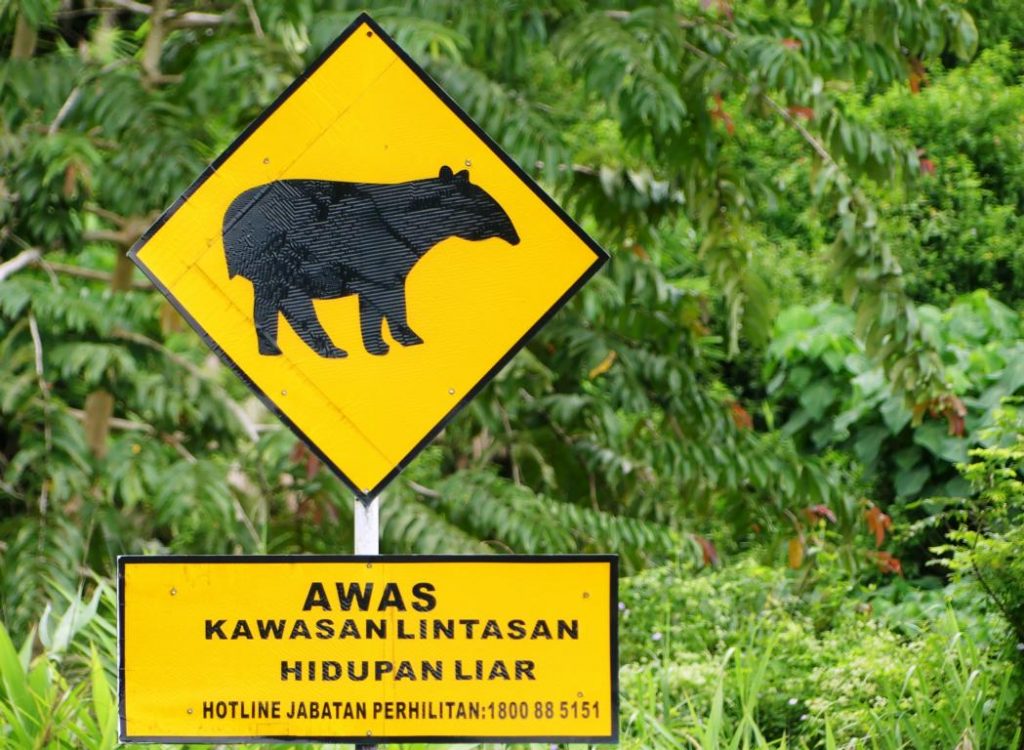
Despite the scale of forest loss across its range, the tapir shows some adaptability. It is regularly found along forest fringes and in secondary growth, and there are reliable reports of animals raiding young rubber plantations. Its preferred food plants — young leaves of Macaranga hypoleuca and Macaranga hosei, along with Ficus species, Melastoma malabaricum, and Hedyotis philippensis — are characteristic of forest edge and regenerating growth rather than deep primary interior. This was reported by B.K. Simpson in 2014. This affinity for transitional habitat means that tapir signs are sometimes encountered in areas that do not immediately suggest classic tapir territory.
The tracks
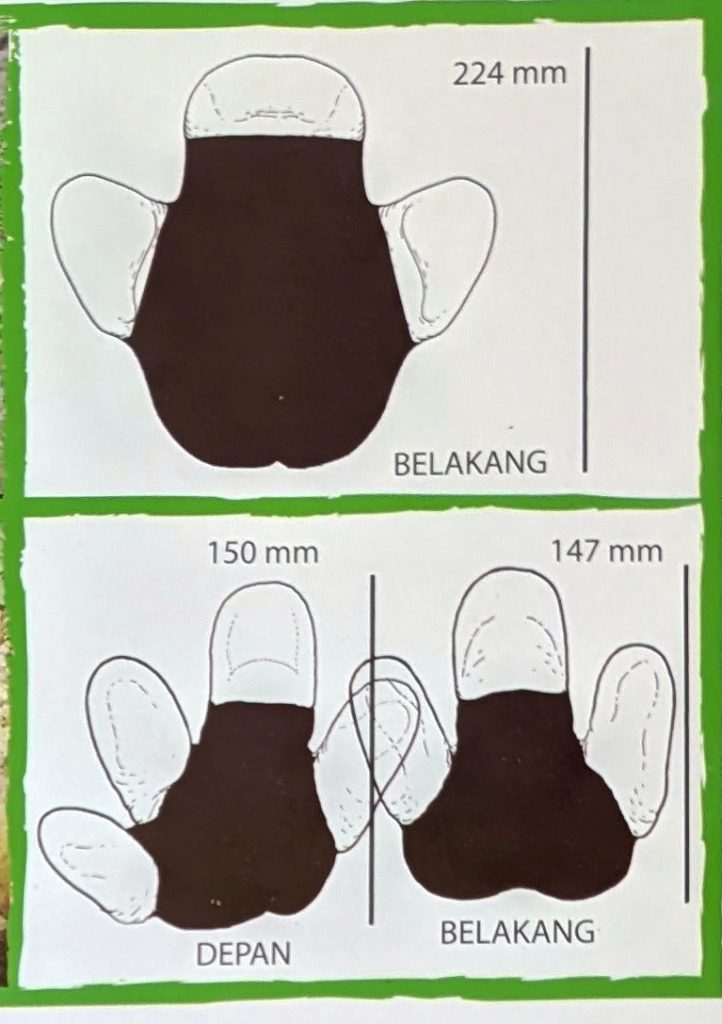
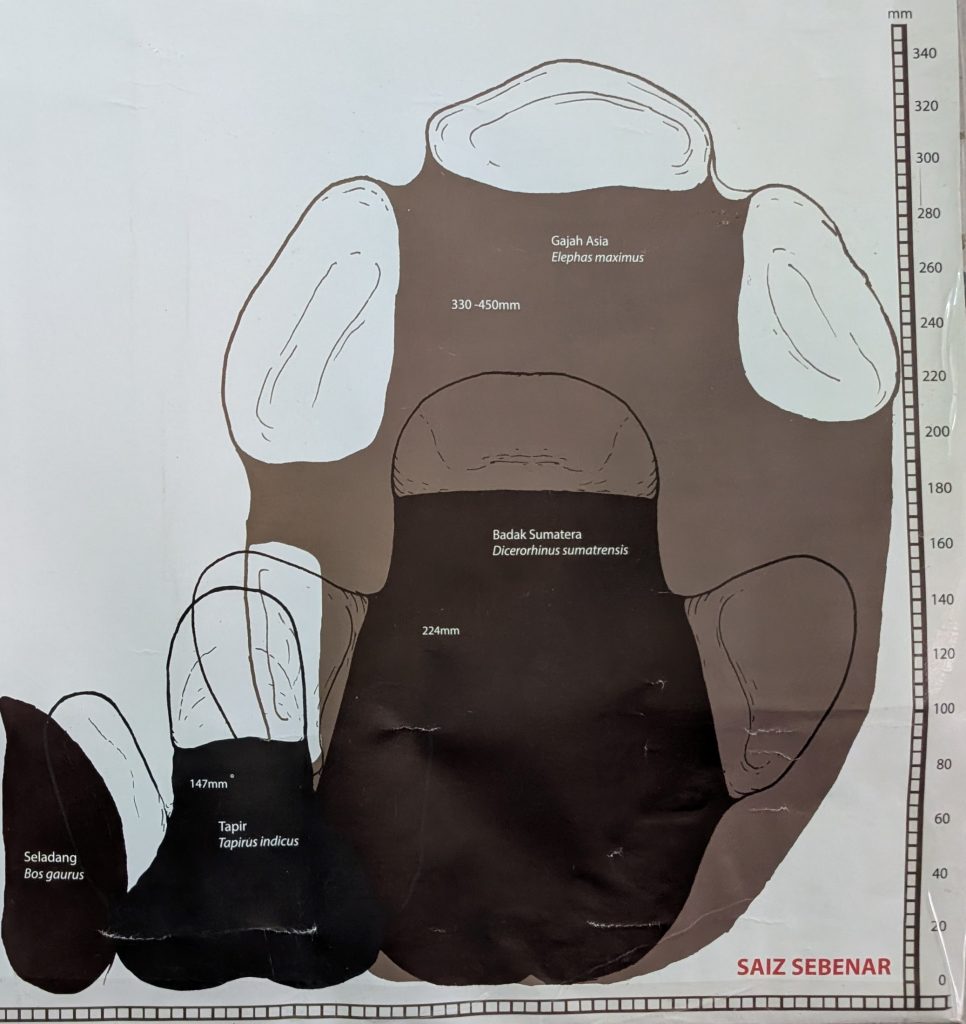
The track of a Malayan tapir is unmistakable once you have seen it. Like the earliest horses, tapirs retain a foot structure that most large mammals lost long ago: four toes on the front feet, three on the hind feet. All toes carry small hoofs, and the foot is supported in part by a large callous pad that takes some of the animal’s considerable weight.
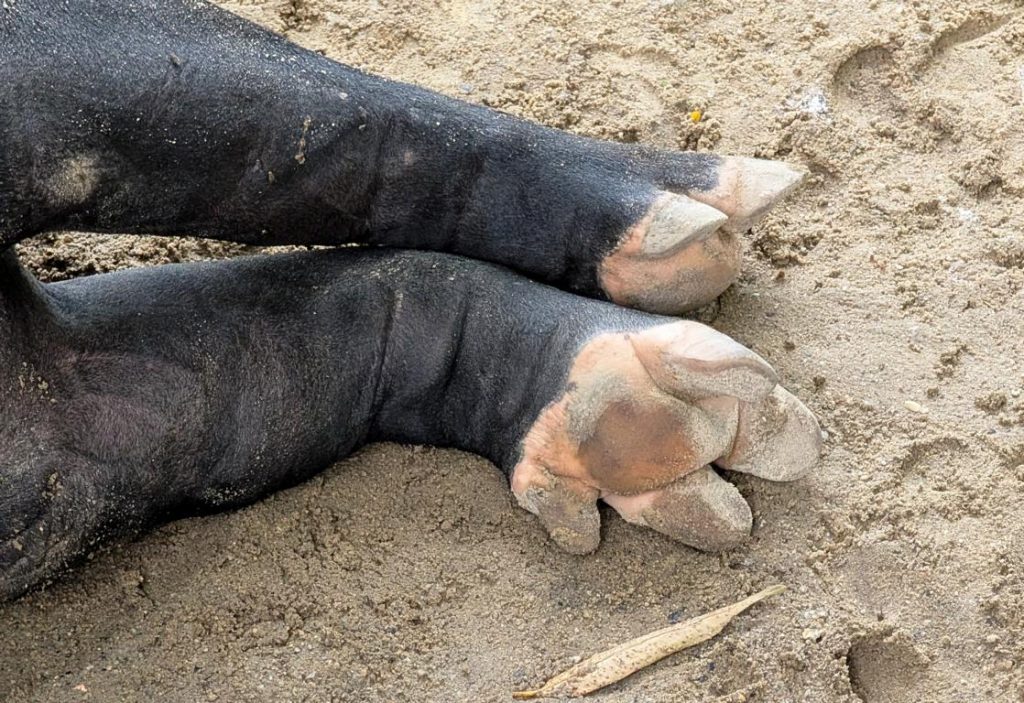
On the front foot, the three main toes are large and widely spread, with the fourth toe — smaller than the rest and positioned to one side — registering only in soft ground. When it does register, it appears offset and slightly higher in the track, giving the front print an asymmetrical quality that is diagnostic once you know what to look for. On the hind foot, only three toes register, and the overall print is somewhat narrower and more compact than the front.
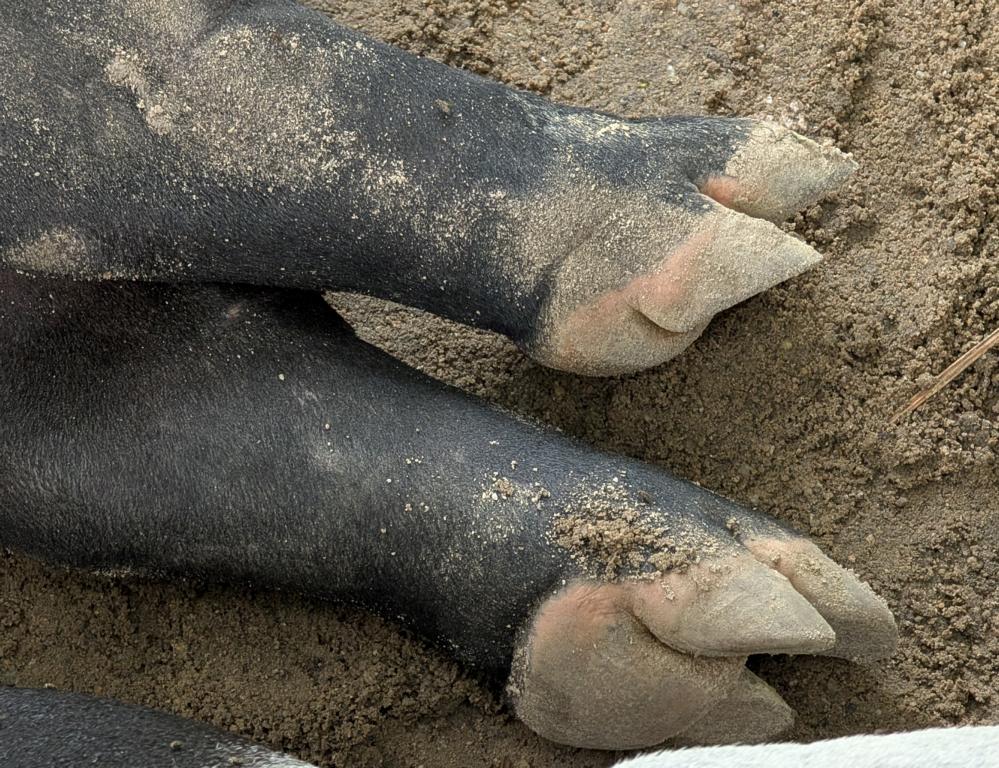
The middle toe is the largest on both feet, and in a clean print on soft riverbank mud, the individual hoof impressions are clearly separated, with the pad impression behind them. Front tracks in an adult animal typically measure in the range of 15–20 cm across. The depth of the print reflects the animal’s weight distribution: the hindquarters sit roughly 100 mm higher than the forequarters, meaning more weight is carried on the hind feet, and hind prints in soft ground are often deeper than the front despite being smaller in width.
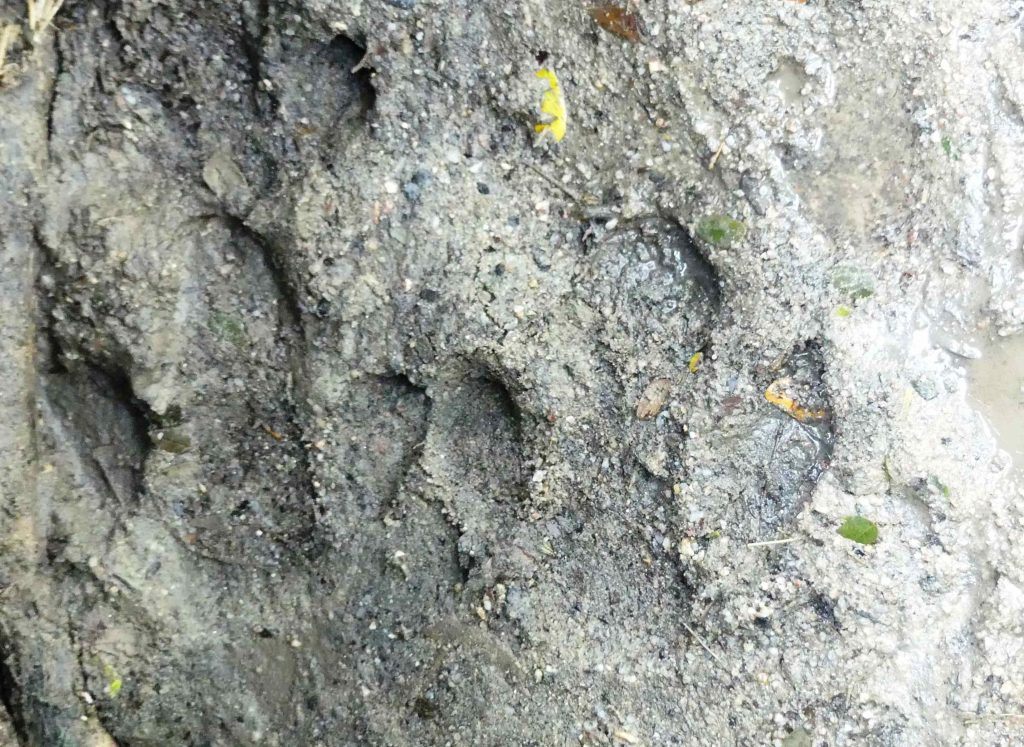
In a walking trail, the footfall pattern is regular and relatively narrow-tracked for an animal of this size. The tapir does not splay widely. On firm ground, the gait leaves a clean series of alternating prints; on soft ground or in shallow water, the toe impressions spread under load and the pad mark becomes very pronounced.
Water and river signs
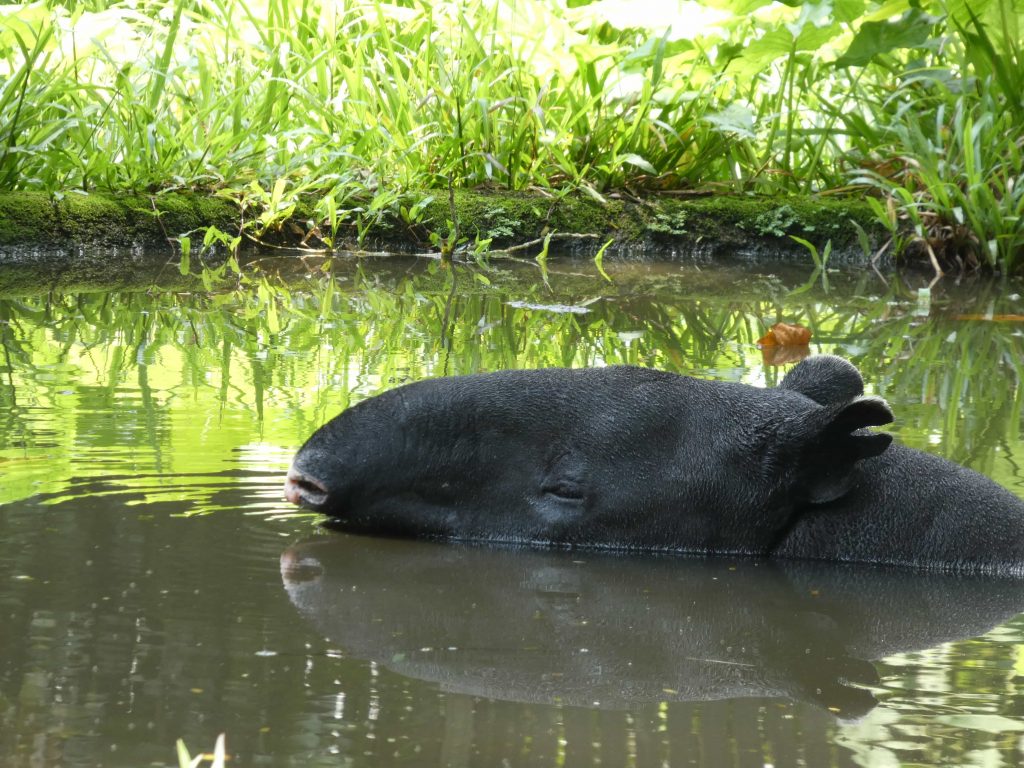
More than almost any other large mammal in the region, the Malayan tapir is oriented around water. It is an excellent swimmer, and much of its nightly activity is centered on streams and rivers, which provide both feeding grounds and escape routes from predators. Tapirs have been observed crossing deep streams by walking across the bottom rather than swimming — Raffles noted this behavior in a captive animal as early as 1822, and subsequent field observations have repeatedly confirmed it. One animal studied by K.D. Williams was tracked along a riverbed and over a large, submerged rock; its prints entered a deep pool and re-emerged from the river 100 meters upstream.
The implication for tracking is significant: a trail that leads into a river and does not exit on the same bank has almost certainly continued underwater. Looking 50 to 150 meters upstream or downstream for the exit point is a reliable next step. Tapirs also have a habit of walking in and following rivers for considerable distances — sometimes 100 meters or more — before leaving the water entirely.
Droppings
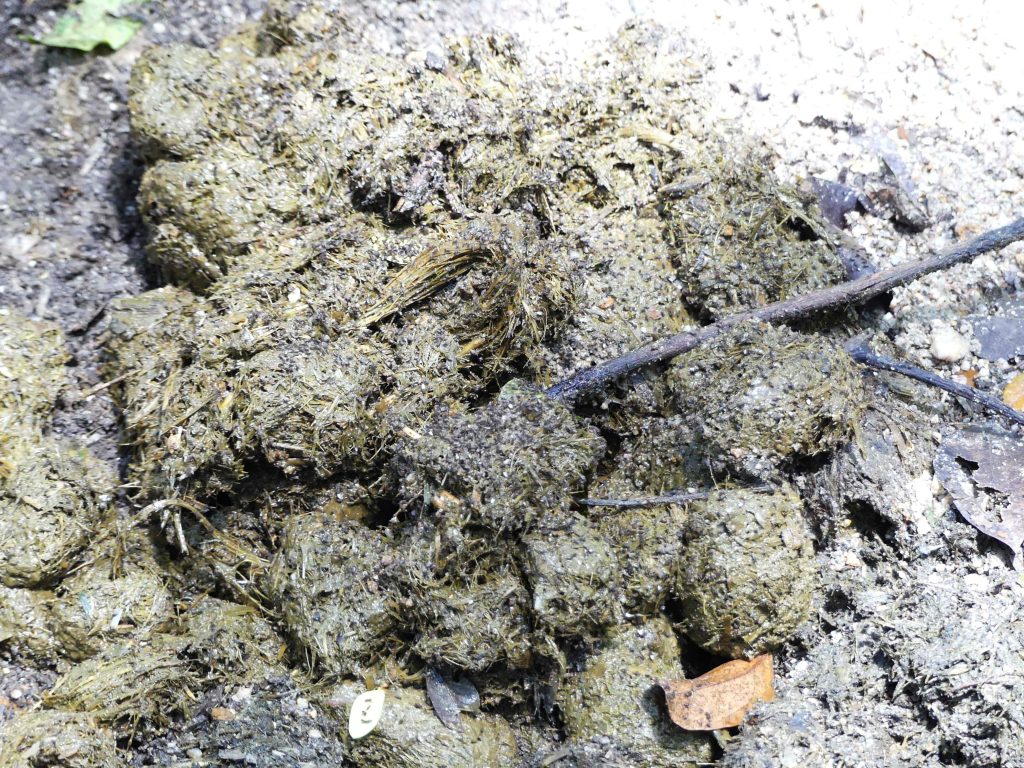
Tapir droppings are consistent and distinctive. A fresh deposit typically consists of about 8 roughly spherical balls, each about 5 cm in diameter, light brown, and composed of coarsely ground plant material. Fragments of leaves approximately 1 cm² in area and twig pieces 1 to 3.5 cm in length are usually clearly visible, along with fruit parts and seeds when fruit is in season.
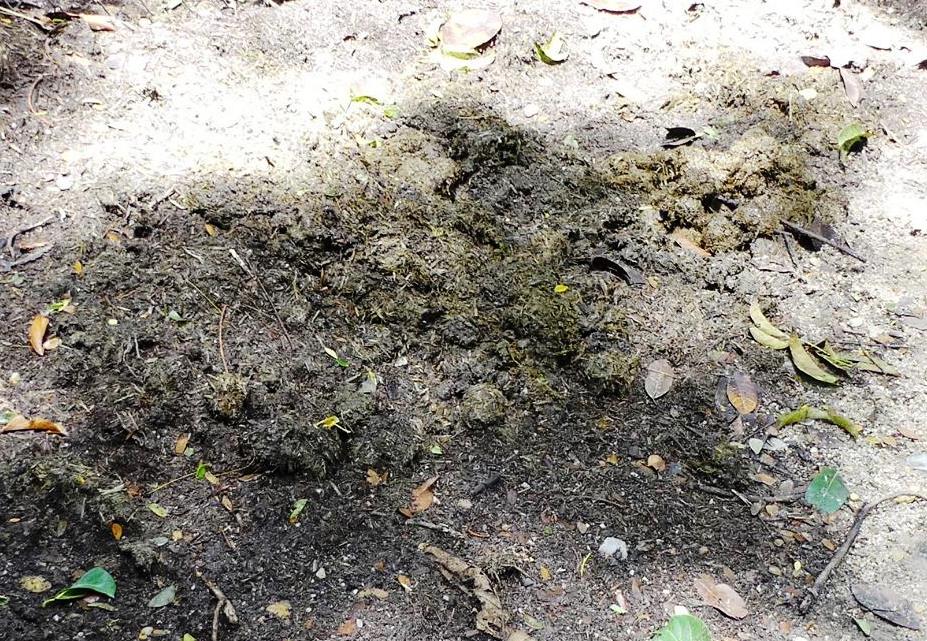
Droppings are deposited both on the ground beside the animal’s path and directly in water. Ground deposits are associated with a characteristic pawing behavior: the tapir scrapes the ground with its hind feet before and after defecating, partially or completely covering the droppings with leaves and debris. The feet do not contact the dung itself, but the disturbance around the deposit — raked leaf litter, scraped soil — is often a more visible indicator than the droppings themselves, particularly once the droppings have been worked over by dung beetles, which can reduce a fresh deposit to loose fibrous material within a day or two. Old deposits are sometimes covered with a thin layer of soil through termite activity, leaving a slight mound that, once recognized, is a reliable indicator of regular use in the area.
In swampy terrain and slow-moving streams, droppings found in water are typically in flowing sections at least 20 cm deep rather than in still pools, and they do not accumulate. Where a tapir defecates in a small pool in swampy ground, it appears to have sought that pool deliberately — contact with water seems to act as a stimulus for defecation in this species.
Urination signs
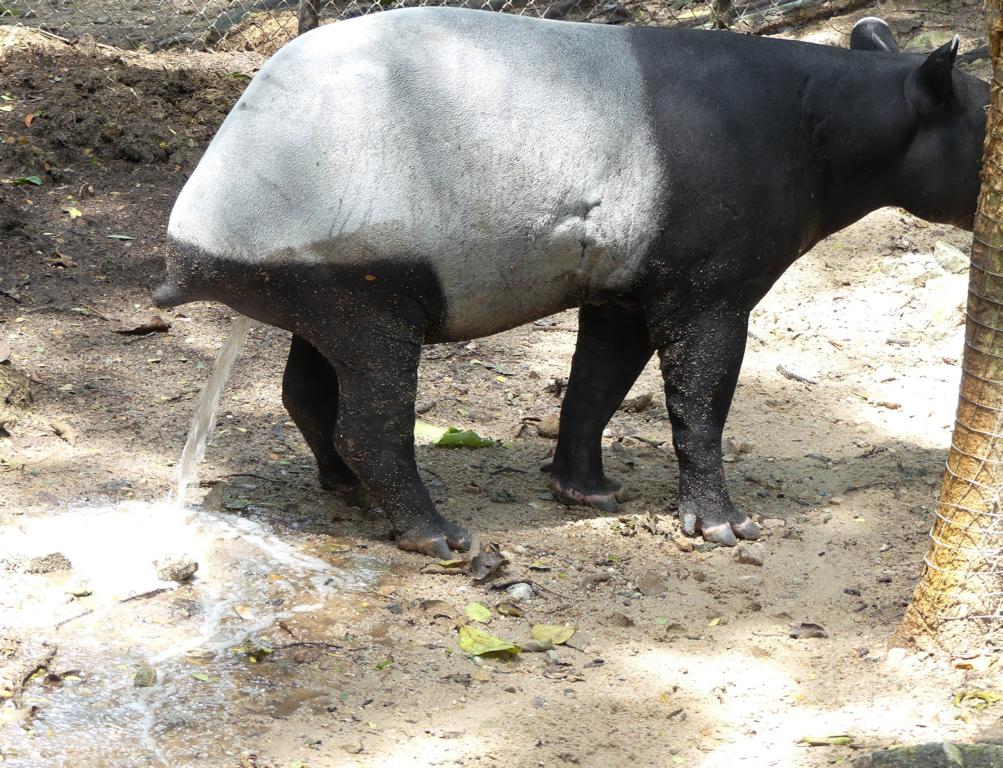
Tapir urination signs are less often discussed but are consistently present along active trails and feeding areas. Both sexes urinate to the side of their line of travel, turning slightly off-axis as they move. Males urinate only at low heights — below 50 cm — and spray backward, leaving a distinctive pattern of wet marks on low vegetation or the ground at ankle height. Males typically urinate in a series of three to five efforts spaced 20 to 50 meters apart, making the sign repetitive and easy to follow along a trail once identified. Female urination is more frequent but less concentrated.
The pawing behavior described for defecation also occurs in association with urination, and sometimes independently, meaning that raked ground is not always accompanied by a visible deposit. A stretch of trail with repeated patches of disturbed leaf litter and occasional low, wet marks on vegetation is a reliable composite indicator that a tapir is moving through regularly.
Feeding signs and trails
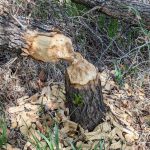
Tapir feeding evidence consists of cleanly browsed leaf tips and broken young stems at roughly knee- to hip-height, consistent with an animal that feeds by moving slowly and selecting individual shoots rather than stripping branches wholesale. The preferred plants are characteristic of secondary growth and forest edges, and browsing pressure on Macaranga saplings can be a useful indicator of tapir presence where tracks are not immediately visible.
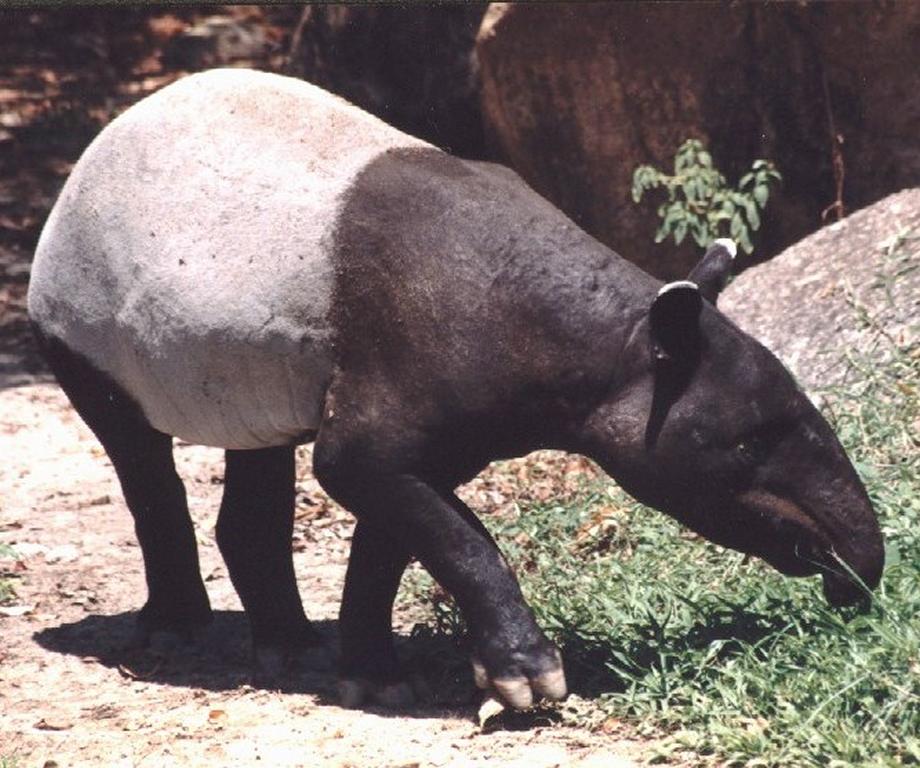
On the question of trails, the evidence is somewhat contradictory between observers. Some researchers have found that tapirs use regular, well-worn paths; others report that individuals wander without following fixed routes except at specific bottleneck features — saddles between hills, gully crossings, river fords, and the approaches to salt licks. When we tracked tapirs with the Semilang Orang Asli people at Tasik Berea in Pahang, Malaysia, the tracks were always very faint and nearly impossible to see to the untrained eye. The tracker watched out for dense vegetation about 10 meters in front of him, and where the Tapir’s body was pushing the plants sideways. Tracks on the ground were observed only occasionally along this ‘air trail’.
Lessons learned about Malayan tapir tracks and signs:
- Malayan tapir front tracks show four toes, with the fourth registering only in soft ground; hind tracks show three. The middle toe is the largest on both feet.
- Look for tracks at riverbanks, crossing points, and muddy ground near water, where the best impressions are found.
- A trail entering a river without a visible exit nearby likely continues underwater; look 50–150 meters upstream or downstream for the exit point.
- Fresh droppings are roughly spherical balls, around 5 cm in diameter, with visible leaf and twig fragments. Surrounding disturbed leaf litter from pawing is often more visible than the deposit itself.
- Males urinate backward at low height in repeated bursts spaced 20–50 meters apart; this pattern along a trail is a reliable sign of male tapir activity.
- The most consistent locations for tapir sign, regardless of trail use, are river crossings, gully bottlenecks, saddle points, and salt lick approaches.
- Feeding sign on Macaranga saplings and other secondary-growth species is worth noting in areas where ground sign is absent.
.