This is the first installment of our three-part series on atlatl weapon technology. In this article, we explore the global history of the atlatl. Part two breaks down atlatl components and design, and part three covers launching techniques and historical applications.
What is an Atlatl and How Does It Work?
An atlatl (pronounced at-lat-uhl) is an ancient spear-thrower or launching stick designed to propel a lightweight, long dart at high velocities. Acting as an extension of the human arm, it leverages mechanical leverage to hunt game or engage targets from a safe distance.
The word “atlatl” originates from the ancient Aztec language (Nahuatl), combining the terms atl (water) and latl (throwing)—translating roughly to “throwing over water.” This unique etymology was first detailed by anthropologist Zelia Nuttall in her seminal 1891 study, The Atlatl or Spear-Thrower of the Ancient Mexicans.
A Brief History of the Atlatl in North America
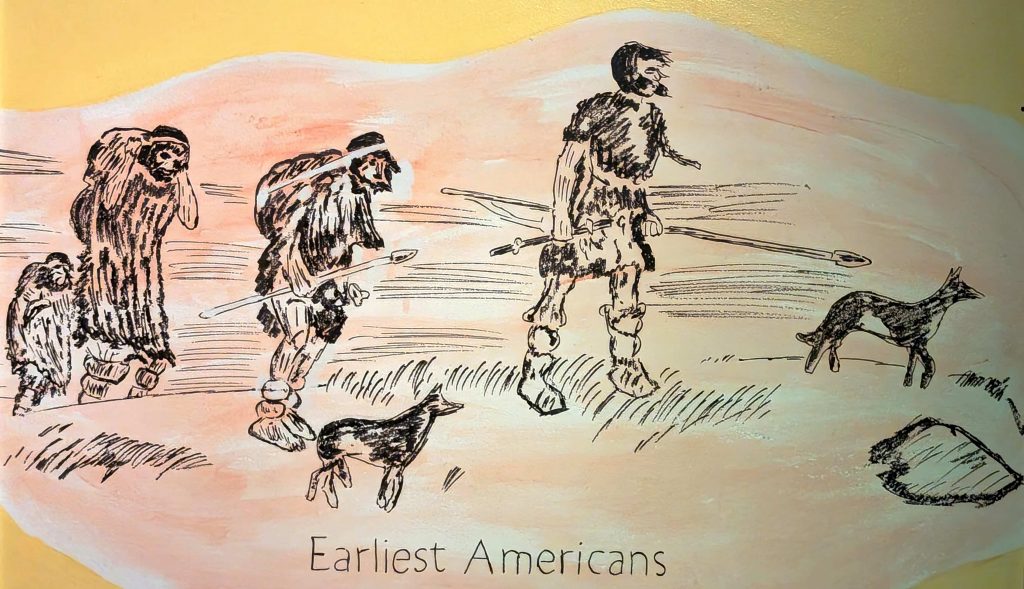
Around 13,000 BC, early humans crossed the Bering Land Bridge from Siberia into modern-day Alaska, eventually populating both North and South America. These early hunters relied on massive stone-tipped spears to harvest megafauna like the woolly mammoth and Mastodon.
As populations migrated south into warmer climates, megafauna began to disappear, replaced by smaller, faster game such as white-tailed deer and wild turkeys. Throwing a heavy, hand-flung spear was no longer efficient. To adapt, ingenious hunters reduced the spear to a flexible dart and invented a wooden lever—the atlatl—to hurl it with immense speed and stealth.
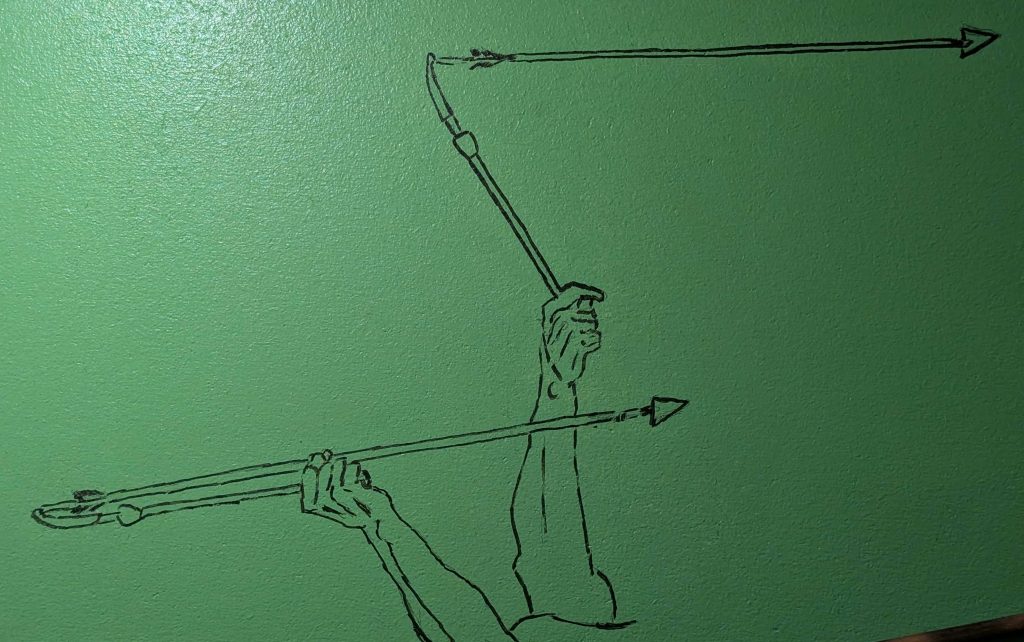
Contrary to popular belief, the atlatl was not a short-lived fad. It ruled the landscape as humanity’s primary long-range weapon for tens of thousands of years before being succeeded by the bow and arrow, which in turn was replaced centuries later by European muskets. Today, modern bushcrafters and survivalists are reviving the atlatl as an alternative primitive hunting weapon because it is significantly easier to craft in the wilderness than a functional bow and arrow.
Where Else in the World Were Spear-Throwers Used?
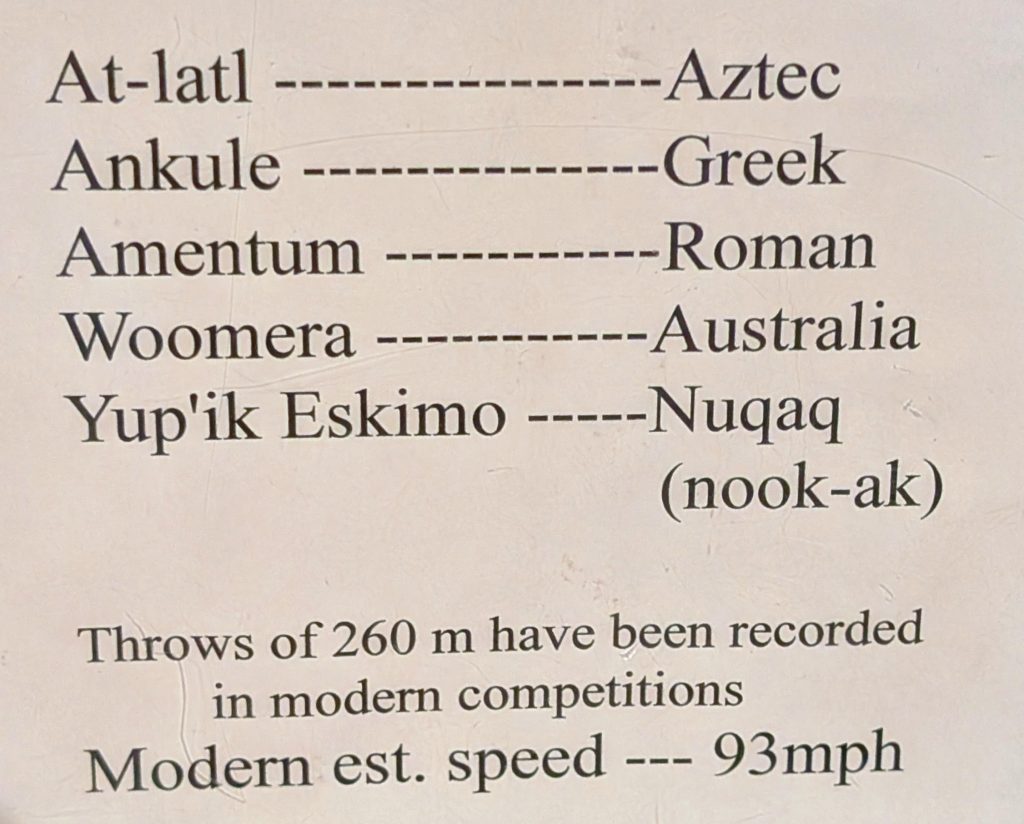
While the word “atlatl” is Aztec, spear-throwing technology developed independently across Europe, Southeast Asia, Africa, and Australia. Interestingly, there are no archaeological records of its use in regions spanning from Western Asia to the Far East.
Depending on the local environment, these tools evolved into distinct shapes, including throwing sticks, boards, and slings:
The Arctic: Inuit Throwing Boards
In the North American polar regions, the Inuit preferred spear-throwers over bows and arrows while hunting on the water. Because an atlatl can be loaded and launched with a single hand, hunters could keep their other hand free to steer their kayaks. These took the form of flat throwing boards that were easy to grip with thick winter gloves when targeting seals and waterbirds.
United States: Weighted Throwing Sticks
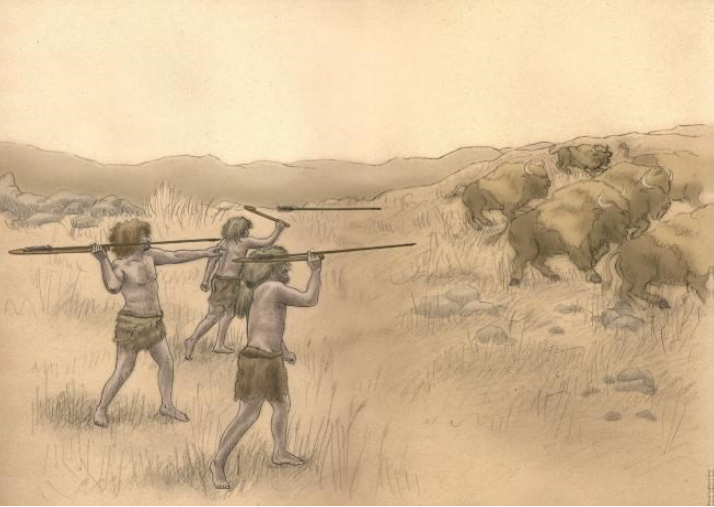
Gig game hunt in North America (© INRAP France)
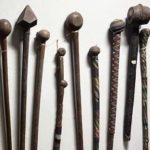
Across the regions that now make up the United States, native cultures used a wide variety of throwing sticks with finger loops, holes, or strap handles. Uniquely, North American atlatls are the only ones in the world known to feature attached stones—often called “bannerstones”—designed to balance the weapon and smooth out the launch energy.
Mexico and the Andes: Ceremonial Atlatls

Aztec Weapons Types and The Atlatl. © Aztec website
From Mexico down through the Andes mountains to Chile, stick-like atlatls reached an incredibly advanced state of design. Many were intrinsically carved and decorated for ceremonial purposes or warfare. The Aztecs famously used these weapons underhandedly to hunt waterbirds over lakes, true to the weapon’s literal name.
Europe: Greek and Roman Spear Slings
In ancient Europe, the Greeks and Romans utilized leather slings (known as the ankyle or amentum) wrapped around the shaft of a spear to increase its throwing distance. While effective, European spears were generally too heavy to fully realize the kinetic potential of a flexible atlatl dart.
Africa: Elephant-Hunting Darts
In Africa, spear-throwers provided enough kinetic energy to bring down the world’s largest land mammals. Historic accounts, including photographs of the Mundari tribe in South Sudan, document hunters utilizing specialized atlatl darts to harvest African elephants. (Note: You can view this historic photo at the end of part three of this series).
Papua New Guinea: Bamboo Throwing Sticks
Native populations in Papua New Guinea crafted highly specialized throwing sticks from local bamboo. These weapons are easily identified by their massive, decoratively carved dart rests fixed to the end of the shaft.
Australia: The Multi-Functional Woomera
The Aboriginal people of Australia created one of the most versatile tools in human history: the Woomera. Shaped like a hollowed throwing board, it didn’t just launch spears to hunt kangaroos and emus. It also served as a fire-making saw, a ceremonial receptacle for mixing ochre, a shield for deflecting enemy spears, and a butchering tool for chopping game.
Key Takeaways: The Legacy of the Atlatl
- Global Presence: Spear- and dart-throwing sticks were engineered independently by ancient cultures across nearly every continent.
- The Asian Gap: Archeologists have found no evidence or records of dart-launching sticks being used in Western or Eastern Asia.
- Aztec Roots: The modern name “atlatl” comes directly from the Aztec language, highlighting its deep roots in Mesoamerican history.
This Mesoamerican Weapon Explanation Video provides an excellent visual deep dive into how actual historic Aztec atlatls were carved, decorated, and designed to anchor darts.
.