
This is the third and final installment of our series on ancient weapon technology. After exploring the global history (Part 1) and mechanical anatomy (Part 2) of the atlatl, we now dive into the bio-mechanics of the launch sequence, calculate its kinetic energy, and examine its real-world hunting capabilities.
The Atlatl Launch Sequence: A Step-by-Step Guide
Throwing an atlatl dart requires a fluid, coordinated kinetic chain that links your lower body, core, and arm into one continuous acceleration path. For a flawless, accurate launch, the body transitions through several distinct phases:
1. Establish the Stance: Preparation.

Begin with a balanced athletic stance. Face your non-throwing shoulder toward the target, positioning the hip on your throwing side toward the rear. Raise your arm and extend your non-throwing hand forward to balance your center of gravity.
2. Initiate the Rotational Chain: Core Engagement.

Drive your back hip forward in a circular motion toward the target. This rotational energy transfers up through your torso, pulling the upper arm of your throwing hand along with it.
3. Lock the Hip & Drive the Shoulder: Linear Acceleration.

As your core reaches its maximum rotation, freeze your hips in place. The upper arm continues forward along its path, acting as a whip that channels the momentum built up by your lower body.
4. Extend the Forearm & Flex the Dart: Kinetic Energy Storage.

With your upper arm approaching its terminal forward position, snap your lower arm forward. This sudden, violent transfer of force causes the highly flexible dart to bow and flex significantly under its own inertia.
5. Execute the Wrist Snap: The Lever Release.
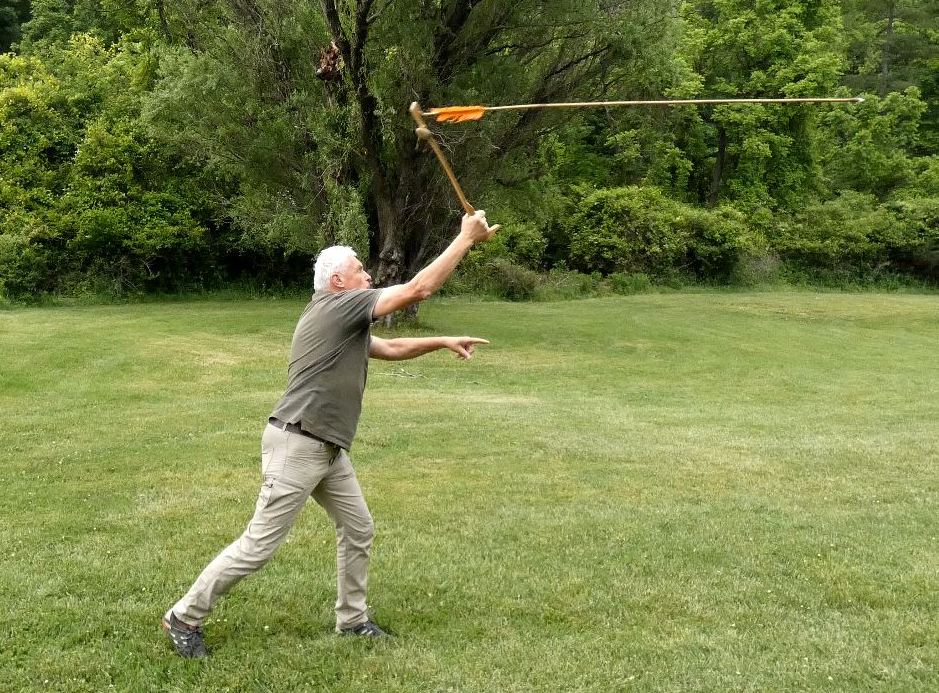
At the absolute extension of your forearm, push the atlatl forward with a sharp wrist-snapping motion. At this precise moment, the dart overcomes its initial inertia, straightens out in mid-air, and rides the forward thrust of the atlatl spur.
6. Achieve Liftoff: Disengagement.

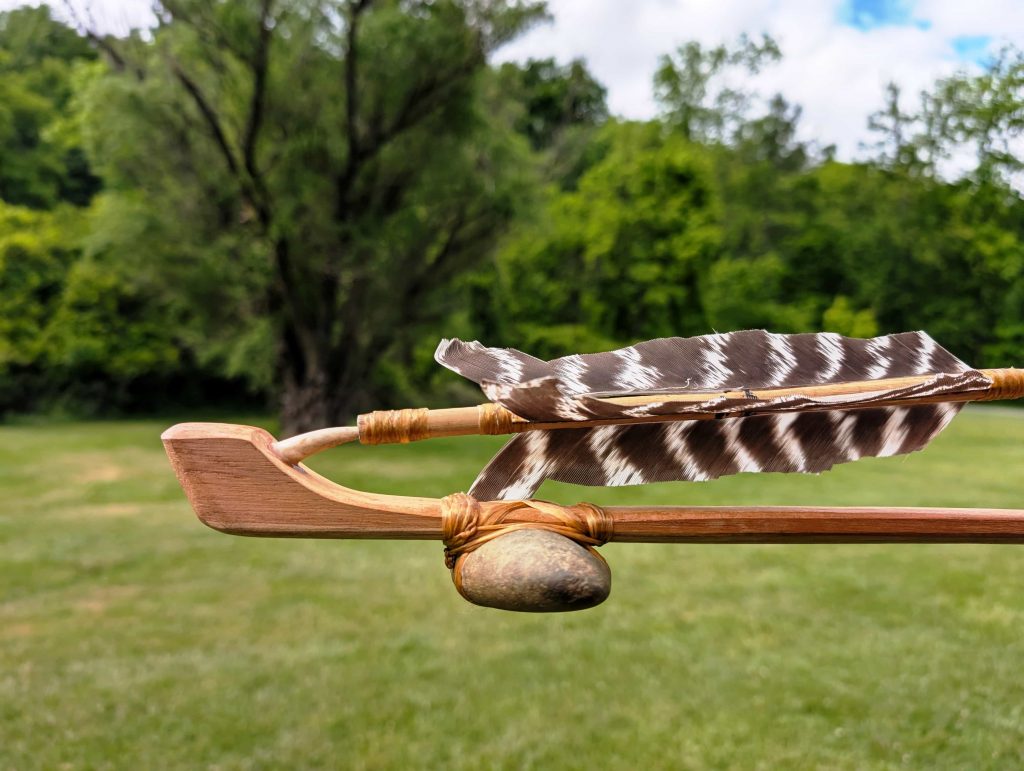
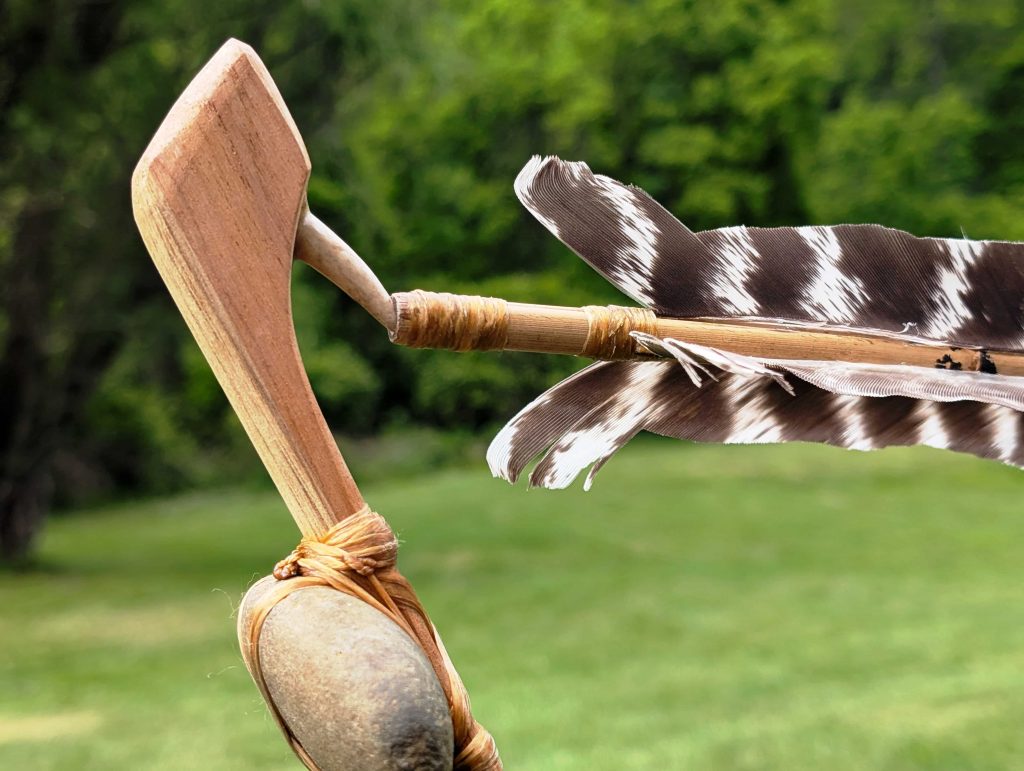
As the atlatl completes its arc, the angular gap between the rear spur and the tail of the dart widens. The dart separates cleanly from the hook, rising on a trajectory toward the target while oscillating in mid-flight to stabilize its path.
Velocity and Kinetic Energy Calculations
In terms of ballistics, the atlatl exists in a sweet spot between hand-thrown javelins and spring-powered bows. It achieves significantly higher muzzle velocities than a standard hand-thrown spear, although it cannot match the long-range flight distance of an arrow.
To determine if an atlatl is capable of cleanly penetrating tough animal hides, we must calculate its kinetic energy at launch using the standard physics formula:
- KE = Kinetic Energy in Joules (J);
- m = Mass of the dart in kilograms (kg);
- v = Velocity of the dart at launch in meters per second (m/s)
Real-World Field-Testing Data
During practical ballistic testing conducted at the Museum of Indian Culture, an experienced traditional thrower achieved an average launch velocity of 28 m/s (roughly 63 mph). Weighing the specialized dart revealed a mass of 140 grams (0.14 kg).
Plugging these empirical figures into our ballistics equation yields:
Our field-tested atlatl system generates approximately 55 Joules of kinetic energy.
Is an Atlatl Powerful Enough for Hunting?
To put this energy into a modern context, we can evaluate its harvesting potential against the ethical hunting guidelines published by the Badass Outdoor Gear Arrow Energy Chart.
| Target Game Size | Required Energy in Foot-Pounds | Required Energy in Joules |
| Small Game (Rabbits, gamebirds, squirrels) | 25–30 ft-lbs | ~33–40 J |
| Medium Game (White-tailed deer, antelope) | 40–50 ft-lbs | ~53–67 J |
| Large Game (Elk, black bear, wild boar) | 50–65 ft-lbs | ~66–87 J |
| Extra-Large Game (Moose, grizzly bear, bison) | 65+ ft-lbs | ~87+ J |
Our baseline 140-gram dart producing 55 Joules easily meets the threshold for humanely harvesting small- and medium-sized game like deer. However, using this lightweight setup on large megafauna would be unethical due to insufficient penetration.
To ethically harvest extra-large game, a hunter must scale up the system’s mass and velocity. Bumping the dart weight up to 200 grams (0.2 kg) and increasing the launch velocity to 30 m/s elevates the terminal output to 90 Joules, clearing the bar for massive game.
While average modern hobbyists throw between 20 and 30 m/s, elite primitive weapon experts can reach speeds of 35 to 40 m/s. According to physicist Mark Denny’s comprehensive study, Atlatl Internal Ballistics, linear velocity can be effectively maximized by increasing the rotational radius—meaning a longer atlatl stick results in a faster, more devastating launch.
Historic and Modern Applications: Hunting and Fishing

The sheer lethal capacity of the atlatl is well-documented in both the archaeological record and modern experimental science.
In writing for the historic preservation series, Iti Fabvssa by the Choctaw Nation of Oklahoma, researchers highlighted a legendary 1978 ballistic experiment led by Dr. Dennis Stanford, the former Chief National Archaeologist for the Smithsonian Institution.
Dr. Stanford demonstrated that a heavy stone-tipped spear thrown purely by hand could only penetrate three inches into an elephant carcass. However, when utilizing the mechanical leverage of an atlatl, the exact same projectile completely penetrated halfway through the elephant’s chest cavity—generating a clean, terminal blow. The weapon system is so effective that many anthropologists believe excessive atlatl pressure, combined with changing climates, contributed significantly to the extinction of the woolly mammoth in North America.
Modern Legal Framework
Today, the atlatl is seeing a massive resurgence among primitive technology enthusiasts, survivalists, and fishermen:
- Primitive Hunting: Modern wildlife regulations vary across the United States, but states like Texas, Oklahoma, and Missouri explicitly permit the use of the atlatl for hunting specific game species under strict seasonal guidelines.
- Bowfishing Alternative: Fishing with modified, barbed atlatl darts is a rapidly growing sport in several major river basins. Because target distances are short, lightweight atlatls are highly effective tools for harvesting invasive species (such as silver carp) and for providing a sustainable source of wild protein in wilderness survival situations.
Key Takeaways: Launch Ballistics
- Complex Kinetic Chain: Successful atlatl throwing relies heavily on sequential core rotation, forearm extension, and an explosive wrist snap.
- Proven Lethality: A standard 140-gram dart traveling at 28 m/s produces roughly 55 Joules of kinetic energy, which easily delivers deep, lethal penetration on medium-sized game like deer.
- Mechanical Dominance: By extending the rotational radius of the human arm, the atlatl magnifies leverage to such an extent that it historically allowed ancient hunters to pierce the thick hides of ice-age megafauna.
.