
USA
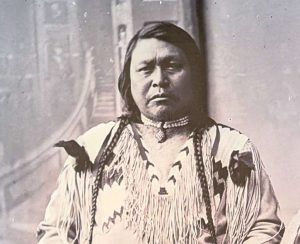
Technical and historical aspects of the Bow of Chief Ouray
Who are the Ute Indians? The Ute (historically self-identified as Noochew) are the oldest continuous residents of the present-day Colorado region. Historically, their territory spanned across the southern Rocky Mountains, encompassing portions of modern Colorado, Utah, northern New Mexico, and southern Wyoming. Unlike the plains-dwelling tribes who relied primarily on large-scale nomadic bison hunting across flat grasslands, the Ute adapted to high-altitude mountain environments. They operated in small, family-based bands that moved seasonally. During the summer months, they migrated to alpine areas above the timberline to hunt elk, mule deer, and bighorn sheep. In the winter, they occupied lower-altitude river…
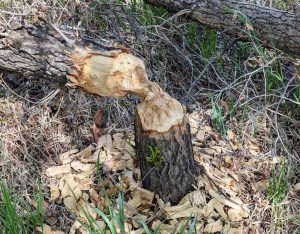
American Beaver tracks and signs
The North American beaver (Castor canadensis) is slightly larger than the Eurasian beaver (Castor fiber), and he modifies its environment to a higher degree than almost any other mammalian species in North America. These alterations change water chemistry, local hydrology, and vegetation structure across riparian zones (Nelner & Hood, 2011). Because beavers are primarily nocturnal or crepuscular, field confirmation of their presence relies heavily on the identification of tracks, trails, feeding signs, and building structures. This article should serve as a documentation of beaver tracks and signs for field identification. Track identification Beavers are heavy-bodied, low-slung semi-aquatic rodents. Identifying their…
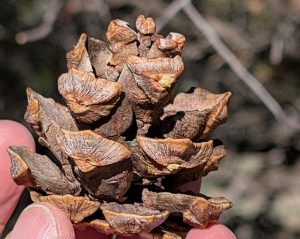
Pinyon Pine – The Tree of Life for the Ute Indians
When hiking across the rocky expanses of the American Southwest, it is very likely to walk through pinyon-juniper woodlands. The pinyon pine (Pinus edulis or Pinus monophylla) in these woodlands looks like a humble, twisted little tree struggling to survive in a harsh environment. But this tree is of by far higher value than it appears at first sight. For thousands of years, this resilient conifer has been one of the most vital survival resources on the Colorado Plateau. For the Ute Indian people, the pinyon pine was not just a plant; it was a cultural cornerstone, a reliable and…
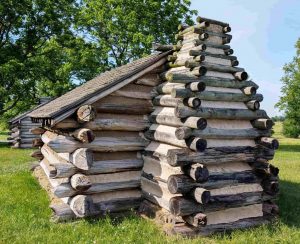
Valley Forge Log Huts
When we talk about wilderness survival and emergency shelters, we usually think of debris huts, tarp configurations, or lean-tos. But if you want to look at one of the greatest large-scale survival construction feats in North American history, you must look back to December 1777. When General George Washington’s Continental Army marched into Valley Forge, they didn’t find a fortified base. They found a windswept, frozen plateau. Within days, thousands of regular citizens-turned-soldiers had to use basic hand tools to engineer a massive, improvised city out of the standing timber around them. The Valley Forge log cabins (historically called “huts”)…
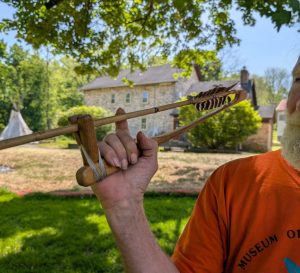
Atlatl Mechanics: Launch Physics and Hunting Applications (Part 3)
This is the third and final installment of our series on ancient weapon technology. After exploring the global history (Part 1) and mechanical anatomy (Part 2) of the atlatl, we now dive into the bio-mechanics of the launch sequence, calculate its kinetic energy, and examine its real-world hunting capabilities. The Atlatl Launch Sequence: A Step-by-Step Guide Throwing an atlatl dart requires a fluid, coordinated kinetic chain that links your lower body, core, and arm into one continuous acceleration path. For a flawless, accurate launch, the body transitions through several distinct phases: 1. Establish the Stance: Preparation. Begin with a balanced…
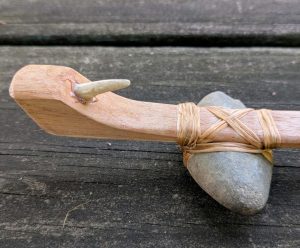
Atlatl Anatomy: Understanding the Throwing Stick and Dart (Part 2)
This is the second installment of our three-part series on ancient weapon technology. While part one explored global history, this article breaks down the engineering, dimensions, and parts of traditional North American atlatls and darts. Part three will cover launching mechanics and modern survival applications. Anatomy of the Atlatl Throwing Stick A traditional atlatl is not just a piece of wood—it is an engineered system consisting of three core elements: the handle, the shaft (stick), and the spur. Together, they transform manual muscle movement into high-velocity kinetic energy. Generally, an atlatl’s length is roughly the distance from your inner elbow…
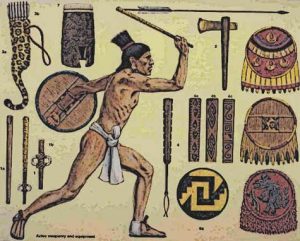
The History of the Atlatl (Part 1)
This is the first installment of our three-part series on atlatl weapon technology. In this article, we explore the global history of the atlatl. Part two breaks down atlatl components and design, and part three covers launching techniques and historical applications. What is an Atlatl and How Does It Work? An atlatl (pronounced at-lat-uhl) is an ancient spear-thrower or launching stick designed to propel a lightweight, long dart at high velocities. Acting as an extension of the human arm, it leverages mechanical leverage to hunt game or engage targets from a safe distance. The word “atlatl” originates from the ancient…