
D.R. Congo

Edible Rubber Vine Fruits in Central Africa
Landolphia camptoloba (Apocynaceae) Common names: Mbungumbungu, dinsania, dinsona (Kongo). Magoki is also used for all Landolphia species with edible fruit. Description A slender vine or shrub growing from 30 cm to 8 m long. Mature fruits, 5 cm in diameter, are yellow to orange with red or brown spots, have a white pulp and can be found throughout the year. Ecology and propagation Grows on sand at the forest edge in dry forests, woodlands or savanna in Angola and adjacent parts of D.R. Congo and Zambia. Can be grown from seed. Uses The fruits are eaten, particularly by children. The…

Oil Palms in D.R. Congo: Versatile Uses from Food & Oil to Building & Survival
Elaeis guineensis (Arecaceae); Common names Ba di nsamba, ba di ngasi (Kongo), palmier à huile (Fr.), oil palm Ecology In Kongo Central scattered trees are commonly left in the bush fallow. Propagation Seed requires heat treatment before it will germinate and even then is slow and variable. It is best to use pre-germinated seed from improved Tenera types. Management Cultivated palms commence bearing after 4 years and reach their peak after 12 – 15 years. They may continue producing for 40 to 50 years. Wild plants may take 10 years to start fruiting. Inter-cropping with cassava, soya beans or sesame…

Hog plums for food
Spondias mombin (Anacardiaceae); Common names: Mungyenge (Kongo), Hog plums Description A tree which grows to 25 m. Flowering occurs during the dry season. Fruiting of hog plums starts after about 5 years though cuttings may produce earlier. The tree has a bushy habit on drier sites. Ecology Originally from West Africa or tropical America but now present from Senegal to Angola. The tree is often found on the sites of old villages in western D. R. Congo. It does well in a variety of soils, including shallow sands, gravel and heavy clay, but grows best on rich, moist, relatively heavy…

Raphia sese – a very special Raphia palm
Raphia sese (Arecaceae) Common names: Nsaku (Kongo = knife with a long blade), ba di magangu (Kongo). Description A palm which grows in dense clumps up to 10 m tall. Female flowers are produced at the base and male flowers higher up the spike. Ecology Found in certain marshy sites. It is also present in the central forest zone of D.R. Congo. Uses The pulp around the seeds is edible and contains a yellow-orange oil composed of over 70% unsaturated fatty acids (compared with 55% for palm oil). The fruits are piled up and covered with branches and foliage until…

African milkbush causes painful blistering and inflammation
Euphorbia tirucalli (Euphorbiaceae) Common names: Ngego, ngewu, nlembonlembo (nlembo = finger) (Kongo), Euphorbe effilée, tirucalli (Fr), finger tree, finger euphorbia, African milkbush Description A leafless succulent shrub with cylindrical shoots, 2 – 8 m tall. All parts produce copious white to yellowish latex. Dense clusters of flowers are produced at the ends of the branches. Fruit is an almost round capsule circa 8 mm × 8.5 mm, containing 3-seeds. Ecology Often planted on graves, in markets, and around homes in Kongo Central. Originally from Eastern tropical Africa, it has long since become naturalized in other parts of Africa, including South…

Some varieties of edible wild mushrooms in DR Congo
Some mushroom collectors And some sellers Bunsambi (Polyporus tenuiculus) grows on dead tree trunks (particularly Voacanga africana) and can be found throughout the year. It is cooked with simsim or seeds of pumpkin or squash. Lumvumvu (Lentinus squarrosulus) Grows on dead wood in the forest. Photo: Jacques Miaglia Lutumbula or Lutumbulu is found in large quantities in the savanna at the start of the rains. The mushroom is very popular being used as a substitute for meat and vegetables. Eating large amounts, however, is believed to cause illness. Nkaka bu bwaka bwaka The “grandfather” of Bwaka bwaka, on a dead…

Some important edible caterpillar species in Kongo Central, Part 2
In former articles on this website, we already discussed two edible caterpillar species from Kongo Central. One species was ‘Bisu’ Nudaurelia petiveri, which was described here. And the other species was ‘Kaba’ Lobobunaea phaedusa, described in this article there. Additionally, a good number of edible caterpillars in Kongo Central was already presented in Part 1 of this series, which can be seen here. Paul Latham and Augustin Konda ku Mbuta will now continue to briefly present all other important edible caterpillar species in Kongo Central. —————————————– Minsongo or Malemba (Gonimbrasia alopia) This species is found from Guinea to Congo and…

Some important edible caterpillar species in Kongo Central, Part 1
In former articles on this website, two edible caterpillar species from Kongo Central were already discussed. One species was ‘Bisu’ Nudaurelia petiveri, which was described here. And the other species was ‘Kaba’ Lobobunaea phaedusa, described at this article there. In the following, Paul Latham and Augustin Konda ku Mbuta briefly present all other important caterpillar species for food in Kongo Central. ——————————————————————————————————————– Kindengula, Kidishi foncé (Daphnis nerii) A solitary species. When disturbed it curls its head and thorax down to display the large eyespots. It feeds on Rauvolfia vomitoria in Kongo Central. Photo: Augustin Konda ku Mbuta Kitete mbika, Mbua…

Beekeeping Safety in the Bush: Improvised Veils, Suits, and Smokers
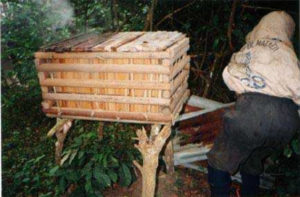
Locally made-up smokers and overalls are used for inspection or harvesting the hives as improvised equipment. These have also become expensive and are often shared by a group of beekeepers. Improvised protective overalls A protective bee suit enables the beekeeper to work with bees calmly and safely. A pair of ordinary trousers can be used as an alternative to the bottom half of the suit. Design by Ntangu Targou. A bee veil/hood with foam padding sewn in to protect the head from stings will serve the purpose. The picture above shows the preparation to inspect hives at Targou’s apiary near…
Low-Cost Beekeeping: How to Build Alternative Beehives in D.R. Congo
In recent years the shortage and expense of timber and corrugated iron sheet have encouraged people to use alternative materials for beehives. The range of substitutes includes old 200-liter fuel drums cut in half. Their ends removed, and their sides pushed together until they form an oblong approximately 50 cm wide to accommodate the top bars. Plastic basins and old truck fuel tanks have also been successfully converted. Hives have been built with bricks which have the additional advantage of being fire proof should a bush fire get out of control. Cheap hives can be made up from Nkooko (Raphia…

Beekeeping in D.R. Congo: Income for Rural Families
Honey hunting has been a traditional activity in Bas-Congo, as in much of Africa. But beekeeping in Congo has only been practiced in the area since the early 1980’s. The beehive in common use is the top bar hive which has been introduced from Kenya. However, in Congo, the sides are vertical rather than sloping. Beehives are always sited in areas of fairly thick bush or forest and therefore usually in the Nkunku. Beekeepers choose these areas to provide shade and seclusion and to enable them to get away from the hive without being followed by bees after inspection or…

Growing Breadfruit in Central Africa
Synonyms A. communis, A. incises; Common names Kikwa ki santu Petelo (Kongo), arbre à pain (Fr.), breadfruit Description A tree up to 35m tall produces a wide crown. All parts of the tree produce a white, bitter latex. Fruits are nearly spherical, 15 – 30cm in diameter, and either contain large seeds (breadnuts) or are rough, but not spiny, and seedless (breadfruit). The fruiting season may last for 5 months. Ecology The tree is occasionally found in villages in Kongo Central. It thrives in a humid climate at low altitudes. The young plants require some shade, but for fruiting, full…

Kaba: Edible Green Caterpillars of D.R. Congo
The name Kaba is used for several large green caterpillars. Lobobunaea phaedusa can be up to 10 cm long and is usually found singly between October and May. When disturbed the caterpillar contracts in defence. They are sometimes very difficult to see, blending well with surrounding leaves. The green caterpillars are usually found when its droppings are discovered below the tree on which it is feeding, hence the saying: “Kaba kafurilanga mu nsasa yani kibeni kagetanga va ntoto” “The death of the Kaba is caused by its droppings”. It turns brown when about to pupate. This takes place in the…

Bush Yams: Young Shoots Eaten Like Asparagus in Central Africa
Synonym: D. cayenensis var. praehensilis; Common names: Kisadi, sadi, Bisadi (Kongo), Igname de brousse (Fr.), bush yams, forest yam Description A sturdy climbing plant, up to 15 m long, growing from a large tuber that often protrudes from the ground. The latter is armed with curving, protective, spiny roots that arise from the top of the tuber. Stems are hairless, purplish-green, and lightly ribbed longitudinally. The tuber has white flesh tinged yellow and may be either oblong or round. Leaves are 4 – 10 x 3 – 5 cm. Ecology Grows wild in forests and gallery forests from Sierra Leone…

Edible caterpillars Nudaurelia petiveri
This species (Nudaurelia petiveri) is widespread throughout western, central, and southeastern Africa. It appears in Kongo Central in December and January. Up to 200 eggs are laid in clusters on the undersides of young leaves. They hatch after about two weeks. Larvae are often found feeding together in large numbers. Pupation takes place underground and there may be 4 to 5 generations per year. The moths hatch out when the soil becomes damp at the start of the rainy season. The caterpillars are most often found on Milicia excelsa in Kongo Central but may also be found on Ricinodendron heudelotii,…

Collecting and Cleaning Edible Caterpillars in D.R. Congo
Children are the main caterpillar collectors, though most people while walking in the bush, keep a constant watch for them. Frequently people will bring back young caterpillars and place them on trees near their homes where they can keep an eye on them. Many villages have a few Acacia auriculiformis trees planted nearby and these are used to rear the caterpillars of several species until they are ready to eat. Some farmers have taken this a step further and allow a proportion of caterpillars to pupate and frequently, for certain species, the resulting moths will lay eggs on the same…

How Cassava is Processed in D.R. Congo: From Root to Flour
Image sequence of cassava’s long way from root to market and shows the processing of cassava in its various steps Source This article is an excerpt of Paul Latham’s and Augustin Konda ku Mbuta’s books ‘Useful plants of Kongo Central Province’, Vol 1 and Vol 2, which can be downloaded in English here or French there. All photos in this article © Paul Latham and Augustin Konda ku Mbuta .

Why Caterpillars Are a Key Food in Central Africa
Rural families in Kongo Central find it very difficult to get sufficient protein to eat. Hunting has cleared out most of the larger animals and even many of the smaller animals, such as the cane rat, are now difficult to find. Fish and meat are generally far too expensive, and the only other main source of protein is groundnuts. Cassava root and leaf are the staple foods for most rural and city dwellers. Trees with colonies of caterpillars are often marked either with a cross or with various items hung on the trunk to show that the colony has been…

Rattan vine in Africa – Calamus deerratus
Synonym C. laurentii; Common names Nkau (Kongo), Rotin (Fr.), Rattan vine Description A slender to moderately robust rattan palm, climbing up to 20 m high and often forming dense clumps. The stems and leaves are armed with spines. Stems have an extended whip-like organ called a flagella, up to 2 m long, with hooks that help the palm climb into the tops of forest trees. Canes may grow to 5 cm in diameter but are usually only 1 – 3 cm. Old stems lose their thorns. Ecology It grows in swamp and riverine forests but is less common in areas…

Why Cassava is Central Africa’s Top Staple Crop: Roots and Leaves, Uses.
Synonym: M. utilissima; Common names: Dyoko, Saka Saka (Kongo), Manioc (Fr.), Cassava roots Description A perennial shrub, up to 3 m high, with enlarged tuberous roots and a well-developed root system. There are many varieties, some of which are bitter and others sweet. Sweet varieties are short-season crops being harvested after 6 – 9 months. Some of these can be eaten raw. PRONAM and IITA have been responsible for breeding high-yielding, disease-resistant varieties such as Kinuani for Kongo Central, which is recommended along with the local variety Mpelolongi. Ecology Grown throughout the humid tropics in pure or mixed stands. Rainfall…

Water Vine Tetracera alnifolia: Drinkable Sap in the Savanna
Tetracera alnifolia (Dilleniaceae); Synonym T. alnifolia subsp. alnifolia; Common names Kiziazi, Nziazi, Nziazia (Kongo), Liane à eau (Fr.), Water tree Description A woody creeper up to 20 m long and up to 10 cm. in diameter. Leaves are 4 – 16 cm long and 3 – 8 cm wide, often recurved, on a petiole up to 2 cm long. Flowers are white in large, terminal panicles 15 – 25 cm long. The oval fruits are dull red and woody. Seeds are few, shiny black, with an orange aril, enclosing the seed. There are four other species of Tetracera present in…

Edible Caterpillars in D.R. Congo – An Overview
My first experience with edible caterpillars took place in 1985 when my wife and I lived at Kavwaya near Kisantu in what was then the Bas-Congo province of D.R. Congo. On one occasion I was shown how to hunt for Minsangula caterpillars by a group of children from the village. Scrambling through dense bush they would stop now and then to call out “Yi Yi”. If the caterpillars were present, they would jerk from side to side on the twigs of the trees where they were feeding and thus conveniently identify themselves. Insects as a food source Insects represent an…
Mammea africana – Sweet Fibrous Fruit & Oily Seeds: Key Bush Food in Central Africa
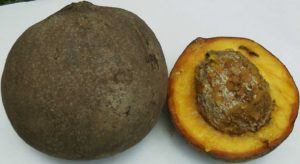
Common names are Mafambu, Dimbu dingi (dingi = gum, resin, incense) (Kongo), Bokodji (Lingala), African mammee apple, Oboto or Djimbo (commerce). Scientific name: Mammea africana. Description A large forest tree up to 45 m tall with a straight, cylindrical trunk and scaly brown bark. The inner bark yields a yellowish resin. Leaves are opposite, glossy, 9 – 35 cm long and 3 – 13 cm wide. Young leaves are copper-red. The flowers are produced in leaf axils and are either bisexual or male. Bisexual flowers are solitary, white, and up to 2.5 cm long. Male flowers are borne in clusters…

Okra in D.R. Congo: A Favorite for Soups and Stews
Okra plants (Abelmoschus esculentus): Synonym: Hibiscus esculentus Common names Dongo, Lonto (Kongo), Dongo dongo, Molenda (Lingala), Gombo (Fr.) Description An erect annual herb usually 1 – 2 m. high. Leaves are 3 to 5 lobed, spirally arranged and may be up to 50 cm in diameter with a petiole of similar length. The solitary yellow flowers have a purple centre and arise from the leaf axils. Fruit is produced during the rainy season and is a cylindrical capsule 5 – 35 cm long and 1 – 5 cm in diameter. Ecology In Kongo Central province, DRC, a few okra plants…