
Vegetable
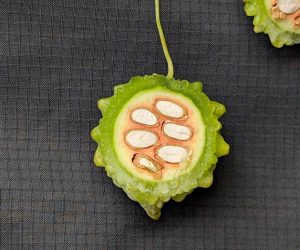
Discover Katu Karavila: Sri Lanka’s Wild Bitter Gourd
In Sri Lanka, a variety of cultivated and wild bitter gourds occur. The most commonly collected wild bitter gourd (Momordica charantia var. muricata (Willd.) Chakrav.) is, in fact, only a semi-wild one. It is locally called කටු කරවිල (Katu Karavila), and the English common name is – confusingly – ‘Wild Bitter Gourd’. Momordica charantia var. muricata is a botanical variety of bitter gourds that sits taxonomically and morphologically between the cultivated bitter gourd and truly wild Momordica species. It is often a source of confusion because it shares traits with M. charantia (the cultivated form) as well as with M.…

Wild asparagus in Sicily
Wild asparagus, a unique culinary delight, is prominent in Sicily’s springtime cuisine. The region boasts two distinct species: Asparagus albus, White asparagus, and Asparagus acutifolius, affectionately dubbed ‘Wild asparagus’ in English. Another edible part of these plants is its ‘crown’ of roots, which is seldom eaten. Therefore, we will concentrate this article on the young spears of these two asparagus species. Distribution and description Asparagus acutifolius This species is distributed throughout the arid and rocky areas of the Mediterranean region. It typically occurs in maquis/macchia and garrigue shrubland biomes and avoids sandy areas, like parts of the northern coast of…

Young Cassava Leaves provide protein and micronutrients
Young cassava leaves are a regularly eaten side dish for Mentawai people. Cassava (Manihot esculenta, Crantz) is endemic to the southern rim of Amazonia in South America. There, it was domesticated around 5000 BC. In the 16th century AC, Spanish and Portuguese explorers brought them to Africa. Only in the 1960s was cassava introduced to Asia. So, it is not a traditional food addition to Mentawais but only a recently adopted one. Mentawai eating habits As mentioned in previous articles, Mentawais’ staple foods are Sago, Taro, and Bananas. These are foods rich in carbohydrates. Protein comes from the field, stream,…

Vegetable ferns are a source of nutrients in Siberut
Vegetable ferns (Diplazium esculentum (Retz.)) are among the few wild vegetables Mentawai people in the forests eat regularly on Siberut Island. By Mentawais, they are called ‘Laipat.’ Other wild vegetables are cassava leaves, ginger flowers, taro stalks, and wild eggplants. In times of hunger, Mentawais also eat shoots of sugar palms. But generally speaking, all these wild vegetables are just an irregular addition to the regular diet of sago/taro/bananas and meat. Where do vegetable ferns grow? Vegetable ferns (Diplazium esculentum) prefer to grow at the edge of forests towards cultivated land. However, distinguishing between cultivated and non-cultivated land is often…

Seekoraal plants in Southern Africa
Seekoraal is the Afrikaans term for the Salicornia natalensis plant, which belonged to the Sacocornia taxonomic genus before being reclassified under the Salicornia genus in 2017. Salicornia plants are succulent, halophytic (salt-tolerant) flowering plants in the Amaranthaceae family. They thrive in salt marshes, on beaches, and amidst mangroves. There are 53 known Salicornia species native to North America, Europe, Central Asia, and Southern Africa. In Southern Africa, these plants are commonly known as Seekoraal and Pickleweed. Historically, they were pickled and consumed as a salad with vinegar and olive oil dressing to prevent scurvy. In the United States, they can…

Purple Laver – cherished food in many cultures
Purple Laver (Porphyra capensis) belongs to a genus of cold-water seaweeds that grow in shallow seawater. More specifically, it belongs to the red algae phylum of laver species (from which comes laverbread), comprising approximately 70 species. It grows in the intertidal zone, typically between the upper intertidal zone and the splash zone in cold waters of temperate oceans. Description Purple Laver’s dark purple to purple-green blades are thin and membranous. Males have a yellowish, and females have a pinkish tinge on the edge. The blades get up to approximately 15cm in length. It looks almost black when dry. It becomes…

Okra in D.R. Congo: A Favorite for Soups and Stews
Okra plants (Abelmoschus esculentus): Synonym: Hibiscus esculentus Common names Dongo, Lonto (Kongo), Dongo dongo, Molenda (Lingala), Gombo (Fr.) Description An erect annual herb usually 1 – 2 m. high. Leaves are 3 to 5 lobed, spirally arranged and may be up to 50 cm in diameter with a petiole of similar length. The solitary yellow flowers have a purple centre and arise from the leaf axils. Fruit is produced during the rainy season and is a cylindrical capsule 5 – 35 cm long and 1 – 5 cm in diameter. Ecology In Kongo Central province, DRC, a few okra plants…

Morning glory – a valuable wild vegetable in Asia
Swamp morning glory or Water spinach (Ipomoea aquatica) has various common names, like ‘Kangkong’ in Southeast Asia or ‘Kung Shin Tsai’ in China. It is a staple vegetable food throughout the Asia-Pacific region. It is deficient in calories (19 cal/100 g) but high in vitamins (Vit. C, Vit. A, and others), minerals, and antioxidants. The taste is slightly sweetish; the texture of the leaves is succulent, and the stems are hollow, a bit mucilaginous, and crunchy. It is used for salads, stir-fries, or – best for my taste – braised with garlic. An in-depth description of this vegetable can be…
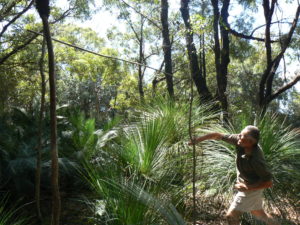
Spear shafts from grass tree stalks
Grass trees (Xanthorrhoea sp.) and grass tree stalks are endemic to Australia. They are locally called ‘Black Boys’ due to their appearance after bushfires. They need a certain number of regular fires for their survival and are well protected against them. Xanthorrhoeas were utilized historically intensively for a very long time by First Nations people. And for a very short time also by non-Aboriginals. During these abt. 10 years in the 1920s, non-Aboriginal people eradicated these plants in many environments where they were once common. Currently, grass trees are only protected in National Parks, although three species are already ‘Endangered’.…

Spekboom leaves as vegetable in South Africa
Among the many edible South African plants, few are as remarkable as Spekboom (Portulacaria afra), a member of the Didiereaceae family. Known locally as the elephant bush, this hardy succulent is celebrated for its ecological benefits and, increasingly, for its role as a nutritious vegetable. A Hardy, Indigenous Shrub Spekboom is native to South Africa’s arid and semi-arid regions, especially the Eastern Cape. It grows as a dense shrub or small tree, often reaching up to five meters in height, and can live for over a century. Its resilience is legendary — thriving in poor soils, surviving drought, and sprouting…