Fire making
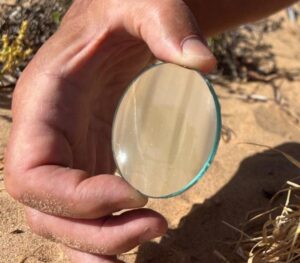
Creating fire with a magnifying glass
A magnifying glass has been used to start fires since ancient times. Greek and Roman writers recorded the use of ‘Burning glasses’ for domestic and war purposes. A concise history of these applications can be found on Wikipedia. Nowadays, fires are primarily started with Bhutane lighters, and these lenses are mainly used as ‘Magnifying glasses’ by people with slight vision disabilities sitting in their rocking chairs. But survivalists can still use Magnifying glasses as Burning glasses, a lightweight, versatile, and absolutely waterproof fire-making alternative. This website already discussed a similar topic in an article called ‘Solar fire lighting.’ Convex lenses…

Hadza hand drill friction fire
Hadza hand drill friction fires are the standard fire-making method of the Hadzabe people in Tanzania, who live remotely. They do not have the omnipresent butane gas firelighters of the modern world or any other artificial methods. Even when lighting a self-rolled cigarette on a hunt, they use their firestick to produce an ember. Lightning a fire with the hand drill is just one of their daily routines. Our interpreter was very particular about not giving them a gas lighter when visiting them, as this would trigger a demand to purchase these lighters from Datogas in the future. Which in…

Bow Drilling – following the method of Mattias Norberg
At the Global Bushcraft Symposium 2022 in Wales/UK, the Swede Mattias Norberg demonstrated his method of creating fire by bow drilling. Sweden has a rich outdoor tradition, and it was a privilege to meet him there, as he has deep knowledge and experience on this subject. Mattias is the author of the book ‘Konsten att Elda’ (‘The Art of Fire’), which delves into this subject matter in great detail but is currently only available in Swedish. He has long been an instructor with the Swedish Survival Guild, an association of all individuals and organizations in Sweden dealing with bushcraft and…

Giant Fennel stalks for lighting fire
Various internet pages and YouTube channels describe lighting fire with stalks of giant fennel (Ferula communis) as easy. I doubted these claims, so I tested them myself. The outcome was sobering, which I will describe in the following article. I also checked the possibility of using them to transport fire. Lighting fire with a Fire rod Fire rods are one of those gadgets modern survivalists think they need for their back-to-nature experience. Except they overlook that when unexpectedly stranded in nature, there is no shop to buy such rods when required. Nevertheless, I tested the effect of fire rod sparks…

DIY Egg Carton Fire Starters with Candle Wax and Lint
Fire starters are convenient aids in Austria’s cold winters. Wood shavings lighted wood- and coal-burning stoves one generation ago. These shavings lighted spruce kindling, which in turn started burning bigger pieces of wood. Nowadays, it’s easier. Either commercially available or DIY fire starters directly light even thick pieces of hardwood. For many years, we have produced our fire starters ourselves. These are pieces of egg cartons filled with either lint, wood shavings, or cotton textiles and impregnated with candle wax or paraffin. One piece of such a fire starter will securely light big chunks of hardwood for our tiled stove…

Batwa pygmies traditional fire lighting method
The Batwa people live around Bwindi Mgahinga National Park in Uganda. This park is significant because it houses half the world’s mountain gorilla population. The Batwa were the last tribe permitted to hunt in this national park before they were forced to leave between 1991 and 1994. The forest was recognized as a UNESCO World Heritage Site during this time. With a population of less than 7,000, the Batwa are known for their strength and short stature. They are one of the few remaining tribes in Uganda that has maintained its traditions and history. Traditional Fire Lighting Method of the…
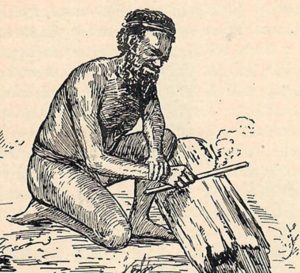
Australian Firesaws
Firesaws are only known as a traditional fire-making method on the Pacific Islands. In Australia, these methods were replaced by friction fire hand drills and later, under Western influences, by bow drills. Nevertheless, fire sawing is an interesting technique, which was famously described by Robert Brough Smyth in his book: ‘The Aborigines Of Victoria V1: With Notes Relating To The Habits Of The Natives Of Other Parts Of Australia And Tasmania (1878)’. The whole book can be legally downloaded here. The following are excerpts of the original text and the two original figures published to benefit the wider bushcraft and…

How Humans Mastered Fire: From Natural Force to Tool
The history of fire is fundamentally the history of humanity itself. Long before our ancestors learned to create a flame, fire was a terrifying natural force—a byproduct of lightning strikes that brought both destruction and opportunity. However, the transition from fearing the flame to the controlled use of fire became the single most important turning point in human evolution. From providing warmth and protection against predators to revolutionizing our diet through cooking, the mastery of fire didn’t just change how we lived; it changed who we became. In this brief historical overview, we explore how early man tamed the element…

Manketti Wood: The Ju/’hoansi Choice for Hand Drill Fire
In the northeastern parts of Namibia, Ju/’hoansi Khoi-san bushmen preferably use Manketti wood (Schinziophyton rautanenii) for friction fire lighting, at least in areas where Manketti trees are growing. Such areas have slightly higher elevations compared to savanna bushveld vegetation. Both parts of the fire lighting set, the hearth board, and spindle, are made from the same branches of these trees. Therefore, both have nearly the same diameter. In areas where no Manketti trees are growing, they use White raisin bush (Grewia bicolor) spindles, and for base woods, various Commiphora sp.. Choosing the correct wood for a fire-lighting set Suitable wood…

Flint and Steel Fire Lighting: Method and History
In the Stone Age and Bronze Age, European men created fire by striking flintstone on marcasite and catching sparks on tinder made from horseshoe fungi. Marcasite is crystallized pyrite (an iron sulfate mineral) and is not readily available but has to be traded over long distances. When the Iron Age arrived, times got easier for firemakers because, at this age, firelighting was done with flint and steel. The hardest stones with fine crystal structures (besides diamond) are chert, flintstone, and very dense quartzite. High-carbon steel was used in the Iron Age and later on as a striker; as such, steel…

Hand drilling in UK as taught by Dave Watson
Friction fire hand drills are usually not the first choice for fire lighting in the Northern Hemisphere, as they are regarded as a strenuous technique, especially in cold and humid environments. Dave Watson proved this perception is incorrect under overcast Northern Wales weather conditions. He produced an ember as fast with hand drilling in the UK as with a bow drill. Materials used for friction fire hand drills in boreal forest biomes in the Northern Hemisphere Hearth board for hand drill friction fire method Dave uses dry Wild clematis (Clematis vitalba) wood as a hearth board, which he cuts into…

Bow Drill Fire Lighting: Dave Watson’s Methods and Woods
The approach to friction fire lighting with bow drills in the UK slightly differs from that in other countries. In the following, these differences will be explained. Materials and shapes of the various bow drill elements Hearth board of the bow drill Preferrable lime (Tilia cordata) wood is used for hearth boards. Lime sap- and heartwood are hardly distinguishable; lime has a medium density of about. 0,530 g/cm3, which is uniformly dense and not elastic. Another type of wood used for hearth boards is Sycamore (Acer pseudoplatanus), which is technically spoken hardwood with high water content but produces lots of…
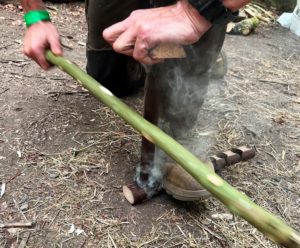
Bow drilling in Australia by Gordon Dedman
At the Global Bushcraft Symposium 2022 in the UK, Gordon Dedman presented the bow drilling technique he teaches in Australia. Since readers are assumed to know the basics of bow drill friction fire lighting, I will only concentrate on specific aspects of this technique as taught by Gordon. Setting up the bow drill set My post about Australian woods for friction fire lighting discussed the hearth board and spindle’s wood choice. It can be found here. In this article, I will discuss shapes, geometries, and hand drill friction fire lighting procedures. Hearth Board For the hearth board for bow drilling…
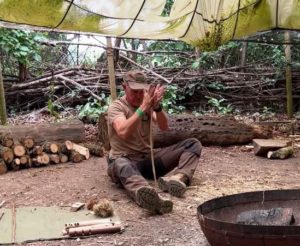
Hand drill friction fire lighting in Australia
At the Global Bushcraft Symposium 2022 in the UK, Gordon Dedman presented the hand drill friction fire lighting method he teaches in Australia. As most readers of this topic will know the basic techniques of hand drill friction fire lighting, I will only concentrate on specific aspects of this technique as taught by Gordon. Setting up the hand drill set In this article, we already discussed recommended wood species for hand drills in Australia. Here, I will only discuss the shapes and procedures of hand drill fire lighting. As can be seen, the whole equipment set-up of a hand drill…
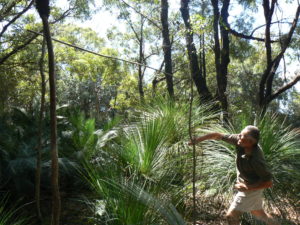
Spear shafts from grass tree stalks
Grass trees (Xanthorrhoea sp.) and grass tree stalks are endemic to Australia. They are locally called ‘Black Boys’ due to their appearance after bushfires. They need a certain number of regular fires for their survival and are well protected against them. Xanthorrhoeas were utilized historically intensively for a very long time by First Nations people. And for a very short time also by non-Aboriginals. During these abt. 10 years in the 1920s, non-Aboriginal people eradicated these plants in many environments where they were once common. Currently, grass trees are only protected in National Parks, although three species are already ‘Endangered’.…

Creating fire by hand drill in Namibia
The type of wood for fire hand drills changed over time Fire starting with friction hand drills was traditionally common among Khoi-san (Ju//hoansi) people in their distribution area, which was once over Southern Africa and became increasingly confined by invading Bantu tribes and White colonists. Now, they are restricted to some areas within and around the Kalahari. With this restriction in space, there was also a restriction in available materials for tools, implements, building materials, pots, etc. For lighting fires, it was necessary to change from one type of wood fire set to two kinds over time. Type of wood…

Solar Fire Lighting: Starting a Fire with a Focusing Lens
Harnessing the power of sun rays for fire lighting is one of the most elegant and rewarding skills in the bushcraft repertoire. Unlike friction-based methods that require intense physical exertion, solar ignition harnesses the sun’s virtually unlimited energy to create a precise, high-temperature focal point. By mastering the use of a burning glass or magnifying lens, you can transform a clear day into a reliable survival advantage. This guide explores the essential techniques for capturing sun rays for fire lighting, from selecting the right tinder to perfecting your focal distance, so you can spark a flame with nothing but light.…