
Poison
Hadza Arrow Poison – Strophanthus and Acokanthera species
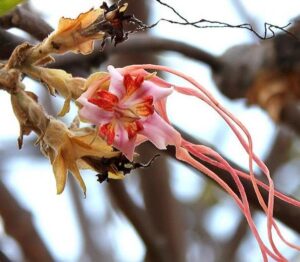
Arrow poison based on Adenium sp. plant extracts was covered in a former article on this website. In the following, we will discuss the second type of poison the Hadzabe people make, which they call Shanjoko, a Strophanthus species. Additionally, we will present an arrow poison not made by the Hadzabe people but that is sometimes traded in from neighboring tribes. They call it K’alik’asi, and it is made from Acokanthera schimperi plants. General description of Shanjoko, or Shanjo The second most used arrow poison by Hadzabe people is an extract of the grains from the Poison Arrow vine (Strophanthus…
Hadza Arrow Poison made from Adenium species
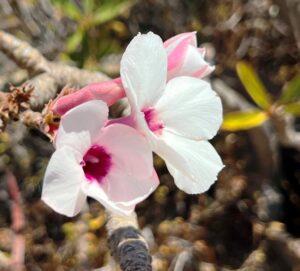
Remotely living Hadzabe people use three types of arrow poison to bag big game animals. However, due to the shrinkage in the size of their areas, they currently produce only two kinds. I will describe these arrow poisons briefly to record and document as much information as possible on these crucial auxiliary tools for hunting. As one article covering all three types of arrow poisons would be too long for comfortable reading, I have split the topic into two parts. This article (Part 1) covers the arrow poison based on the Adenium plant. Part 2 will cover arrow poison based…

Mentawai arrow poison
The Mentawai people use poison on their arrows to hunt game. In previous articles on this website, we discussed the Mentawai people’s hunting methods. Then, we presented an actual hunt for Flying foxes. We then discussed the longbows used on these hunts, the arrows used for different animals, and quivers. In the following section, we will discuss the manufacture of Mentawai arrow poison. Before starting this article, one important fact has to be remembered. The Mentawai people don’t have a written language and only communicate orally. Therefore, a variety of different transcriptions of this vernacular language exist. I wrote the…

African milkbush causes painful blistering and inflammation
Euphorbia tirucalli (Euphorbiaceae) Common names: Ngego, ngewu, nlembonlembo (nlembo = finger) (Kongo), Euphorbe effilée, tirucalli (Fr), finger tree, finger euphorbia, African milkbush Description A leafless succulent shrub with cylindrical shoots, 2 – 8 m tall. All parts produce copious white to yellowish latex. Dense clusters of flowers are produced at the ends of the branches. Fruit is an almost round capsule circa 8 mm × 8.5 mm, containing 3-seeds. Ecology Often planted on graves, in markets, and around homes in Kongo Central. Originally from Eastern tropical Africa, it has long since become naturalized in other parts of Africa, including South…

Utilizing Horseshoe Crabs as a Food Source
Foreword Horseshoe crabs are a species not protected in Thailand and are experiencing a significant decline. Their primary habitats, particularly the mudflats around mangrove forests, where they live and reproduce, are diminishing, and there is a growing demand for edible female horseshoe crabs as exotic cuisine. However, it is crucial to emphasize that this article does not endorse or encourage the unsustainable exploitation of these creatures. Instead, it aims to provide international readers with an overview of the historical significance of horseshoe crabs as a traditional food source. I firmly stand against removing even a single horseshoe crab from its…

Koppie Foam Grasshoppers
Koppie Foam Grasshoppers (Dictyophorus spumans) are indigenous to South Africa and prefer sparse and low vegetation on rocky outcrops. They are flightless and have some aposematic coloring, which are yellow or orange stripes on the warty thorax shield and stripes on their abdomen. These grasshoppers can attain a length of up to 80 mm. Interestingly, despite their size and coloring, they are commonly not called locusts but grasshoppers due to their solitary lifestyle. However, all locusts belong anyway to the genus of grasshoppers. Pic.: Koppie Foam Grasshopper at West Coast N.P, Western Cape Province, South Africa. Why are Koppie Foam…

Bluebottle jellyfish – a stingy creature
The bluebottle jellyfish, also known as Physalia utriculus, is commonly found along the coasts of non-tropical regions bordering the Atlantic, Indian, and Pacific oceans. These creatures are not jellyfish but rather siphonophores composed of multiple organisms known as zooids. These zooids work together in unison and rely on each other to function correctly. They each serve different purposes, such as floating, feeding, reproduction, and stinging. Despite their small size of about 10 cm/ 4”, bluebottle jellyfish have tentacles stretching up to 3 meters (9 feet) long. These tentacles are equipped with stinging cells that contain barbs and neurotoxic venom. When…

The Torchwood Tree: Ethnobotanical Uses and Properties of Balanites maughamii
The Greenthorn, or Balanites maughamii, is a medium to large deciduous tree indigenous to the low-lying, sandy areas of Southern Africa. Often referred to as the Torchwood, this species is characterized by a distinctly fluted, buttressed trunk and bifurcated (Y-shaped) green thorns. Its various components—bark, fruit, and kernels—have served practical and medicinal functions in regional communities for centuries. Natural Illumination and Lubrication The common name “Torchwood” is derived from the high oil content found within the fruit’s kernel. This clear, odorless oil is highly combustible. Historically, it was used to manufacture torches by soaking the fibrous, dry stems of the…

Poisonous beauty: The ‘Elegant Grasshopper’
Aposematic coloration The ‘Elegant Grasshopper’ (Zonocerus elegans) occurs commonly throughout Southern Africa and is mentioned due to its aposematic coloration, typical for animals that want to announce that they are poisonous. And he is a poisonous grasshopper. In the case of Zonocerus elegans, its poisonous properties are based on its favorite foods, milkweed, and bitter apple. The ingested toxins of these plants accumulate in the grasshopper’s body. When disturbed by an inexperienced predator, they will produce a frothy substance with distasteful and toxic properties. This concept worked for Zonocerus elegans so well that most of them lost the ability to fly, and…