
Trees & Shrubs

Climbing a Baobab tree
A Baobab tree (Adansonia digitata) is characteristic of African Savannah biomes. In Tanzania, the Hadza people in the mountainous southern area of Lake Eyasi taught us to climb these trees. Although it is not difficult, knowing the techniques for a safe climb is important. Distribution and tree characteristics Concentrations of these trees occur in Western Africa below the Sahel zone, Eastern Africa, and a belt from Southern Angola via the Caprivi strip and Zimbabwe down to the Limpopo River. Baobab trees are large, round, canopied trees with a swollen trunk, about 10-25 m in height. Their bark is thick, smooth,…
Tu-Lip trees in Papua New Guinea
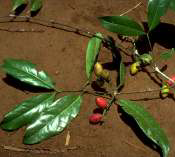
Tok Pisin: Tu lip; Scientific name: Gnetum gnemon What does a tu-lip tree look like? It is a small tree often only 8-10 metres high. It is a fairly straight tree with one trunk that has branches spread out along its length. The branches are not very long so that the tree does not spread out very wide. The tu-lip tree In Tok Pisin this small tree is called tu-lip. As people in Holland and other countries grow a flower called tulip, we need to point out that the two plants, or their names have nothing in common. The “tu-lip”…

Solomon’s Sago Palm: How it differs from True Sago
How is this sago different? The Solomon’s sago palm that occurs in the North Solomon province and the Solomon Islands is quite different from the sago that grows in other areas of Papua New Guinea. It has a different scientific name. The scientific name is Metroxylon salomonense. Originally, the sago in North Solomon Province was called Metroxylon bougainvillense, but now that name is not correct as the plant is the same as the one in the Solomon Islands. How is it different? The leaves or fronds of this sago palm are much larger than those of the other Papua New…

Camelthorn as firewood
Camelthorn is an excellent firewood in Southern Africa. Its outer layer is light-colored sapwood, and its dark, hard, and heavy heartwood is inside. This hardwood produces long-lasting coals and high heat. Its northernmost distribution area extends from the Northern Cape province of South Africa to Angola and Zambia. How did the name for Camelthorns arise? Camelthorn (Vachellia erioloba) got its English common name from the Afrikaans name for giraffes. When the Dutch Boers landed in 1652 in South Africa, they found various exotic plants and animals for which they did not have a name. When they saw giraffes, they thought…

Chewing sticks for dental care in Southern Africa
Chewing sticks, or toothbrush sticks, were widely used in former times from Ethiopia down to the southern tip of Africa. Nowadays, plastic toothbrushes are commonly used, and chewing sticks are still commonplace only in very rural parts of this area. Generally, a good chewing stick must have a fibrous texture and be easy to chew initially. It must also be agreeable in taste and have antibacterial and antiplaque properties. Many types of shrubby trees fulfill these requirements. In Southern Africa, the most widely used are Bluebush sticks, followed by Mustard tree sticks, Magic Guarri, and Small Knobwood sticks. Bluebush chewing…

Manketti (or: Mongongo) nuts
Manketti nuts are a staple food for a variety of people within its distribution range. And there is a strict division of naming them. Khoi-san people (Bushmen) call them ‘Manketti’, whereas Kavango people (Bantus) call them ‘Mongongo’. Both names denominate the same trees and nuts. Whereas Kavangos (the Kavango river and the O’kavango swamps were named after them) live mainly from Mahangu (Pearl millet) porridge, Khoi-sans rely for 8 months a year heavily on Manketti nuts for food. The Manketti tree (Schinziophyton rautanenii) belongs to the family of Euphorbiacea. There is however no milky sap or poison in any parts,…
Indochina Dragon Plums from Hanoi streets
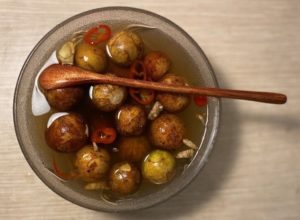
The Indochina Dragon Plum (Dracontomelon duperreanum) is a genus of flowering plants in the family Anacardiaceae. In Vietnamese, it is called chi sấu). Dragon Plums are one of the most popular trees on the side of Hanoi streets. The fruits of the trees are also famous for being used by Hanoi gourmets. However, the fruits are usually harvested and used when green. Let’s see how the ripe dragon plums could also become one of the most unforgettable flavors of Hanoi. Harvest the ripe dragon plum. The best time to harvest ripe dragon plums is early autumn, in August or September.…

Buffalo thorn tree – an icon in Southern Africa
The Buffalo thorn tree (Ziziphus mucronata) is called in Afrikaans “Blinkblaar-wag-‘n-bietjie” for its shiny leaves and two thorns, which hold people back when getting caught by them. The shrub or tree has got distinctive zigzag branchlets with pairs of two thorns: one hooked thorn pointing downwards and one straight thorn pointing upwards. Mr. Mxolisi (‘Xia’) Mabilane, a VaTsonga from the Greater Letaba Local Municipality, commented on this tree as follows: Uses of Buffalo thorn shrubs and trees Food from Buffalo thorn trees Young leaves are soft and have low tannin content. They can be eaten raw and taste well. If…

Red Bushwillow: One of Southern Africa’s Best Firewoods
In Southern Africa, fourteen species of Bushwillows belong to the Combretum family. Other trees of the same Combretum family are Clusterleaf species, Leadwood, and others. Interestingly, not all Combretum species are suitable for firewood, but some are excellent for that use. The wood hardness of Combretum family members Although it belongs to the same plant family as Combretum, leadwood is the second hardest wood in Southern Africa. It is highly sought after for firewood and cannot legally be cut down without a special permit. All Bushwillow species got very hard and suitable wood for fires. On the other hand, all…

The Torchwood Tree: Ethnobotanical Uses and Properties of Balanites maughamii
The Greenthorn, or Balanites maughamii, is a medium to large deciduous tree indigenous to the low-lying, sandy areas of Southern Africa. Often referred to as the Torchwood, this species is characterized by a distinctly fluted, buttressed trunk and bifurcated (Y-shaped) green thorns. Its various components—bark, fruit, and kernels—have served practical and medicinal functions in regional communities for centuries. Natural Illumination and Lubrication The common name “Torchwood” is derived from the high oil content found within the fruit’s kernel. This clear, odorless oil is highly combustible. Historically, it was used to manufacture torches by soaking the fibrous, dry stems of the…