
Rainforest

Dangers in the Khao Sok NP in Thailand
About the Khao Sok National Park The Khao Sok National Park is located in the Surat Thani province of Thailand, and about 150 km north of Phuket in a straight line. Cheow Lan Lake on the northern park border serves as the main water reservoir for Phuket and its surroundings. The highlights of Khao San NP are its biologically diverse evergreen tropical forests and geological karst topography. In Thailand, however, the attractiveness of ational Parks is seen in the number and size of caves and waterfalls. I prefer gibbon calls over waterfalls. The park entrance and the park headquarters are…
Jungle footwear for Southeast Asia, Part 3
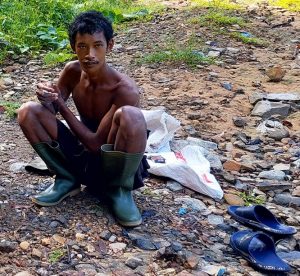
As the topic of jungle footwear is quite an extensive one, it was split up into three articles. The first part covered general requirements, including going barefoot and wearing sandals. The second part covered shoes, including barefoot shoes, rubber shoes, and trail-running sneakers. And this third part will concentrate on jungle boots, gumboots, and leech-proof and waterproof socks. Jungle boots Dedicated jungle boots are different from conventional hiking boots. They have seepage holes along both sides, and a softer rubber sole for good traction and grip in water. There is also no waterproof liner inside the boot, preventing the bathtub…
Jungle footwear for Southeast Asia, Part 2
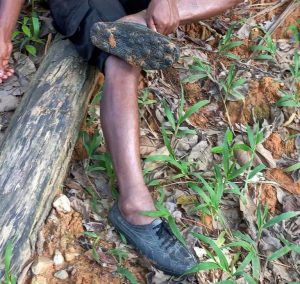
As the topic of jungle footwear is quite an extensive one, it was split up into three articles. The first part covered general requirements, including going barefoot and wearing sandals. This second part covers shoes, including barefoot shoes, rubber shoes, and trail-running sneakers. And the third part will concentrate on jungle boots, gumboots, and leech-proof and waterproof socks. Barefoot shoes The first impression of the suitability of barefoot shoes as jungle footwear is excellent. Their thread seems to be up to the mark; it protects against thorns, allows water to flow in and out easily, and is lightweight. This initial…

Jungle footwear for Southeast Asia, Part 1
In the remaining jungles of Southeast Asia, suitable footwear is of utmost importance for local people and outsiders. The rainforest environment has specific requirements that differ considerably from those of other biomes. However, the suggested footwear not only depends on the environment but also must consider factors such as availability, affordability, and specific requirements for certain activities. As the topic of jungle footwear is quite an extensive one, it was split up into three articles. This first part covers general requirements, including going barefoot and wearing sandals. The second part will cover shoes, including barefoot shoes, rubber shoes, and trail-running…

Water Vine Tetracera alnifolia: Drinkable Sap in the Savanna
Tetracera alnifolia (Dilleniaceae); Synonym T. alnifolia subsp. alnifolia; Common names Kiziazi, Nziazi, Nziazia (Kongo), Liane à eau (Fr.), Water tree Description A woody creeper up to 20 m long and up to 10 cm. in diameter. Leaves are 4 – 16 cm long and 3 – 8 cm wide, often recurved, on a petiole up to 2 cm long. Flowers are white in large, terminal panicles 15 – 25 cm long. The oval fruits are dull red and woody. Seeds are few, shiny black, with an orange aril, enclosing the seed. There are four other species of Tetracera present in…
Mammea africana – Sweet Fibrous Fruit & Oily Seeds: Key Bush Food in Central Africa
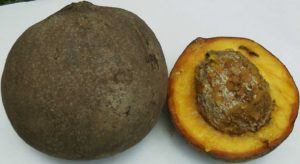
Common names are Mafambu, Dimbu dingi (dingi = gum, resin, incense) (Kongo), Bokodji (Lingala), African mammee apple, Oboto or Djimbo (commerce). Scientific name: Mammea africana. Description A large forest tree up to 45 m tall with a straight, cylindrical trunk and scaly brown bark. The inner bark yields a yellowish resin. Leaves are opposite, glossy, 9 – 35 cm long and 3 – 13 cm wide. Young leaves are copper-red. The flowers are produced in leaf axils and are either bisexual or male. Bisexual flowers are solitary, white, and up to 2.5 cm long. Male flowers are borne in clusters…

Marang fruits in Southeast-Asian Rainforests
There are several local names for the tree and fruits of Artocarpus odoratissimus. In English, it is simply called ‘Marang’, which is based on the Philippines’ common name for this fruit. Originally endemic to the region around Mindanao, Sarawak, Kalimantan, and Palawan, it is nowadays cultivated in many Southeast-Asian countries, and it can grow wild in areas 15 degrees north and south of the equator. Marangs are related to Breadfruits (Artocarpus altilis) and Jackfruits (Artocarpus heterophyllus); all three of them belong to the same genera Artocarpus. Size wise they are right in the middle between smaller breadfruits and larger jackfruits.…

Taste of Gaur meat at Kaeng Krachan rainforest
We were on a weeklong trail through the Kaeng Krachan rainforest, near Hua Hin in Thailand, when we tasted Gaur meat. Together with two National Park (NP) rangers, we came across a freshly died Gaur heifer. This Gaur (Bos gaurus) was poached, as there was a small-caliber rifle shot visible in the upper throat area. And the heifer died most probably of starvation, as the whole throat was full of necrosis. Gaur cow and bull at Khao Kheow Open Zoo near Si Racha, Thailand. Poachers at Kaeng Krachan The location where we found the animal was about 5 km from…