
Crustacean
Terrestrial and freshwater crustaceans at Siberut Island
In the fields and forests of Siberut Island, various land crabs can be found, and the inland waters contain other freshwater crustaceans, like prawns and shrimps. On the coast and in the sea, there lives a far larger variety of crustacean species. Terrestrial crabs The following land crab species occur in Sumatra: With high likelihood, all four species also occur on Siberut. The Pacific Land Crab (Tuerkayana hirtipes) has been explicitly confirmed, and Turkana magnum, the Giant Orange-legged crab, is the famous ‘Anggau’ crab of Mentawai. These crabs are also recorded at Sipora, the island just south of Siberut. The…

White-spotted hermit crabs
While beachcombing in the lagoons of Zanzibar, we found a White-spotted hermit crab (Dardanus megistos) housing itself in a Fusinus sp. shell. These crabs are exceptionally beautiful, and I therefore want to present them in this article. Description of White-spotted hermit crabs Giant spotted hermit crabs are easily recognizable by their coloration. They have bright red and orange bodies and legs with small black-ringed white spots. The body and legs are covered in light brown bristles. They have two sets of antennae: one short pair in the middle with sensory organs on it and the other a white pair that…

Catching mud crabs at Koh Lanta
Mud crabs are common in mangrove areas in Thailand. They are primarily caught in crab pots for commercial purposes. However, my Urak Lawoi friends and I specialized in digging up and catching these crabs by hand. Who are Urak Lawoi people? Ulak Lawoi is one of the three sea-gypsy tribes in Thailand bordering the Andaman Sea. The Northernmost tribes around the Ranong area and into Myanmar are called Moken. From that area down to the north of Phuket, the Moklen people reside, and from Phuket down to Langkawi Island in Malaysia, the Urak Lawoi people live. Urak Lawois changed their…

Catching Ghost crabs by digging
Ghost crabs (genus Ocypode) comprise 22 different species, and they are commonly also called `Sand crabs.` The scientific name Ocypode has Greek origin and means swift-footed. Ghost crabs are semi-terrestrial crabs that dig deep burrows in intertidal zones of sand. They can be found in all subtropical and tropical regions worldwide. Ghost crab comes from their swift movements over the sand during darkness and their whitish-colored claws. Appearance of Ghost crabs The following three characteristics characterize all species of Ghost crabs: Additionally, Ghost crabs can adapt their whole body coloring to the surrounding sand colors and the time of the day,…

Three-spot swimming crabs on surf-beaten sandy beaches
Description of the crab species Three-spot swimming crabs (Ovalipes trimaculatus) have a rounded triangular carapace with five legs on either side. The tips of the back pair of legs are flattened into paddles for better maneuvering in the water. Adorned with rusty-brown flecks, the carapace features three larger markings that curiously resemble a ‘sad’ face. Its nippers are equipped with ridges and sharp cutting teeth, ready for action. Uses of these crabs These Three-spot swimming crabs are widely sought after as fishing bait along the Namibian coastline. Anglers target the Westcoast Steenbras using this bait, while certain shark species, such…

How to Catch Beach Crabs with a simple snare
An advanced, industrially manufactured crab snare usually consists of a bait cage with about six wire snares around it. This setup is used on a fishing line and rod, or is just hung down from a boat to the sea bottom. This type of crab snaring is shown in this article. On tropical beaches, locals use a by far simpler set-up. They just collect a string from the flotsam on the beach, form a snare, and add a wooden stick. Beach flotsam provides the materials Beach flotsam will be found on nearly any beach in Southeast Asia, as the plastic pollution…

The Ultimate Survival Snack: Foraging and Preparing Ricefield Shrimp
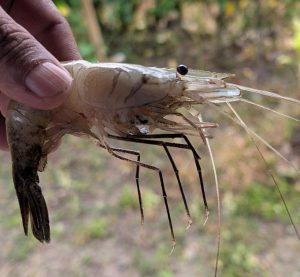
Freshwater prawns, specifically Macrobrachium lanchesteri—locally known as Goong foi in Thailand—are one of the most efficient “survival foods” you can find in the wild. While they might be small, these translucent crustaceans are abundant in nearly every permanent water body across Southeast Asia, particularly in rice paddies. For the bushcrafter or survivalist, they represent a high-protein, low-effort meal that can be harvested with minimal gear. How to Catch Your Meal The beauty of ricefield shrimp is that you don’t need expensive lures or heavy rods. In traditional Thai foraging, two primary methods stand out: Once caught, the shrimp are typically…