
Sea-Gypsies
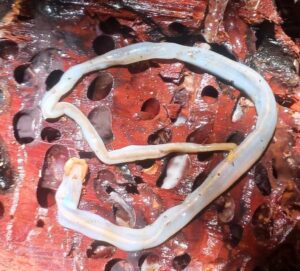
Harvesting Shipworms in a Thai Mangrove Forest
Edible shipworms, in this case Bactronophorus thoracites, are also known as Naked clams, Priyang talay (เพรียงทะเล), and various other common names throughout the region where they occur. They bore into wood immersed in salt water and are a major hassle for wooden ships, piers, and docks. Besides their habit of boring into wood, they are well-liked to be eaten by most Indigenous people within their distribution range in the Asia-Pacific, especially in Southeast Asia. What are shipworms? Shipworms belong to the phylum Mollusca and the class Bivalvia. Their two small shells only circumvent their anterior end and are used to…

Bottom fish traps of the Urak Lawoi people
The following information was gathered from a Urak Lawoi man who has lived in the Rawai Beach Sea-Gypsy Village for 27 years. He was 57 years old and only had one tooth (incisor) left in the middle of his upper jaw. This friendly person spoke good English, was a fisherman, and had his longtail boat. He has caught two Black Marlins in his life. One was 27 kg heavy, and the other one was 41 kg. I questioned him about the Bottom fish traps being built everywhere on Rawai Beach. His information was recorded in the following. If somebody is…

Catching Octopuses by Sea-Gypsies
Sea-Gypsies – Urak Lawoi, Moklen, and Moken – traditionally catch octopuses along the Andaman Sea’s rocky shores, which they call โวยวาย in the Thai language. Using a metal skewer and baited bamboo stick, they locate octopuses in holes with foam or clean pebbles. Patiently baiting them, they impale octopuses with the metal skewer, preventing contact to avoid their tentacles’ suction. This traditional method includes finding, baiting, and safely handling octopuses for sustenance. General Catching octopuses is a common pastime for Sea-Gypsies. These tribes migrated from the Myanmar archipelago on the Andaman Sea towards Thailand. The Thai government settled most of…