
Bivalves
Mollusks in the inland waters of Siberut Island
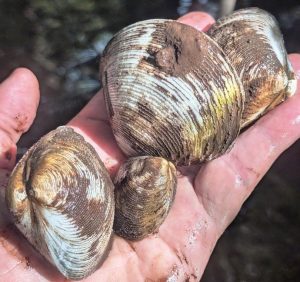
In rivers, coastal zones, and mangrove forests, a diverse array of bivalve and gastropod species is collected and utilized for food. Bivalvia species Freshwater streams River clams (Batissa violacea) occur in large quantities in the lower zones of all slow-flowing rivers with muddy bottom on Siberut Island. These clams are large, thick-shelled bivalves with a dark purplish-brown hue. Collecting these bivalves is always done by a group of women who support each other. Often, two of them will share a canoe, and each one has its own five-meter-long bamboo stick. They ram this stick from the dugout canoe into the…

Collecting Pipi clams at Rawai Beach
Pipi clams (Donax deltoides) are also known as Surf clams, Sandy Donax, and a wide range of other common names. In Thailand, they can be found on most beaches in the Gulf of Thailand and the Andaman Sea. They are called ‘Surf clams’ because they prefer sandy beaches with good surf. Description and Distribution These mollusks are small edible saltwater clams with shell widths between 15 and 25mm / 0.6 and 1 ’’. The outer shell surface is smooth with distinctive growth rings. The shells are robust and rugged, which has led to many shell middens on Australian coasts. Their…

Beachcombing for Vongole clams in Northern Italy
Vongole clams (Ruditapes philippinarum) are the main bivalve species collected from the flat beaches of the Adriatic Sea in Northern Italy. Introduced to aquaculture facilities in the lagoon of Venice in 1983, they are now considered an invasive species, having often replaced the endemic clam Ruditapes decussate. However, despite being invasive, 95% of all Italian clam production comes from these lagoons, and 90% of the entire European harvest of clams is also sourced from there. What is the correct name for vongole clams? Due to their widespread distribution from cool to semi-tropical and tropical habitats in Asia, Europe, and the Americas,…

Black mussels at the Namibian coastline
Black mussels in Namibia include the following species: Ribbed mussel (Aulacomya atra), Black mussel (Choromytilus meridionalis), Mediterranean mussel (Mytilus galloprovincialis), Brown mussel (Perna perna) and Bisexual mussel (Semimytilus algosus). In one of my former articles on this website, I discussed also White mussels on the Namibian coastline. Description Black mussels are black or brown with a tinge of green or blue. They are enclosed by a pair of shell valves linked by an elastic ligament. The flesh of females is orange, and that of males is off-white. They are not very mobile and attach themselves with a ‘beard’ of byssal…

White mussels at the Namibian coastline
Description of White mussels White mussels (Donax serra) are wedge-shaped bivalves with coarse ridges across the posterior. The inner surface is smooth and has a purple tinge. It has a short, stubby inhalant and a long, thin exhalant siphon. It reaches a size of about 88mm (approximately at age 5). They can be found on wave-exposed sandy beaches. Please find further information at the following link. Black mussels were described on this website under this link. Use of White Mussels The white mussel, or wedge clam, is predominantly used as bait for fishing along the Namibian coastline. Their feet can…

Catching Razor Clams with Quicklime at Don Hoi Lot, Thailand
A mudflat full of razor clams ‘Don Hoi Lot’ is a mudflat in the Thai Province of Samut Songkhram with a size of about 15 km2 (about 9 square miles). ‘Don’ means ‘mudflat’ in English. ‘Hoi’ means ‘clam’, and ‘Hoi Lot’ are razor clams (Solen regulars). This razor clam species is endemic to the Gulf of Thailand, and the largest concentration of this species of clams exists at Don Hoi Lot. An extensive description of this mudflat and its razor clams can be found here. Bangkokians like to catch some of them on a family outing and have a feast…