
Birds
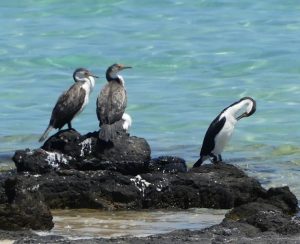
Traditional Malgana Food: Pied Cormorant Eggs from Shark Bay
The Malgana Aborigines in Shark Bay are one of the coastal Aboriginal tribes in Western Australia. One of their traditional food sources is the eggs of Pied cormorants (Phalacrocorax varius). Still nowadays, this Aboriginal community has the right to collect these cormorant eggs. As the community is small, with only a few members relishing this food source, and cormorants are plentiful, there is no threat to the Pied cormorant population. Description and distribution Pied cormorants prefer shallow seagrass beds to catch their favorite prey, which are slow-moving leatherjackets. Often, two of them are swimming side by side. And it is…

Green-billed Malkoha bird on the spit
The Green-billed Malkoha is a common bird in Vietnam’s semi-deciduous tropical forests. An expedition led to the capture of one who was cooked for lunch. This and other species are often hunted by villagers supplementing their diet with this and other forest harvests. The bird, roasted and seasoned with lemongrass, resembled the taste of free-range chicken. Description of Green-billed Malkoha bird Green-billed Malkohas (Phaenicophaeus tristis) are a species of non-parasitic cuckoos. According to the Cornell Lab of Ornithology, they are widespread, and their Red List category is ‘Least Concern.’ A description of this species can be found at this link.…

Finding direction with Buffalo weaver nests
The Red-billed buffalo weaver (Bubalornis niger) is a common bird in parts of Southern Africa. These birds have the largest body size of all weavers and are common in dry woodland and savannas. Buffalo weavers have a peculiar trait when getting used to humans: they will try to stay around settlements and even vacate an area if these humans leave. Finding direction West to North-West Red-billed buffalo weavers usually build their nests on large trees on the North-Western side. These trees are often standing solitary, so the nests can be seen from a reasonable distance away. With this indication, it…

Cormorant fishing at Li Jiang River in China
Cormorant fishing is an ancient art that dates back at least 1300 years. Today, it is only practiced in the southwestern provinces of China. However, some fishermen are attempting to revive this fishing technique for tourists in water villages around the Shanghai and Suzhou areas. This technique is so iconic in China that it is even depicted on the 20 Yuan note. The cormorant species predominantly used in China for fishing is the Black cormorant (Phalacrocorax carbo). One of the most popular locations for cormorant fishing is the Li Jiang River, stretching from Guilin to Yangshuo. This river is a…

How Double-Banded Sandgrouse Reveal Permanent Water in the African Savanna
The Double-banded Sandgrouse (Pterocles bicinctus) is commonly and colloquially called by its abbreviation ‘DBSG’ in Southern Africa. Its main distribution area is the savanna biome, especially Mopani Bushveld. There are three more species of sandgrouses in Southern Africa, all with distinct plumages but, for us, different drinking times for water. Specific behaviors of Double-banded Sandgrouses DBSGs prefer to stay in areas with short, seeding grasses, speckled with bushes, or inother relatively open areas. They try to hide from their main predator, the Peregrine Falcon (Falco peregrinus), by camouflaging against his eyesight. Their color, shape, and movements are adapted for optimal…