In the fields and forests of Siberut Island, various land crabs can be found, and the inland waters contain other freshwater crustaceans, like prawns and shrimps. On the coast and in the sea, there lives a far larger variety of crustacean species.
Terrestrial crabs
The following land crab species occur in Sumatra:
- Cardisoma carnifex,
- Gecarcoidea humei,
- Tuerkayana hirtipes, and
- Tuerkayana magnum.
With high likelihood, all four species also occur on Siberut. The Pacific Land Crab (Tuerkayana hirtipes) has been explicitly confirmed, and Turkana magnum, the Giant Orange-legged crab, is the famous ‘Anggau’ crab of Mentawai. These crabs are also recorded at Sipora, the island just south of Siberut.
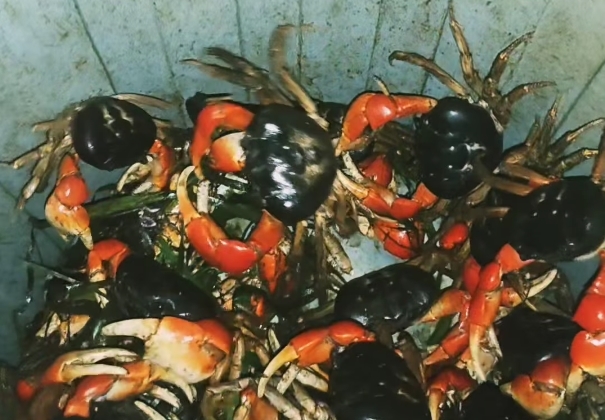
The crab, locally known as ‘Anggau’, has a black carapace, grey legs, and deep red pincers. They live on small islets south of Siberut. From July to August each year, female Anggau crabs will return to the sea to deposit their eggs. During that season, these terrestrial crabs are caught in the evening with the help of torchlights in the grassy undergrowth and under old tree trunks. In former times, 2 m (6 ft) long wooden torches and bamboo tongs were used for collecting them.
Other – unspecified – species of terrestrial crabs in the forests are described as ‘very small’ and caught with the help of small landing nets.
Crabs in fresh- and brackish waters
Mangrove swimming crab (Thalamita crenata).
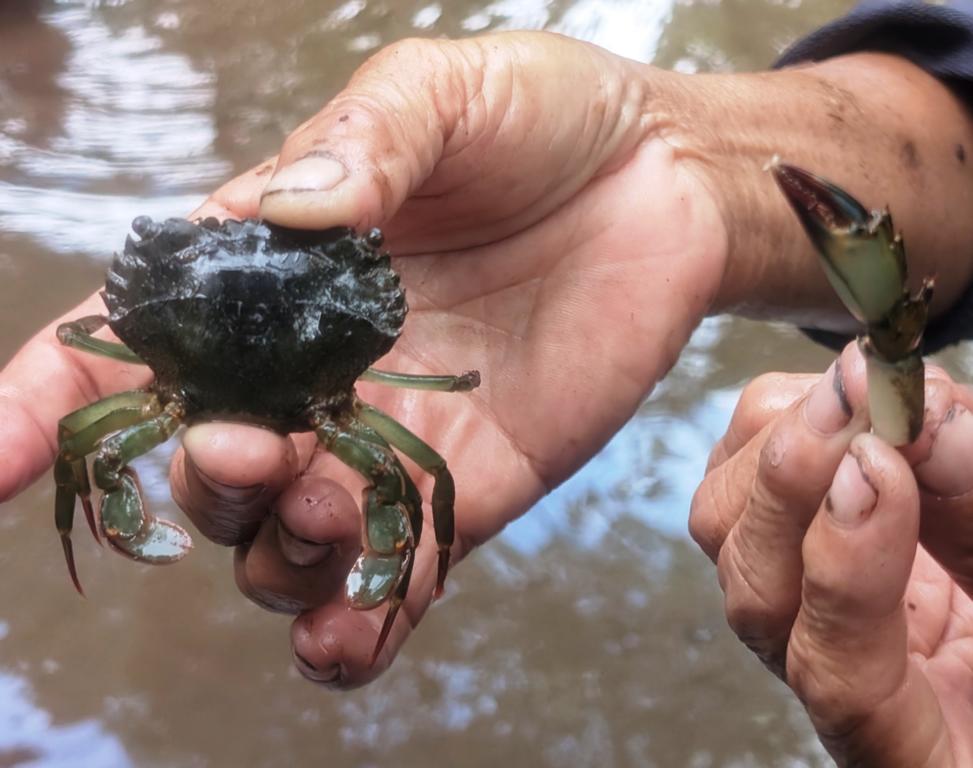
Mangrove swimming crabs (called Laguk in Mentawai) are widely distributed in the mangrove forests of Katurai Bay. When Mentawai women are collecting mollusks on the muddy mangrove forest floor, they frequently encounter – and get bitten by – these swimming crabs. This also happened in the picture above. A second woman around was helping to break off the pincer arm and open the biting claw.
A systematic study of the whole order of freshwater and brackish-water crabs occurring on Siberut Island is not available (Nov 2025).
Prawns and shrimps
The following freshwater prawns and shrimp are caught and consumed by the people around Muntei.
Giant freshwater prawns
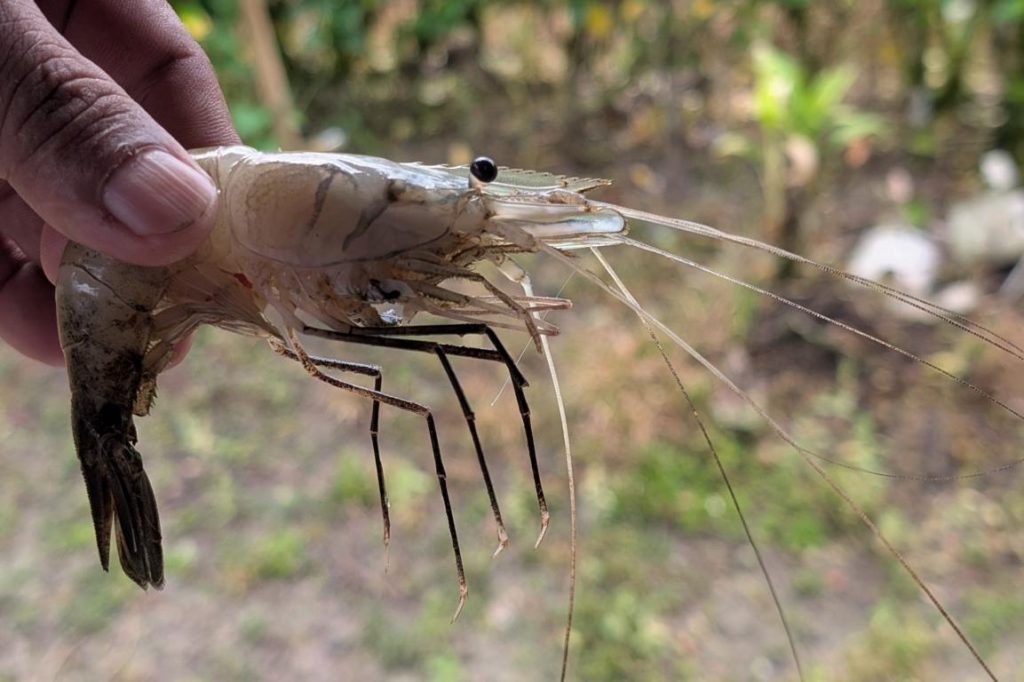
The picture above shows a Giant freshwater prawn with the typical coloration found at Siberut. These are dark tails and legs. This female Giant freshwater prawn specimen lacks the two long pincers, commonly found in male species. The Mentawai call this species ‘Siloloinan’.
Greasyback prawns
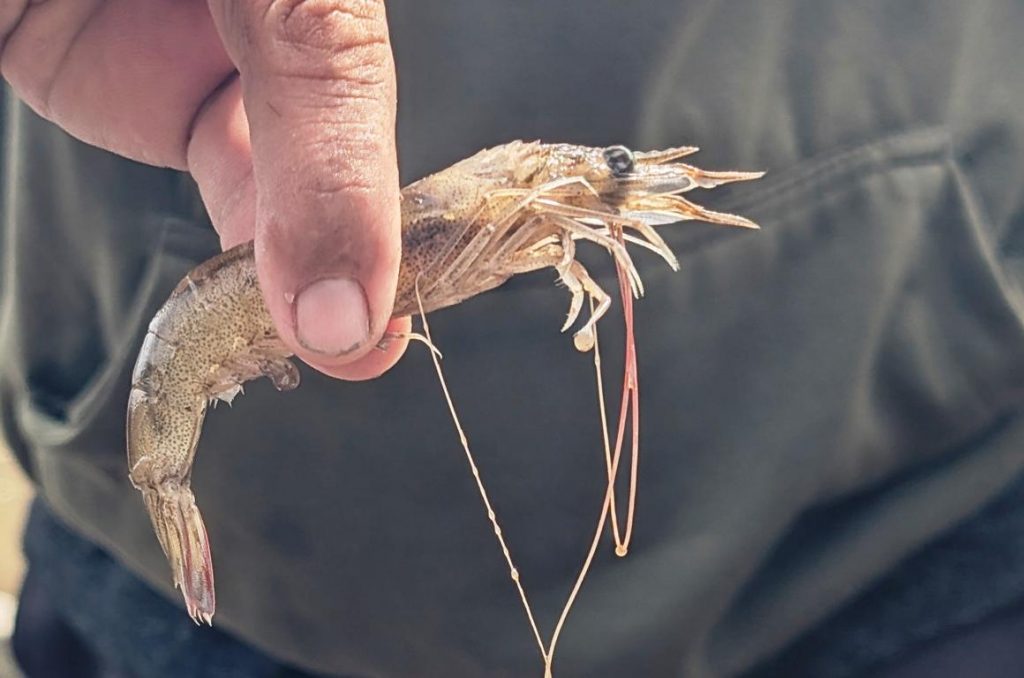
These prawns are easy to recognize by the multitude of tiny dark spots all over their exoskeleton. They lack the long claws of the Giant freshwater prawns, and are called ‘Tutu’ in Mentawai.
Glass shrimps
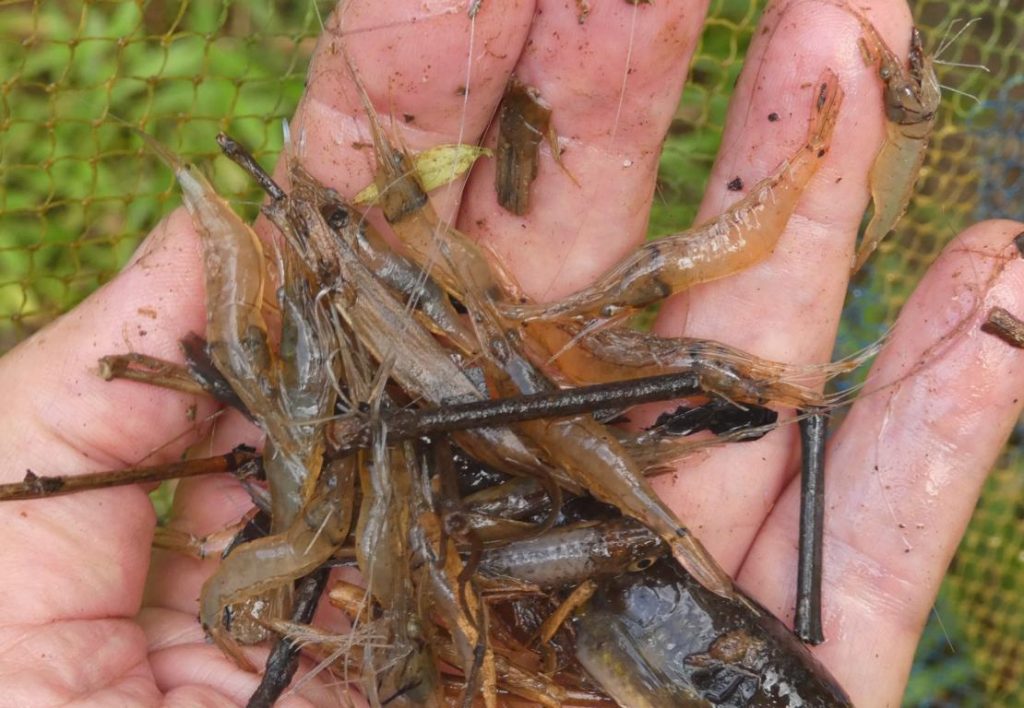
These shrimps are also called Ricefield prawns, although this species is clearly a shrimp and not a prawn. They have two pairs of foreleg pincers. Prawns, on the other hand, show three pairs of pincers.
Besides these three species, two more species occur, the Mangrove prawns (Palaemon concinnus), and the Rough river prawns (Macrobrachium equidens)
Lessons learned about Terrestrial and freshwater crustaceans at Siberut Island:
- Terrestrial crabs: only the Giant orange-legged crab is a significant source of protein for Mentawai people.
- In areas covered by mangroves, the Mangrove swimming crab can be found abundantly.
- Freshwater prawns and shrimps are the main catch when women hand-net fish.
.