
Seeds & Nuts
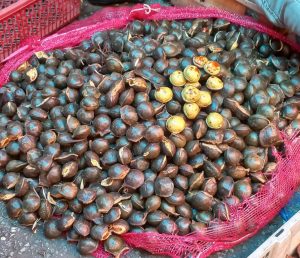
Jengkol seeds
Jengkol (Archidendron jiringa) is a tropical tree that grows up to 20 meters high in the rainforests of Southeast Asia. The seeds are mainly eaten in Indonesia, but also in Malaysia, Thailand, Cambodia, and Myanmar. These seeds are called stink bean or dog fruit in English, which outlines their smell. Description and comments Archidendron pauciflorum is closely related to Archidendron jiringa. They are often considered synonyms or variants of the same species, depending on the taxonomic source. However, some botanists differentiate between them based on morphology, geographical distribution, and local usage. Which further blurs the picture of which species is…
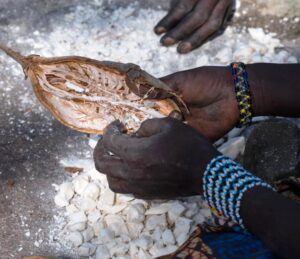
Baobab seeds and pulp porridge
Baobab seeds and vine roots are staple foods for remotely living Hadza in Tanzania. This article already presented the collection and preparation of vine roots. In the following, we will discuss how to prepare Baobab seeds and their surrounding dry pulp into Baobab seed porridge, which the Hadza people commonly eat. Baobab pods and their content Baobab trees (Adansonia digitata) are widely distributed in Yaeda South in Tanzania, where Hadza people live traditionally. Their fruits are hairy pods containing hard seeds cushioned by a white, spongy, dry pulp. In June 2024, a baobab tree was full of ripe pods, which…

Rattan Leaf Stalks: The Mentawai Coconut Grater
Rattan leaf stalks have been, since immortal times, the tools with which Mentawai people have been grating coconuts. These long-lasting tools grate the coconuts into the required size of flakes. When worn out or broken, a new one will be found and cut in the surrounding forest within half an hour. Interestingly, no reference can be found in literature and the internet for using these leaf stalks for grating coconuts, even not here. Which species of rattan is used for grating stalks? The following characteristics of the preferred type of rattan were observed: Due to a recognizable nose-shaped leaf sheath…

Wild Karuka and another pandanus fruit species
The Pandanaceae botanical family comprises the following six species in Papua New Guinea: ‘Karuka’ and ‘Marita’ were already discussed on this website in two former articles. ‘Karuka’, see here, and ‘Marita’ see there. In the following, ‘Wild Karuka’ and Pandanus antaresensis will be presented. Wild Karuka (Pandanus brosimos) Tok Pisin: Karuka The wild Karuka plant. The wild Karuka plant looks a lot like the cultivated Karuka. The leaves are bigger and normally they point straight up instead of bending over at the top. The trunk of the tree is straight like a palm, but it can have some branches near…

Karuka – cultivated pandanus fruits and nuts
Tok Pisin: Karuka Scientific name: Pandanus jiulianettii Two species of pandanus are commonly used for the nuts that are eaten. They are Karuka (Pandanus jiulianettii Martelli) and wild Karuka (Pandanus brosimos Merr & Perry). At least 3 other species of pandanus are used occasionally in Papua New Guinea for edible nuts and marita pandanus is used for the long red fruits. The leaves of many other pandanus species are used for rain capes, sleeping mats, canoe sails etc. This article is about cultivated Karuka. The Karuka plant The Karuka tree is a tall palm like tree with a straight trunk…

Swiss pine cones and their uses
The Swiss pine (Pinus cembra) goes by different names in German-speaking countries, such as ‘Zirbe,’ ‘Arve,’ ‘Arolla pine,’ or ‘Austrian stone pine.’ For generations, people have used the nuts of this particular pine species as food during the winter months, especially by farmers and hunters. Additionally, the young cones have been and continue to be used to make a cold extract for clear country liquor, Pine booze or ‘Zirben-Schnaps,’ or ‘Zirberl’ in Austria. Description and distribution of Pinus cembra Swiss pines, also known as Austrian stone pines, earned their name due to their preference for growing in high alpine locations,…

Use of Tsamma melons in Namibia
Tsamma melons are the original progenitors of watermelons. Historical records indicate that these melons were already under cultivation in the Nile Valley as far back as 2000 BC. In contemporary times, Tsamma melons continue to be utilized for their oil in the cosmetic industry. For some people, they still serve as both sustenance and a source of hydration. Species of wild melons in Namibia In Namibia, the following species of Tsamma melons are found: According to Mrs. Mienkie Welman, a researcher at the National Herbarium in Pretoria, the perennial Citrullus ecirrhosus lacks tendrils and is confined to Namibia and the…

Nara melons: Bread of the Namib desert
Nara melons were, in former times, the only food Topnaar people had available for four months (Jan – April) a year. They used conserved fruit pulp and seeds to supplement other food sources for the rest of the year. They could buy additional food sources from income generated by selling Nara seeds. So, all in all, the life of the Topnaar people depended and still depended on Nara fruits, small livestock, and supplement income. As an interesting matter of fact, it was archeologically proven that the original inhabitants of the land already ate Nara seeds at least 8000 years ago.…

Manketti (or: Mongongo) nuts
Manketti nuts are a staple food for a variety of people within its distribution range. And there is a strict division of naming them. Khoi-san people (Bushmen) call them ‘Manketti’, whereas Kavango people (Bantus) call them ‘Mongongo’. Both names denominate the same trees and nuts. Whereas Kavangos (the Kavango river and the O’kavango swamps were named after them) live mainly from Mahangu (Pearl millet) porridge, Khoi-sans rely for 8 months a year heavily on Manketti nuts for food. The Manketti tree (Schinziophyton rautanenii) belongs to the family of Euphorbiacea. There is however no milky sap or poison in any parts,…

Cashew apples and -nuts in Goa, India
Cashew trees (Anacardium occidentale) are native to areas around Northeastern Brazil. Portuguese colonists brought them around 1560 to Goa, India, from where they spread to Southeast Asia and Africa. Therefore, cashew products already have a long history in Goa and are considered a local food item. Currently, Cote d’Ivoire, India, and Vietnam are the primary producers of cashew nuts. In 2020, India produced 18% of the world’s cashew nuts. Cashew harvesting season is in Goa from about March to mid-May each year. The cashew fruit, as a whole, consists of the cashew apple and the cashew nut. The cashew apple…

Natal Mahogany seed milk and its preparation
Natal Mahogany (Trichilia emetica) trees have got a dense canopy of dark green, glossy leaves, and a round outer shape of the tree silhouette. They preferably grow in moist places and riparian forests along drainage lines. Natal Mahogany is easy to spot amongst other trees due to its dark green and densely foliated roundish shape. Natal Mahogany seeds During February the seeds are ripening and will be released from the pods. The seed is yellowish-greenish in color with an oil content of about 68% and surrounded by a red aril with a black spot, which has an oil content between…