In rivers, coastal zones, and mangrove forests, a diverse array of bivalve and gastropod species is collected and utilized for food.
Bivalvia species
Freshwater streams
River clams (Batissa violacea) occur in large quantities in the lower zones of all slow-flowing rivers with muddy bottom on Siberut Island. These clams are large, thick-shelled bivalves with a dark purplish-brown hue.
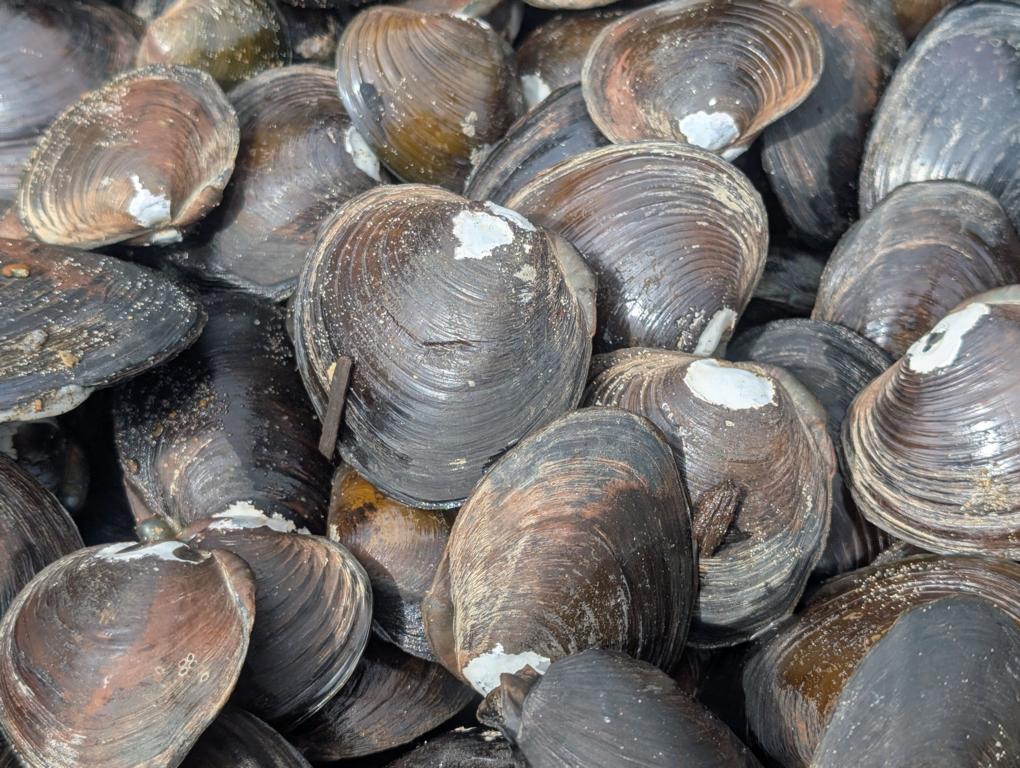
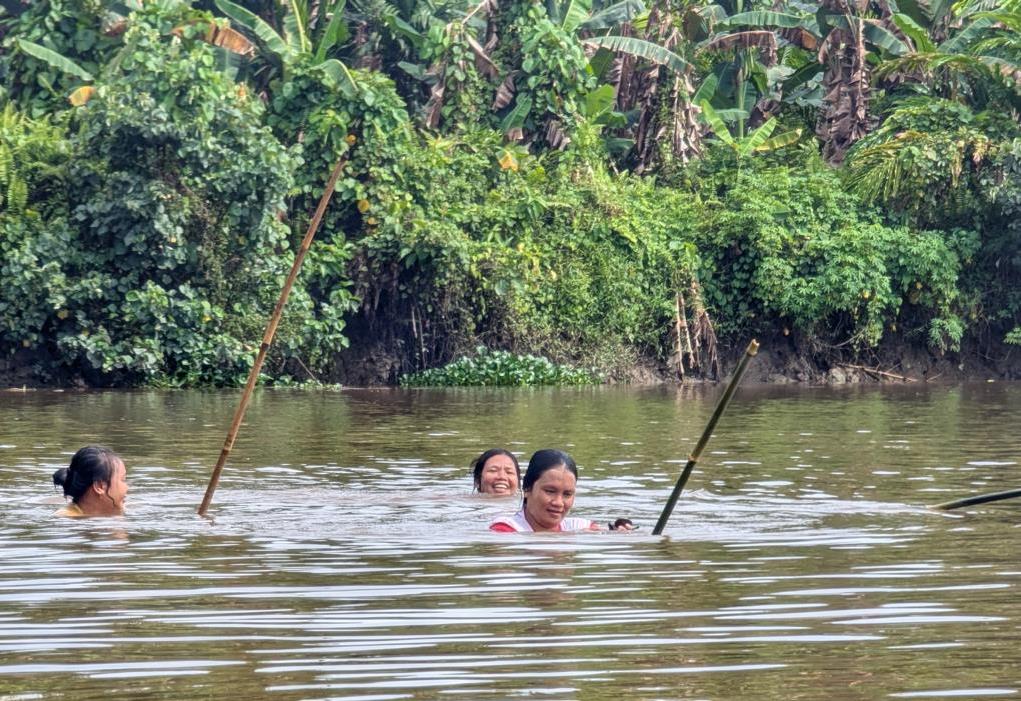
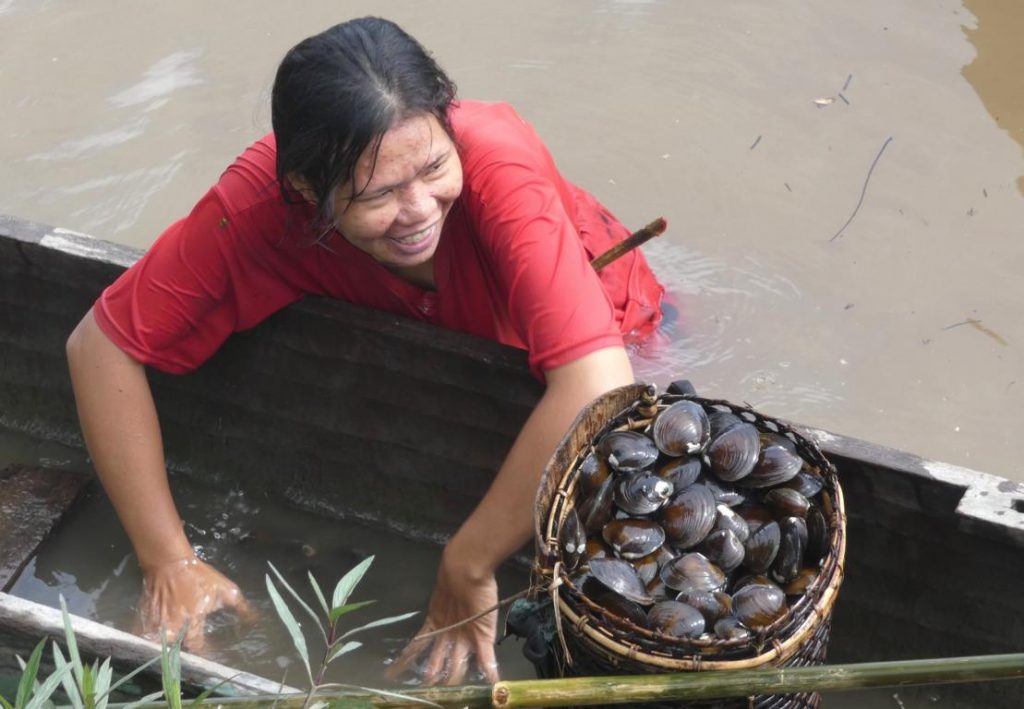
Collecting these bivalves is always done by a group of women who support each other. Often, two of them will share a canoe, and each one has its own five-meter-long bamboo stick. They ram this stick from the dugout canoe into the muddy river bottom and dive down along it to the bottom. Diving depth is around three meters. There, they feel the clams in the mud and collect them. After about six hours of diving, they collect, on average, a half-canoe full of River clams.
Another bivalve, ‘Toek’ in the Mentawai language, the Edible Shipworm (Bactronophorus thoracites), is highly relished. It is semi-cultured, as sections of Tumung tree (Campnosperma auriculatum) logs are deliberately placed and left to rot in brackish water. Shipworms will soon infest these logs. They have a taste similar to oysters and are typically eaten raw. Just the two small shells and two calcareous spiny pallets at the ventral end will be spat out.
Mangrove areas
In the mangrove forests of Katurai Bay, groups of women occasionally go on clam-collecting trips. There, they search in three different ecosystems for certain types of mollusks. In addition to the main species, clams, oysters, nerites, and whelks are also collected.
Menggu clams at muddy batches surrounded by mangrove stilt roots
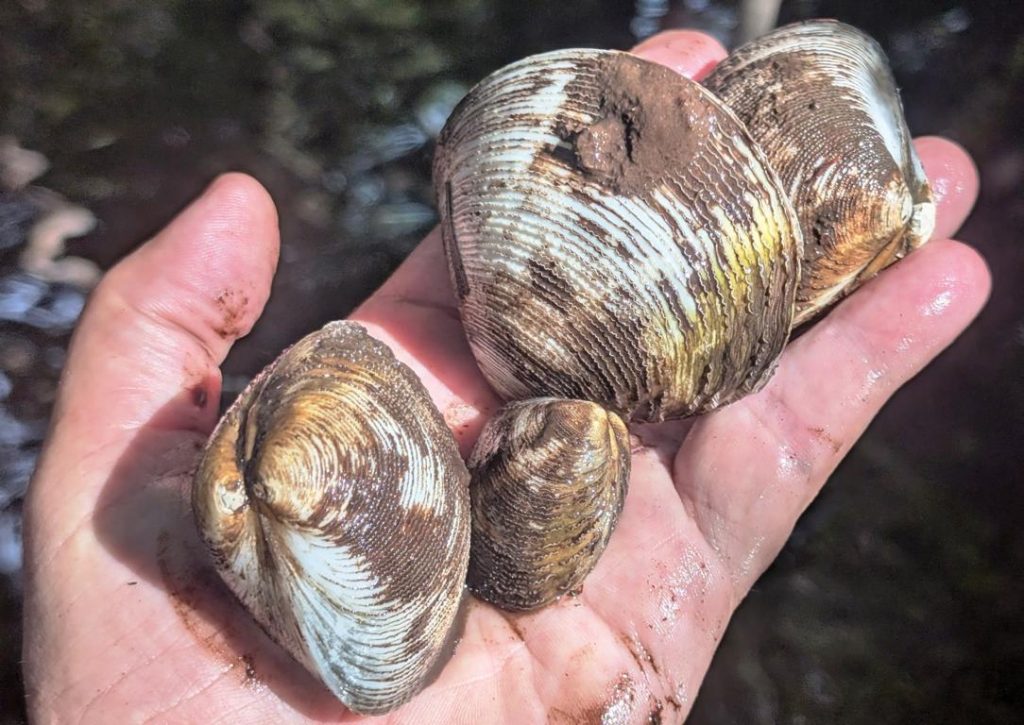
In this specific micro-ecosystem, Mangrove clams (Geloina expansa) and Bengali Geloina (G. bengalensis) are collected. Formerly, G. erosa was also regarded as a separate species living in this environment, but was subsequently synonymized with G. expansa.
In the available scientific literature about these clams, they are called ‘Meggu’. Which I cannot support, as all three women in our collecting party, the boatsman and the translator, pronounced them clearly as ‘Menggu’. I therefore stick with the Mentawai term Menggu for this group of clams.
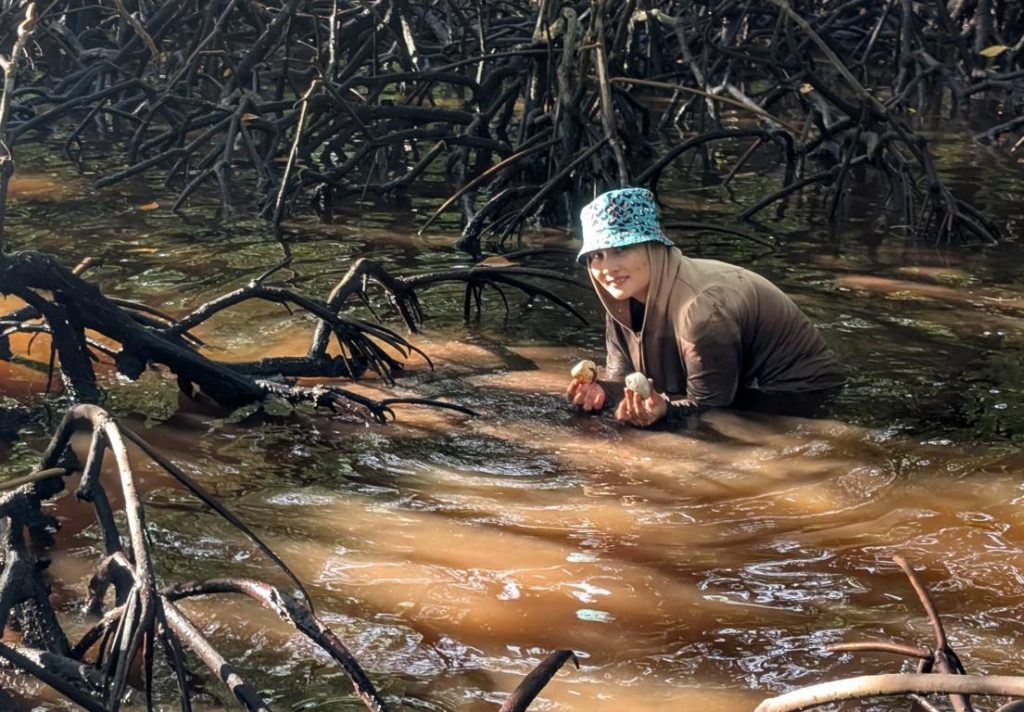
Menggu clams are mainly found in small, muddy water patches surrounded by Rhizophora mangrove stilt roots. Adult clams are about 7 cm, or 2.8’’, wide across the shell, but some of them reach about 10 cm, or 4’’. They prefer a water depth of about 50 cm (1.6 feet) at low tide, where they are stuck in the mud. The majority – about 2/3 – of their shell is buried within the mud, but a small portion sticks out into the water.
They are located by kneeling in the water and ploughing a hand through the muddy surface. This way, they can be located and collected. Menggu clams are never found near the wooden roots, but always in the mud away from these roots.
These clams are very adaptable to fluctuating water levels and can undergo aerial respiration and draw water from subterranean sources during low tide.
Sikoira clams next to mangrove stilt roots in deep water
In hip-deep water at low tide, a specific Venus clam species is found around the stilt roots of mangroves. When searching for them, it is done by probing the bottom surface around the roots with feet and toes. The Mentawai caught them with their toes, but I had to stretch down into the muddy water to get a grip on them.
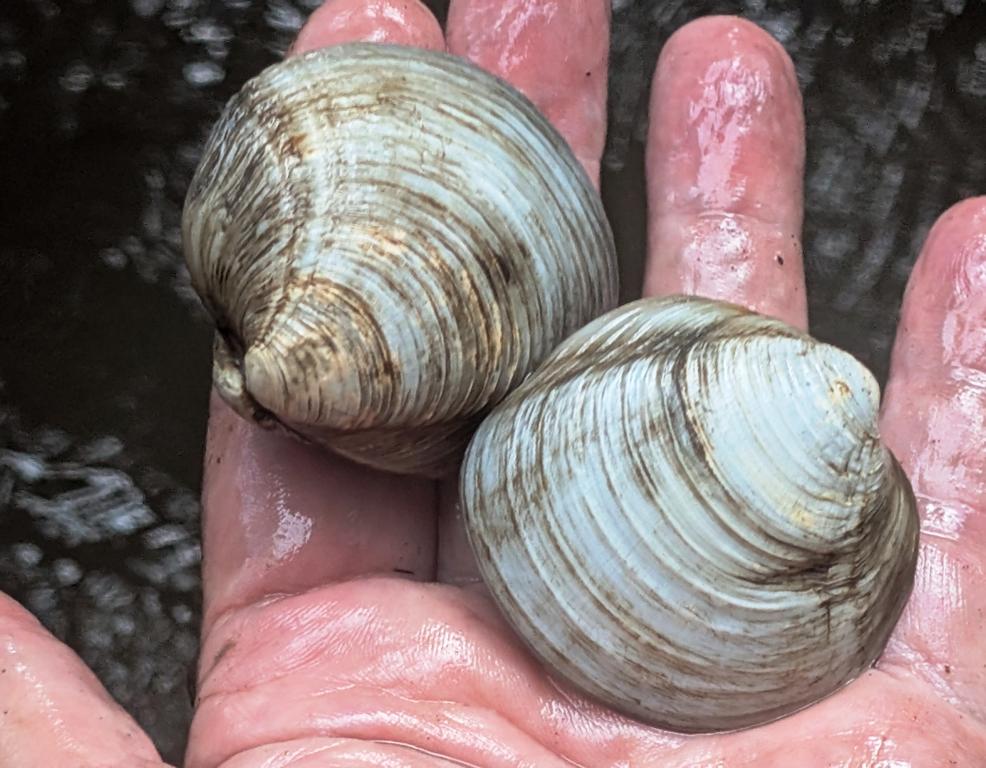
Adult clams of this species, called Sikoira in the Mentawai language, are slightly smaller than Menggu clams, and measure around 5 cm, or 2’’, in width. They show a whiter shell coloration than Menggu clams.
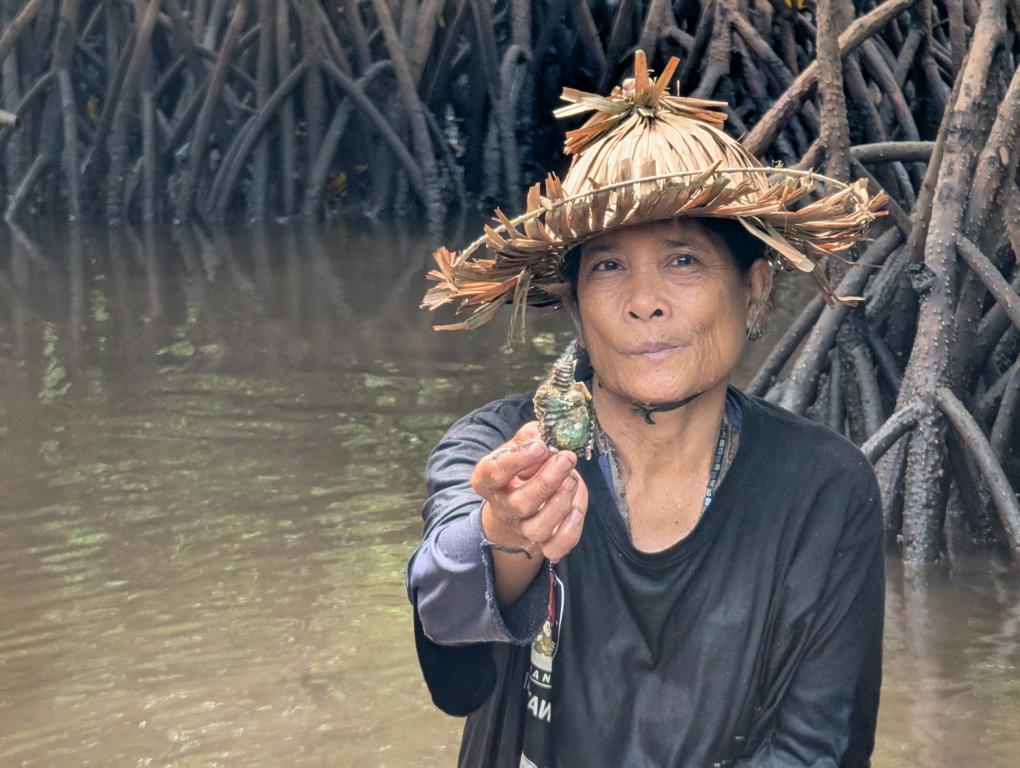
Other species at open stretches of shallow intertidal waters
The third micro-ecosystem within the mangrove forests for collecting clams is the intertidal flats. Water height fluctuations are high. Whereas during low tide the water depth to the muddy bottom was just about 30 cm (1 foot), it increased quickly as the tide rose.
In these shallow waters, we collected two clam species, named Takkai and Bizilet by the locals. Both were considerably smaller than Menggu or Sikoira clams. The shell width from both was in the range of about 3 cm, or about 1 ¼’’ (that is not an exact conversion, but it is sufficiently precise to imagine the size of the shells).

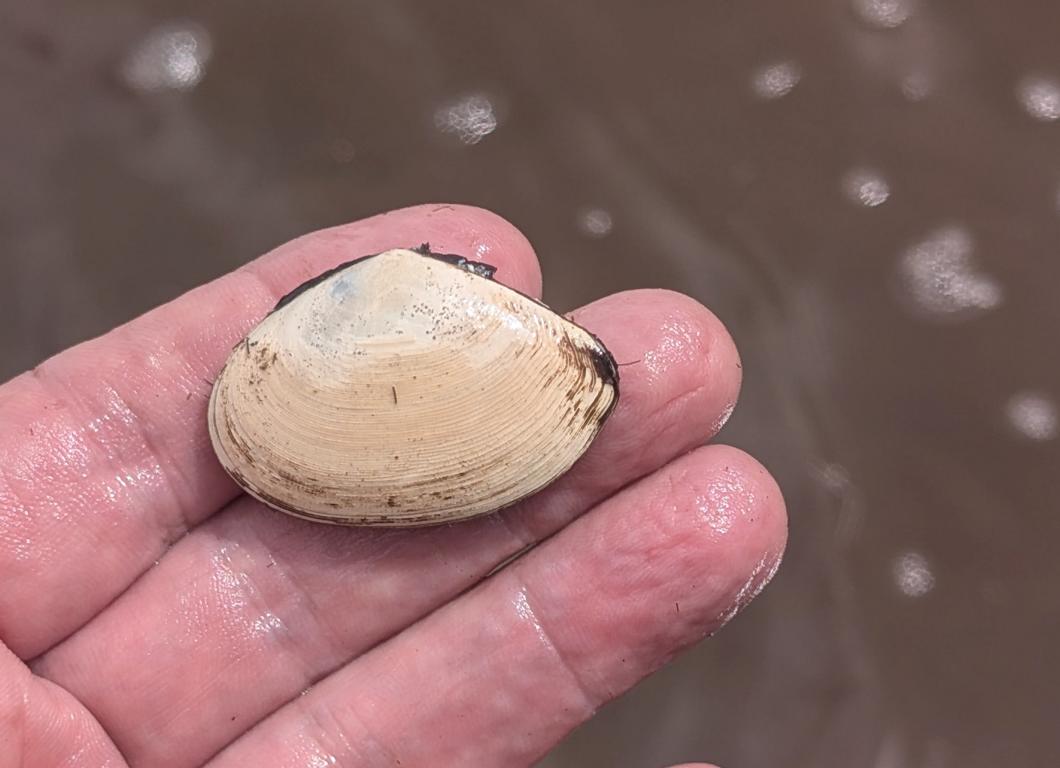
Two species of clams of an unknown species. Mentawai names are on the left: Takkai. On the right: Bizilet.
Takkai’s were bulky clams, similar to River clams, whereas Bizilet’s are flat and always have white colored shells. Both are found side by side in large quantities on muddy tidal flats.
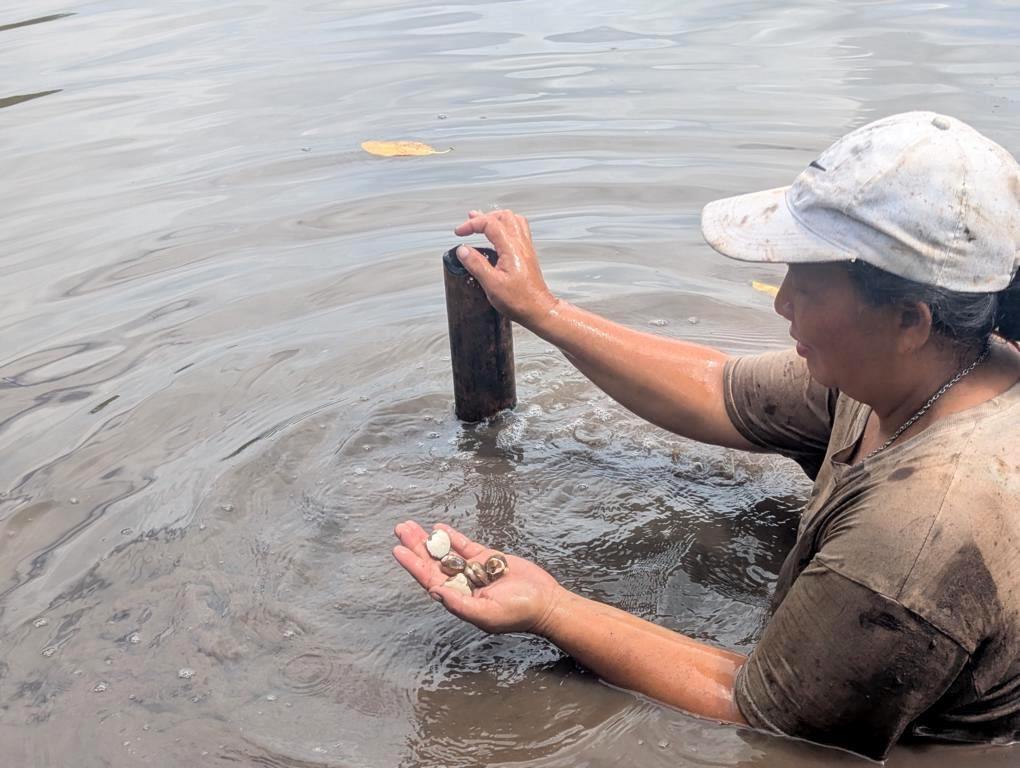
These clams are collected by kneeling in the water and ploughing with both hands about 15 cm, about 6’’, deep into the mud. There are so many of these small clams that every stroke will collect three to five shells. Many of them are also dead ones, which will be sorted out immediately.
Gastropods
We collected three species of gastropods: Horn snails (Telescopium telescopium), Belitong snails (Terebralia sulcata), and River nerites (Nerita planospira).
Horn snails (Telescopium telescopium) are called ‘Lilith’ in the Mentawai language. They are very common on exposed mud flats in the mangrove forests and were eagerly collected by the Mentawai women. Our total catch of the day of Menggu clams contained about 10 – 20% of Lilith snails. Despite the large size of their shells, the edible part of this snail is relatively small. The taste of the freshly exposed and raw animal was sweet and delicious.
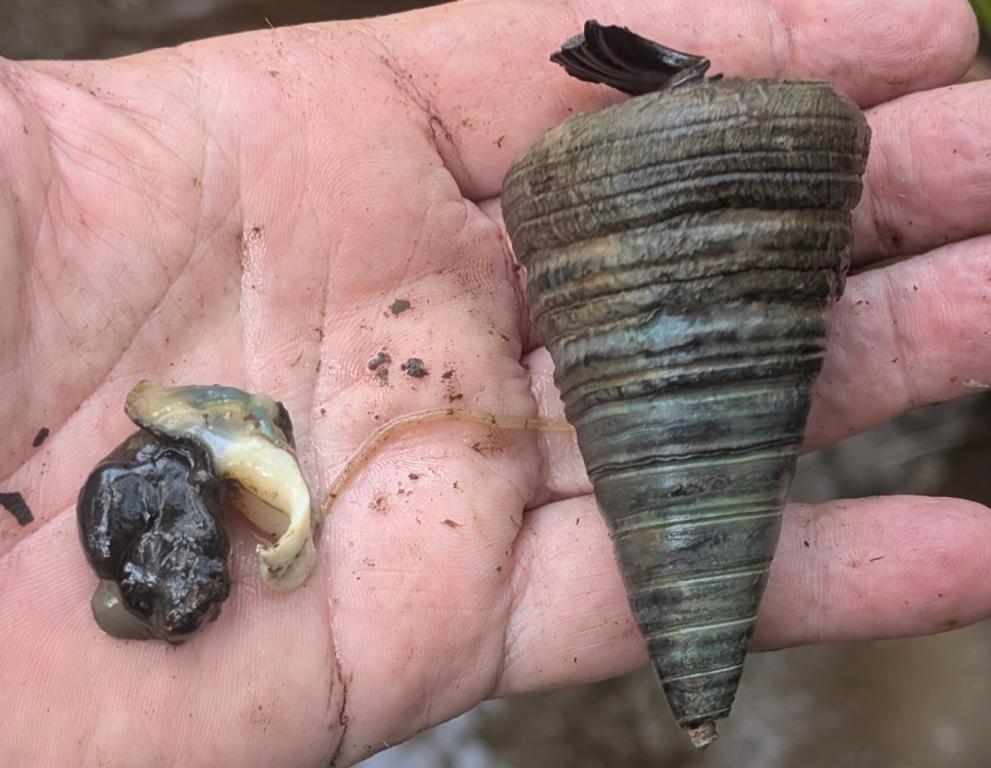
The other two gastropods the women were catching were Belitong snails and River nerites. Both contributed only a minor part of the total catch.
Other gastropods confirmed from the Katurai Bay mangrove forests are, according to Burgos (2016), the following species:
- Quadrate horn shell (Cerithidea quadrata)
- Mangrove periwinkle (Littoraria pallescens)
- Giant mangrove whelk (Terebralia palustris)
- Cassidula sp. (Cassidula sowerbyana)
- Judas Ear Cassidula (Ellobium aurisjudae)
Lessons learned about Mollusks in the fresh- and brackish waters of Siberut Island:
- Inland rivers hold many good-sized river clams. The saltier the water becomes, the more bivalve and gastropod species are available for harvesting.
- In brackish mangrove waters, there are at least three methods for collecting clams.
- Menggu clams are sought in muddy patches within the mangrove forest, but never around mangrove stilt roots.
- Sikoira clams are caught alongside Red mangrove (Rhizophora sp.) stilt roots.
- Takkai and Bizilet clams are gathered on tidal mudflats.
- Horn snails are an essential bycatch when collecting Menggu clams throughout all micro-ecosystems of a mangrove forest.
.