Harnessing the power of sun rays for fire lighting is one of the most elegant and rewarding skills in the bushcraft repertoire. Unlike friction-based methods that require intense physical exertion, solar ignition harnesses the sun’s virtually unlimited energy to create a precise, high-temperature focal point. By mastering the use of a burning glass or magnifying lens, you can transform a clear day into a reliable survival advantage. This guide explores the essential techniques for capturing sun rays for fire lighting, from selecting the right tinder to perfecting your focal distance, so you can spark a flame with nothing but light.
The energy received by the earth from the sun is called the Solar Constant, which describes the effect that every 1 m2 of planet Earth facing the sun’s rays at a 90-degree angle (directly overhead) will receive 1375 Watts (Joules/sec). 1375 W/m2 of direct sunlight will not be enough to start a fire as this is only 0.1375 W/cm2. A burning candle turns out about 80 W.
The further the location North or South from the equator – generally spoken – is, the more spread this 1 m2 area on the equator will become. On the ground, as the mirror is always perpendicular to the sun, this remains unchanged for latitude. However, the scattering of the sun’s rays through particles in the atmosphere will increase.
Sunlight, therefore, has to be focused, which can be done by parabolic mirrors, lenses, or lens-like objects. The best efficiency in all three types will only be achieved by clean and even surfaces that do not deflect light in undesirable directions.
Parabolic mirrors for solar fire lighting
Parabolic mirrors reflect sunlight and concentrate it at the focal point on the same side as the incoming sun rays. This principle is commercially used for so-called ‘Solar Spark’ lighters.
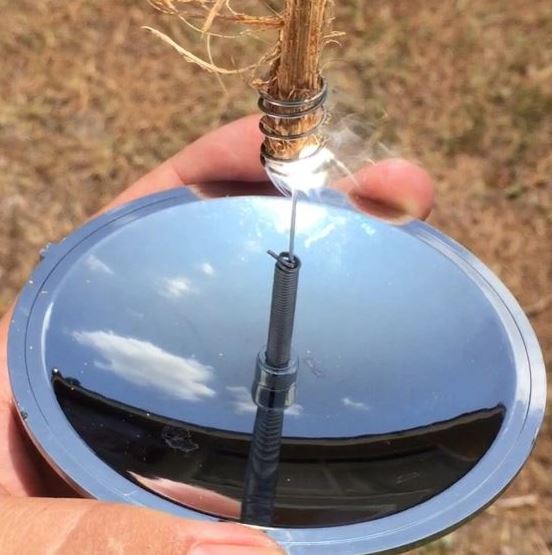
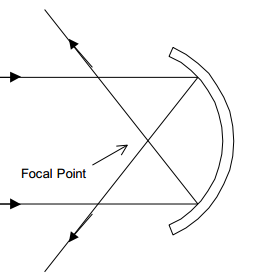
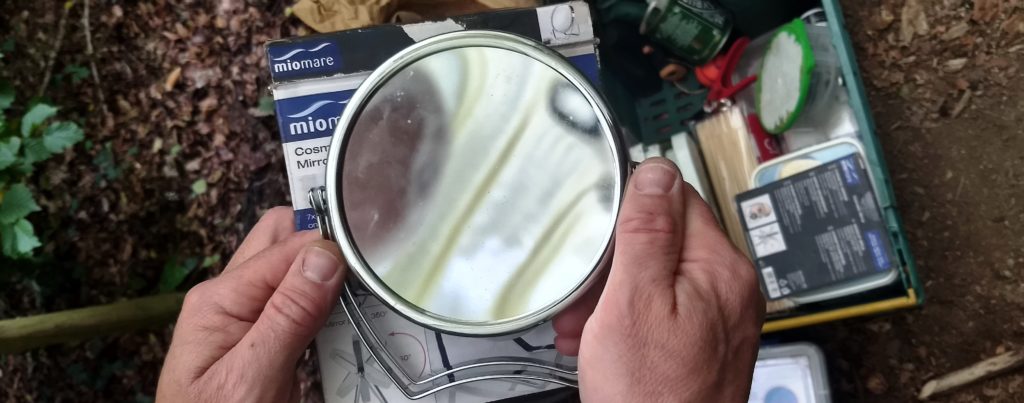
The same principle is also used for cosmetic mirrors. These mirrors are highly recommendable for solar fire lighting due to their relatively large diameter and even surface (which is necessary not to distort the face picture). In general, mirrors are more efficient in lighting solar fires, as there is no need for the rays to pass through a denser medium, like glass, which reduces its efficiency or is subject to the tinder casting a shadow onto the mirror. Their disadvantage, however, is that parabolic mirrors without central tinder catch at the focal point have to be held so that the focal point is always at an angle to the tinder and, therefore, distorted.
Lenses for solar fire lighting
Lenses concentrate light on the opposite side of the incoming sun rays. These rays will either be focused by optical lenses or Fresnel lenses. Energy output in both types of lenses will depend significantly on the available lens diameter. A disadvantage of lenses is that the sun rays must pass through different mediums; their big advantage, however, is that the lens can be held strictly perpendicular to the incoming rays for an optimized small focal point.
Lens-like objects for solar firelighting
Lens-like objects can be made of various materials or a combination of such materials. For example, they could be Water in a clear plastic bag, clear ice shaped like a lens, or clear glass bottles or parts of them.
Calculating the power output of a solar lens/mirror
Calculating the approximate power output of a lens or mirror can be done by multiplying the area of the mirror/lens by the solar constant. A mirror with a diameter of, let’s say, 16 cm / 6 1/4” results in a power output of 27,5 W. Calculation is done as follows:
Area = π r2 (squared) = π x (8 cm x 8 cm) = π x 64 cm2 = 201 cm2
Power = 201 cm2 x 0.1375 = 27.5 W
Color of target material for solar fire lighting
The color of the target material is critical for success in solar fire lighting. As commonly known, white color will reflect light, whereas black color will absorb it. We want as much absorption as possible; therefore, our target material should be as black as possible. When using punky wood as a tinder (which is relatively light in color), it would be best to rub old charcoal on it. However, charcoal itself would be a good tinder. Or use a black ink pen or board marker.
Whatever is done to darken the target material, it is always necessary to keep it fully dry. It is not an option to bring humidity into the tinder by, e.g., dark soil. Dryness before color! The often-cited example of how easy it is to burn dark paper compared to white paper with solar fire lighting may sometimes mislead the observer, as paper is not a tinder, but only an object of demonstration to show the differences in light absorption and -reflection.
Which tinder is used for solar fire lighting?
To successfully capture sun rays for fire lighting, the quality of your tinder is just as important as the strength of your lens. Not all materials are created equal when it comes to absorbing solar energy and holding an ember.
The Best Tinder for Solar Ignition
The most difficult part of solar fire lighting is finding tinder that produces a smoldering ember! Most materials flash up or burn away fast, but we need something that forms an ember. Here are the top choices for catching a solar ember:
- Char Cloth: Generally considered the “gold standard.” Its black color and pre-carbonized state allow it to ignite almost instantly when hit with a focused beam.
- Punk Wood: Dry, rotting wood (especially from birch or willow) that has a spongy texture. It smolders exceptionally well once a focal point is established.
- Chaga (Inonotus obliquus): A natural powerhouse. It is dark, dense, and can hold a coal for a long time, making it perfect for transferring to a larger bird’s nest.
- Horse Hoof Fungus (Fomes fomentarius): The inner “amadou” layer is highly effective at catching solar heat.
- Darkened Natural Fibers: If you only have light-colored tinder (like dry grass or cattail fluff), you can “cheat” by rubbing it with charcoal from an old fire or even using a dark marker to create a “hot spot” for the sun rays to hit.
Pro-Tips for Success
- The 90-Degree Rule: Always hold your lens perfectly perpendicular to the sun’s rays. Any tilt reduces the intensity of the light hitting your tinder.
- Focus to a “Pinprick”: Move the lens back and forth until the light on the tinder is at its smallest, brightest point. This is where the heat is most concentrated.
- Steady Hands: Even a slight wobble can dissipate the heat. Brace your arms against your knees or a rock to keep the focal point stationary until you see smoke.
Lessons learned about solar fire lighting:
- A cosmetic mirror with approximately 16 cm / 6 1/4” diameter is considered the best tool for solar fire lighting.
- Solar lighters are also effective for creating a fire when the sun is high in the sky.
- The color of the tinder should be as dark as possible to reduce reflection.
- The goal of solar fire lighting is not to produce an open flame but rather to create a smoldering ember.
- Tinder material must be completely dry and capable of holding an ember.
.