For many years, I’ve been teaching junglecraft and survival skills in the Malaysian jungles. In turn, I learned these skills and knowledge from close Orang Asli friends. For stealth hunting, their primary weapon is the blowpipe, but they also place considerable emphasis on trapping. Over the years, I acquired various blowpipes from the Semai, Jahai, and Temiar tribes, and I also manufactured them using traditional materials and methods. In the following, I will briefly present five blowpipes from my collection.
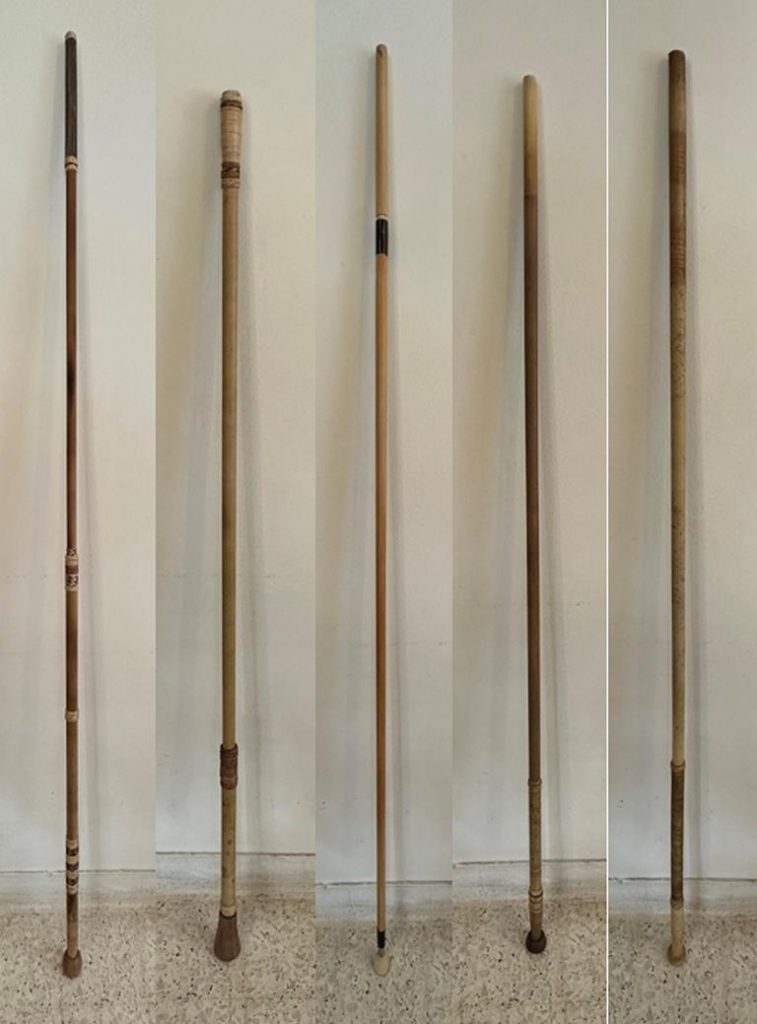
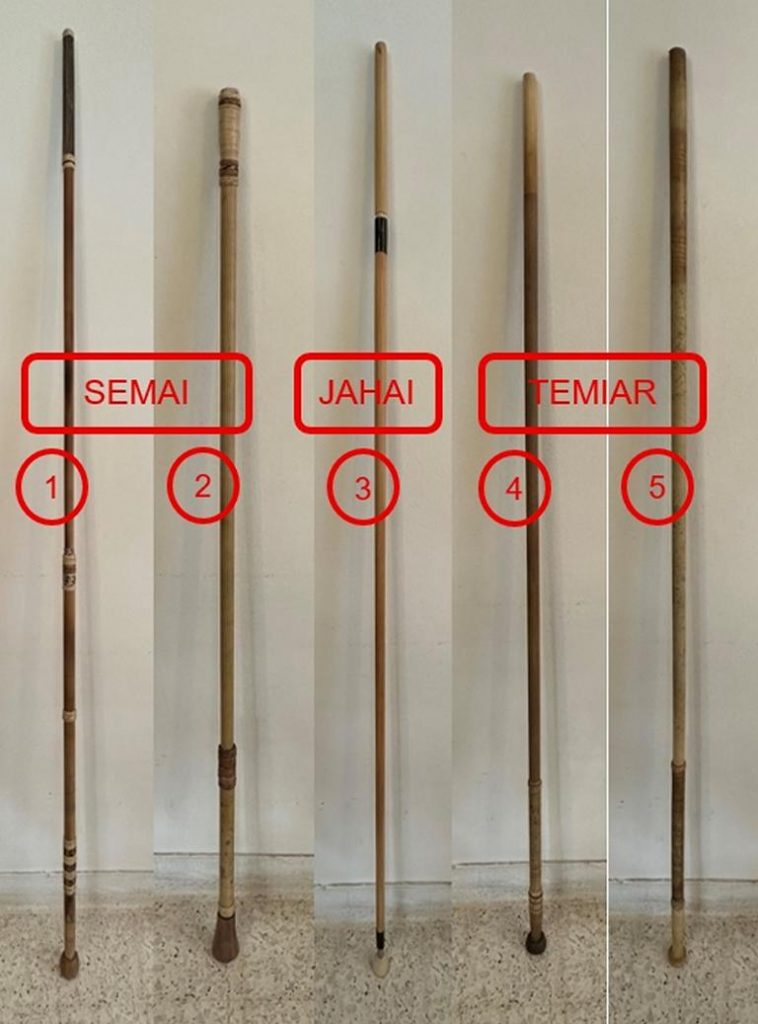
Measurements of five blowpipes
| Inner pipe | Outer pipe | |||||||
| Blowpipe # | Tribal origin | Acquisition year | Total length (cm/feet) | Outer diameter (mm/inch) | Blowhole dia Mouthpiece (mm/inch) | Blowhole dia Muzzle (mm/inch) | Connection between both inner pipes | Outer dia (mm/inch) |
| 1 | Semai | 2015 | 217 / 7.12 | 13 / 0.51 | 10 / 0.39 | 9 / 0.35 | Sheath Of Emerging Palm Frond | 20 / 0.79 |
| 2 | Semai | 2025 | 150 / 4.92 | 15 / 0.59 | 13 / 0.51 | 13 / 0.51 | One Piece | 24 / 0.94 |
| 3 | Jahai | 2024 | 176 / 5.77 | 14 / 0.55 | 11 / 0.43 | 10 / 0.39 | Temiang Bamboo | 17 / 0.67 |
| 4 | Temiar | 2023 | 157 / 5.15 | 15 / 0.59 | 12 / 0.47 | 11 / 0.43 | Temiang Bamboo | 18 / 0.71 |
| 5 | Temiar | 2022 | 162 / 5.31 | 15 / 0.59 | 12 / 0.47 | 10 / 0.39 | Temiang Bamboo | 20 / 0.79 |
The outer diameters of the protective outer pipe range from 17 to 24 mm, and those of the inner pipe from 13 to 15 mm. The corresponding imperial measurements are shown in the table above. Blowhole diameters of the blowpipe barrels are mostly slightly conical towards the muzzle, with the most common contraction of 1mm over the whole barrel length. Short blowpipes of 1.5m or less are made from a single piece of Bamboo internode; above this length, two bamboo pipes are connected by a bamboo sleeve.
Material used for the inner pipes
For the inner pipes, the most commonly used species is Temiang bamboo (Schizostachyum blumei and closely related Schizostachyum species). In addition to its very long internodes, the culm surface has a very high silica content. It was therefore often used in earlier times for strike-a-light fire-making methods, using flint or quartzite to create sparks by striking it and igniting the tinder.
Mouthpieces
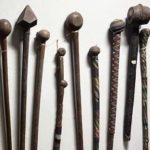
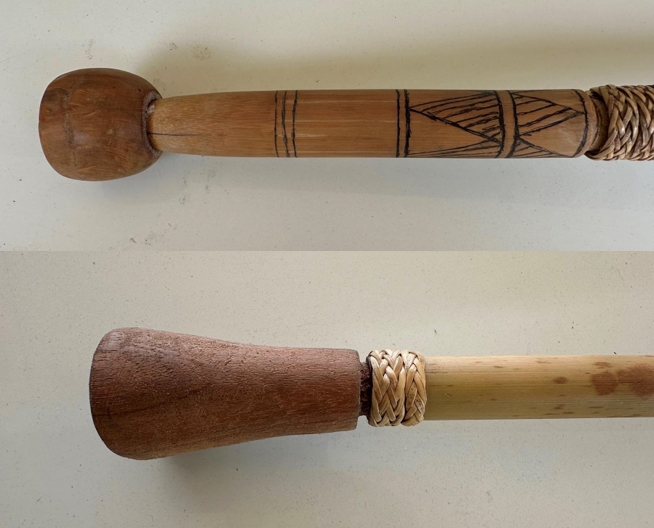
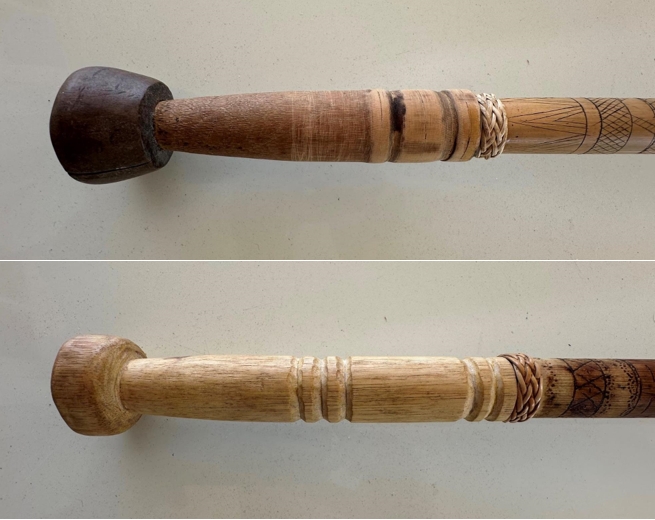
All mouthpieces of the Orang Asli tribes in Malaysia are knob-like and made of various wood species. Their end are flat, and the mouthpieces show a decreased diameter – either half-round or conical – towards the muzzle-end. They are fitted to the inner barrel but often have a wood extension that improves grip on the thin inner barrel. The following presents typical examples of mouthpieces from various Orang Asli tribes.
Connection of the two inner bamboo pipes
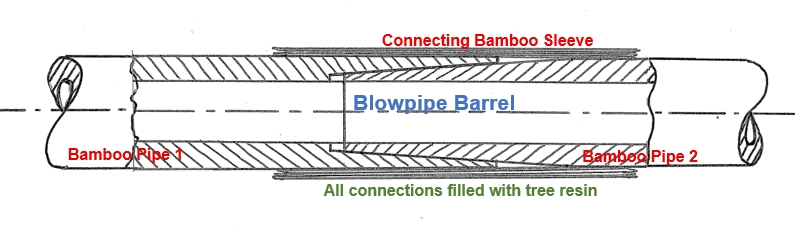
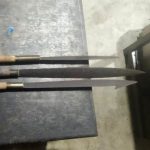
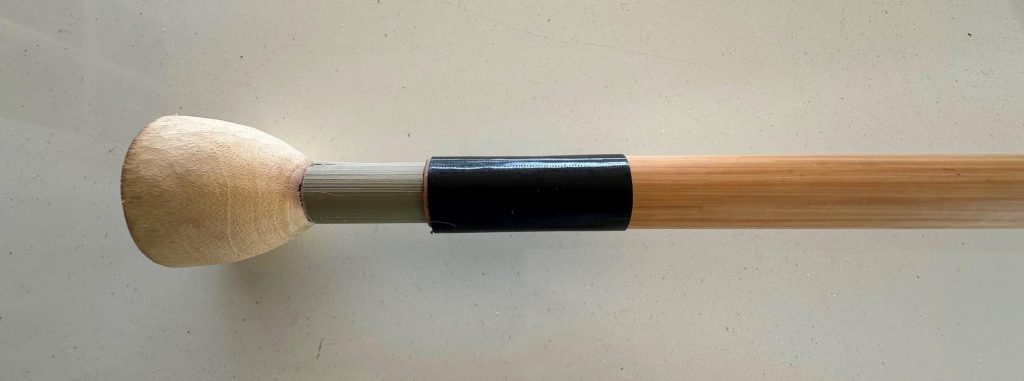
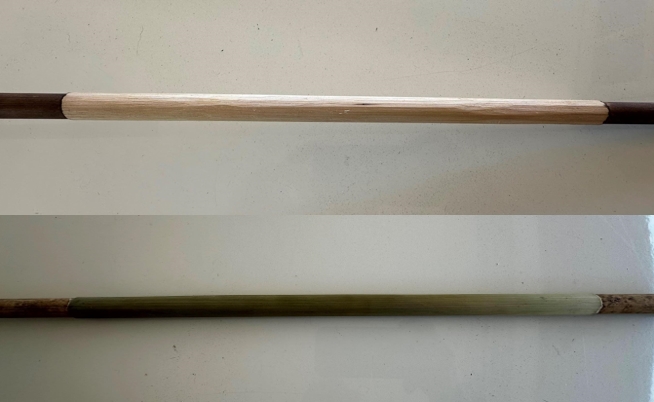
All connections of the presented five blowpipes follow the same principle: The connecting ends of two bamboo culms will be shaped for a male-female (MF) connection, which is secured by either a thin bamboo sleeve or the sheath of an emerging palm frond. All connecting parts are covered with tree resin, which acts as an adhesive and air-tightens the connection between the two bamboo pipes. The finished connection appears on the outside of the connected inner pipe as follows:
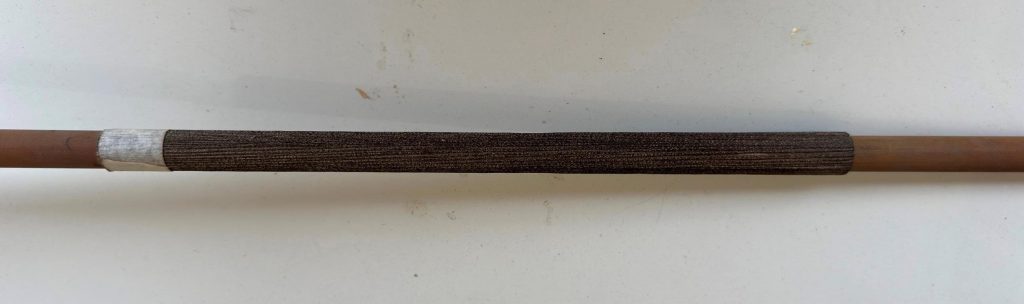
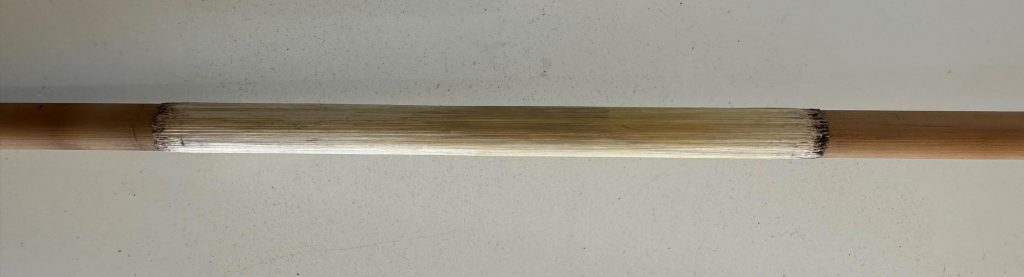
In addition to the blowpipes presented above, I have others in my collection, but they should be sufficient to illustrate the typical features of these primary hunting weapons among the Orang Asli.
Lessons learned about various Orang Asli blowpipes:
- The inner blowpipe consists of longer blowpipes of two separate bamboo internodes, which are fitted together.
- The blowhole diameters are slightly conical towards the muzzle.
- Mouthpieces have a flat end and are shaped to be covered easily with the upper lip.
- There is no clear distinction or feature between the blowpipes of the Semai, Jahai, and Temiar tribes.
If a reader wants to know more about Orang Asli blowpipes or other junglecraft topics from Malaysia, please feel free to contact me via one of the links provided at my personal feature page on this website.