In the following, we will describe the catching operation of octopuses from a fishing vessel with the help of conch traplines. This is the high-end operation of catching these cephalopods, and, based on catching weight, the primary one. But the same technique of catching Marbled octopuses in Thailand is also used by artisanal fishermen, who are often alone on a boat, or only with one helper. These fishermen just use one conch trapline, and often, the distances between each conch shell are larger compared to those on fishing vessels. They operate close to the shore and bring in the catch immediately, feeding to own family and selling the glut.
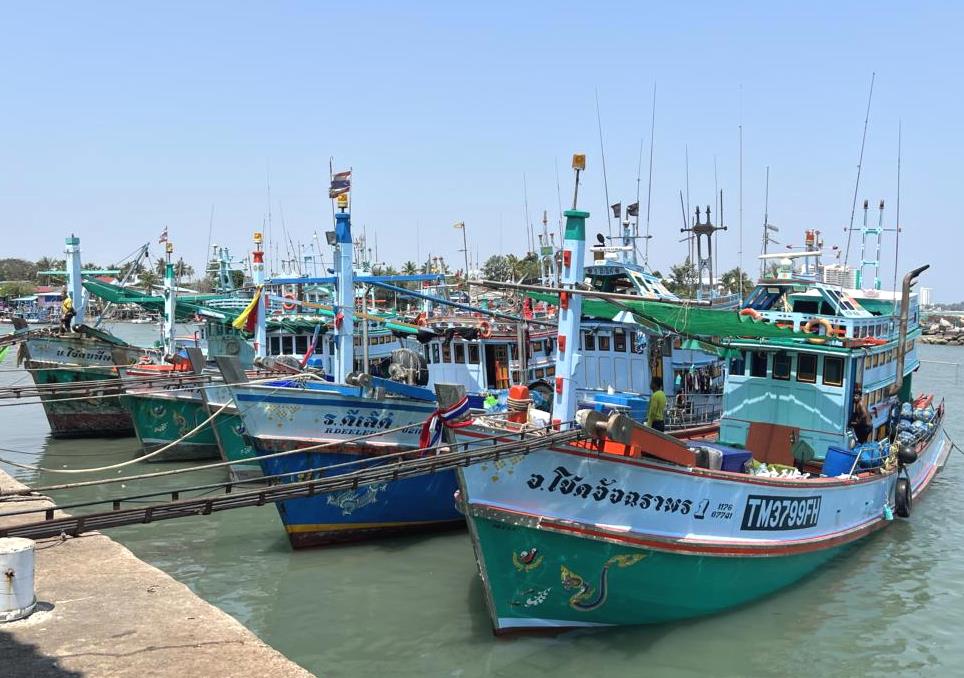
Fishing season for octopuses with conch shells
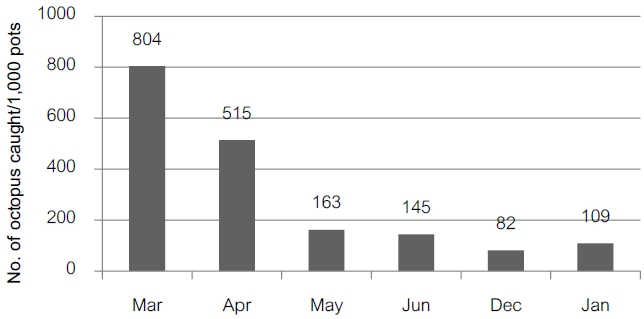
The fishing season for catching Marbled octopuses (Amphioctopus aegina) with Noble volute (Cymbiola nobilis) conch shells ranges from December to August each year. However, in March and April, the catches are the highest. Whereas in March, on average, 800 octopuses are caught in 1,000 shell pots, in April, only about 500 are collected. During Dec, Jan, May, Jun, July, and Aug, only around 100 octopuses are caught in 1,000 shells. The exact numbers can be found in this article, authored by Nakaret Yasook et al. (2002), who also published the following diagram.
Set-up of conch traplines
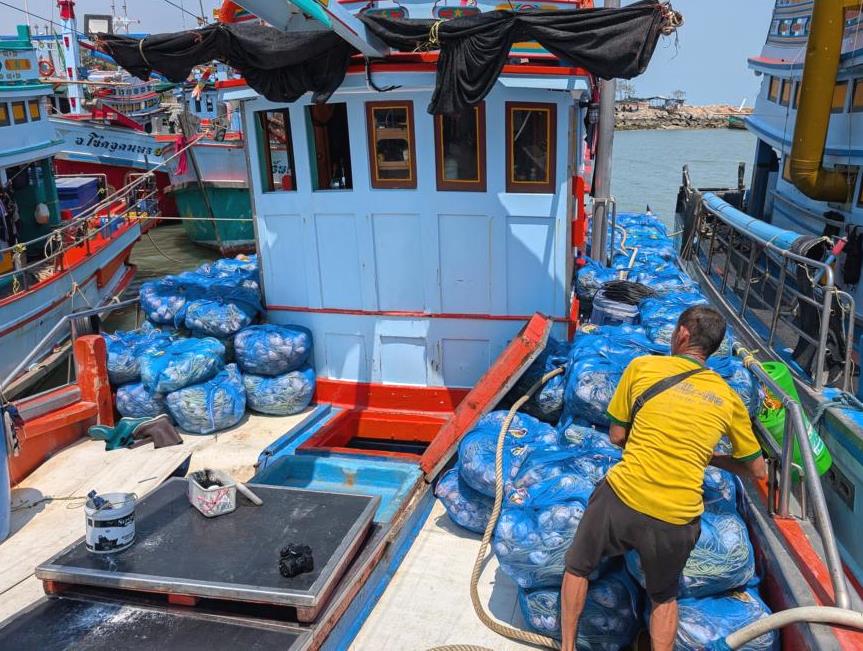
As already outlined in a former article on this website about conch shells for catching octopuses, each conch trapline consists of 160 – 200 shells, spaced 2.5 meters apart. Therefore, the catch line on the sea floor is between 400 and 500 meters long.
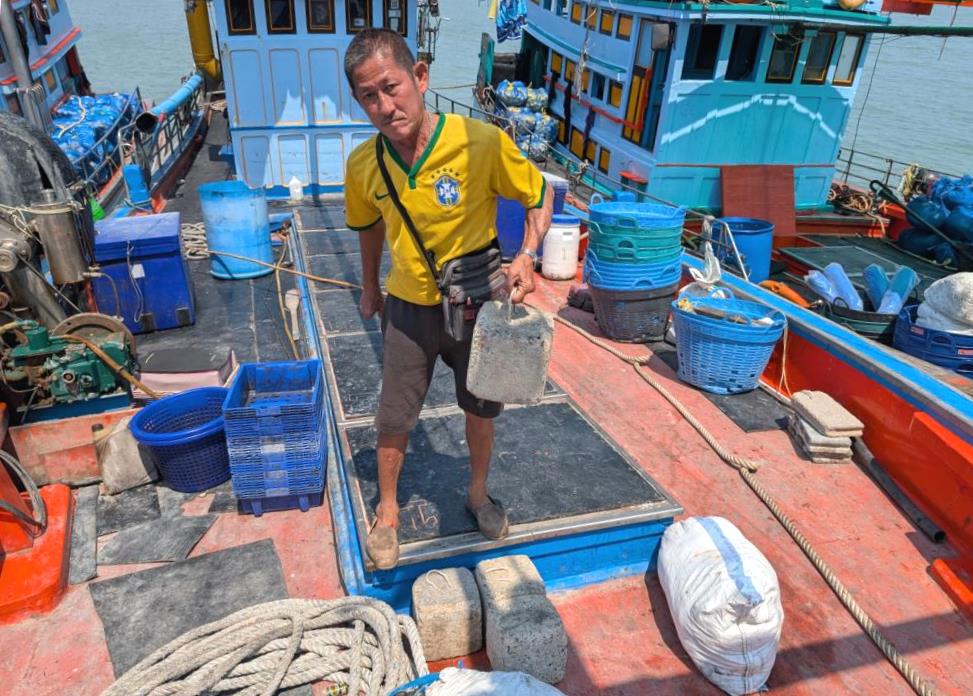
At both ends, each conch trapline is weighted down to the seafloor by either cement stones or bricks, each weighing roughly 15 kg, and connected by a flag buoy that indicates the trapline location.
Setting pattern of conch traplines
The lines are set between 3 and 20 km from the shoreline and parallel to it, at a depth of between 10 and 20 meters. Small fishing boats are trapping closer to the shore in water depths between 10 and 15 meters, whereas larger fishing vessels will set their lines at a depth of 20 meters and above.
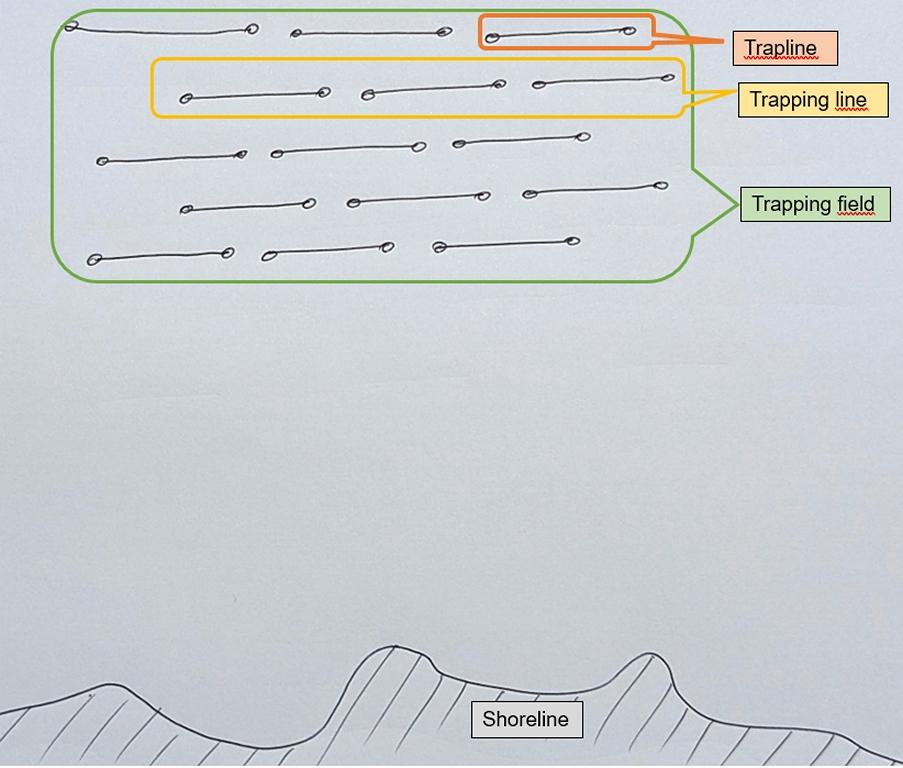
There are various patterns of setting the traplines. In our case, the vessel owner, Mr. Somjud Saetoe, preferred a trapping line, parallel to the coast, with a total length of 1 mile, which is about 1.6 kilometers. On this line, he set three individual conch traplines, spaced about 100 meters apart. And parallel to this 1-mile trapping line, he put another four trapping lines. This results in one trapping field of five trapping lines, consisting of 15 conch traplines. In total, he set eight such trapping fields, which consist of about 120 individual conch traplines. All in all, about 20,000 conch shells are set and retrieved during one trapping operation.
How long are the pots left on the seafloor?
Each fishing or trapping trip takes about one week. During that time, Mr. Saetoe set his traplines after 3 pm each day and retrieved them the next morning. When we met, it was the month of March, which is the high octopus season. During that season, the conch shells will be used every night. Outside the high season, fishermen leave the conch traplines for two days in the water. This has the disadvantage that marine growth will start settling on the shells, as already mentioned earlier.
Retrieval of the catch
When retrieving the conch traplines, at least three people are required. One, on the helm, has to steer the boat or vessel along the traplines. And one or two people have to catch the buoys and retrieve the lines with the shells into the boat. An additional person comes in handy, as some of the caught octopuses crawl all over the place and try to flee.
Basically, there are three methods of retrieving octopuses from the conch shells:
- Some octopuses leave their shells by themselves when they are not in saltwater anymore.
- By immersing the shells in freshwater, the remaining octopuses will crawl out to find saltwater again.
- Water with a high salt concentration will also drive out the octopuses from the shells. Some of the fishermen will inject such high-concentration saltwater into the populated shell, which forces the octopus to leave the shell.
Preservation of the catch
To avoid the catch spoiling on a more extended fishing trip, and with no ability to cool or freeze the catch, the octopuses are preserved in salt. For a week-long fishing trip, Mr. Saetoe loads a 10-ton truckload of salt for preservation, which is about 10 cubic meters of salt. Assuming five catching nights will result in 4 tons of octopuses, which means that for each kg of octopus, 250 grams of salt are available, which is enough for safe preservation.

Lessons learned about the operation of catching octopuses with conch shells:
- Both artisanal and professional fishermen use conch traplines for catching octopuses in Thailand.
- Three 400 to 500-meter-long traplines result in one trapping line.
- Five such trapping lines parallel to the coast make up one trapping field.
- Eight trapping fields are created with the described fishing vessel.
- March is the prime month for catching octopuses.
.