In Sri Lanka, a variety of cultivated and wild bitter gourds occur. The most commonly collected wild bitter gourd (Momordica charantia var. muricata (Willd.) Chakrav.) is, in fact, only a semi-wild one. It is locally called කටු කරවිල (Katu Karavila), and the English common name is – confusingly – ‘Wild Bitter Gourd’.
Momordica charantia var. muricata is a botanical variety of bitter gourds that sits taxonomically and morphologically between the cultivated bitter gourd and truly wild Momordica species. It is often a source of confusion because it shares traits with M. charantia (the cultivated form) as well as with M. dioica, M. subangulata, and other wild forms.
Plant description
The best comprehensive plant description can currently be found on the eFlora of India website. Besides such a botanical description, the main distinguishing features are briefly described as follows.
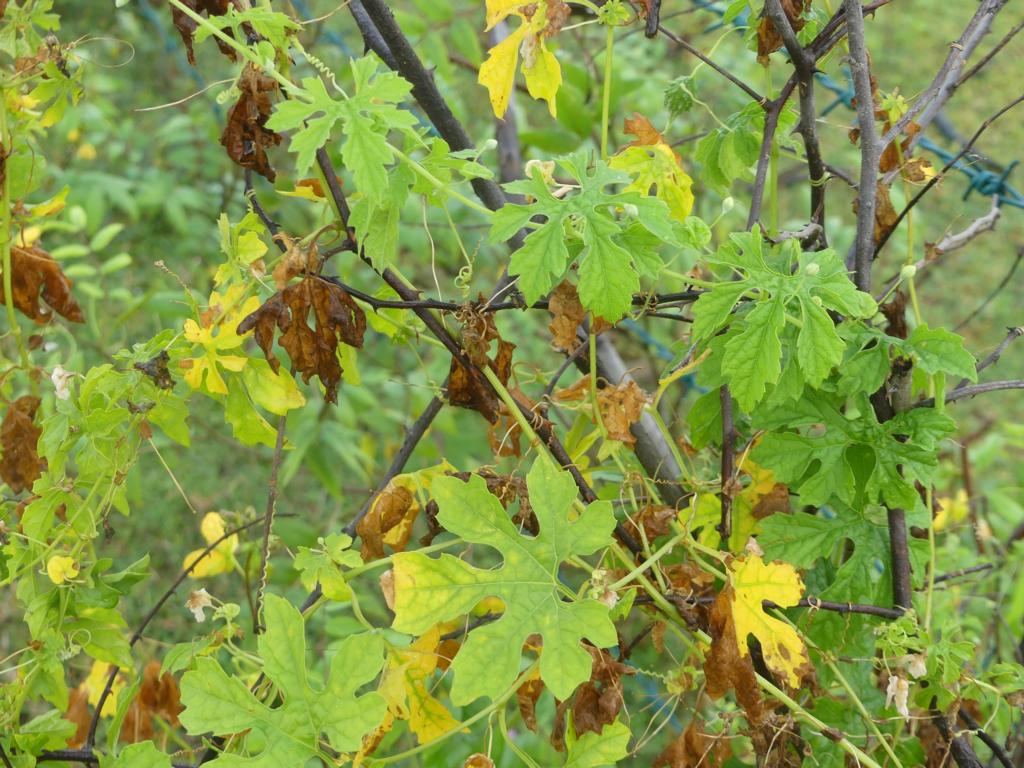
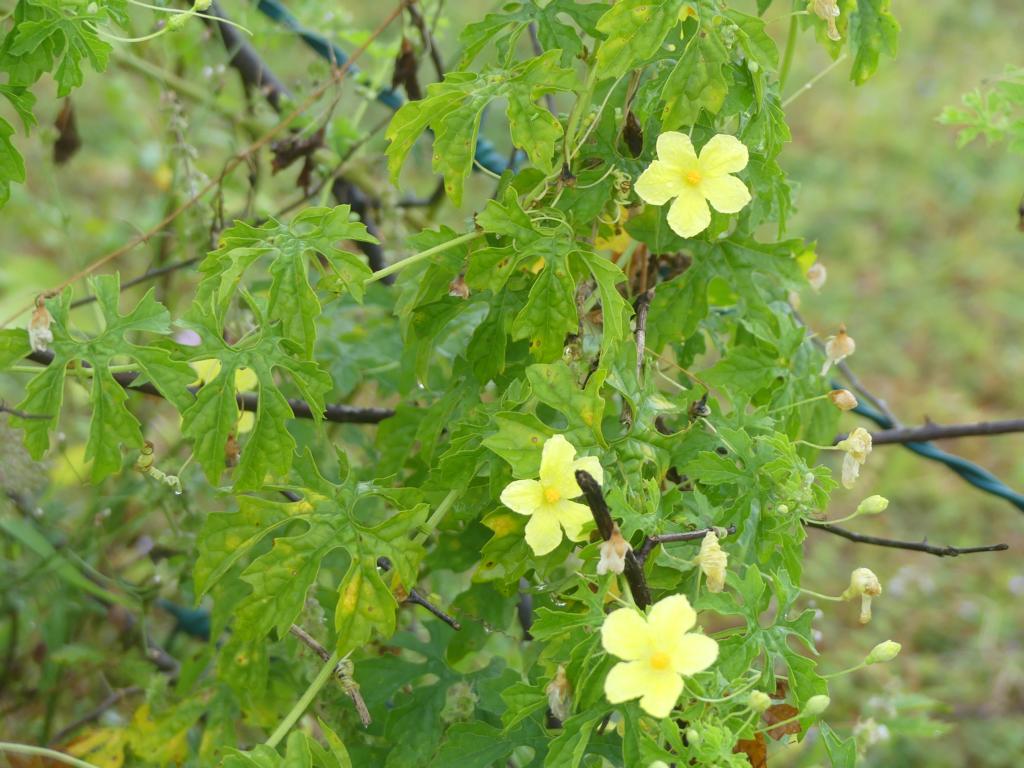
The leaves are deeply lobed and indistinguishable from those of M. charantia. This is a strong indication of one part of its identity. Male and female flowers are on the same plant (monoecious), and the female flowers are yellow and exhibit the typical M. charantia floral structure.
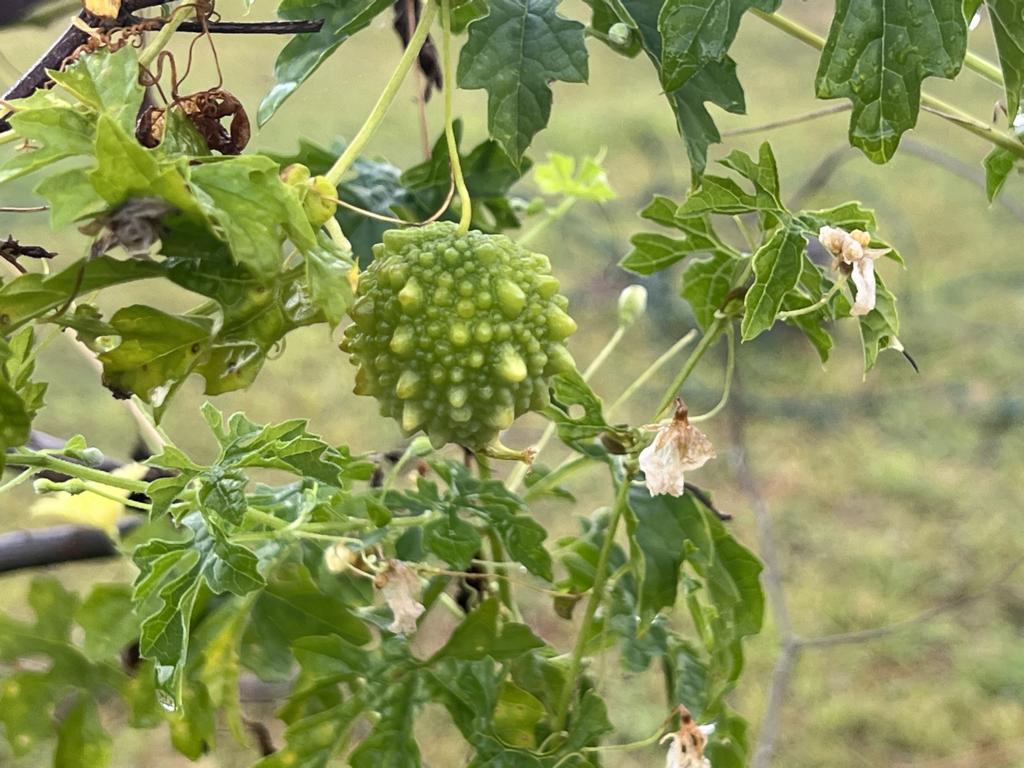
Details about these bitter gourd fruits.
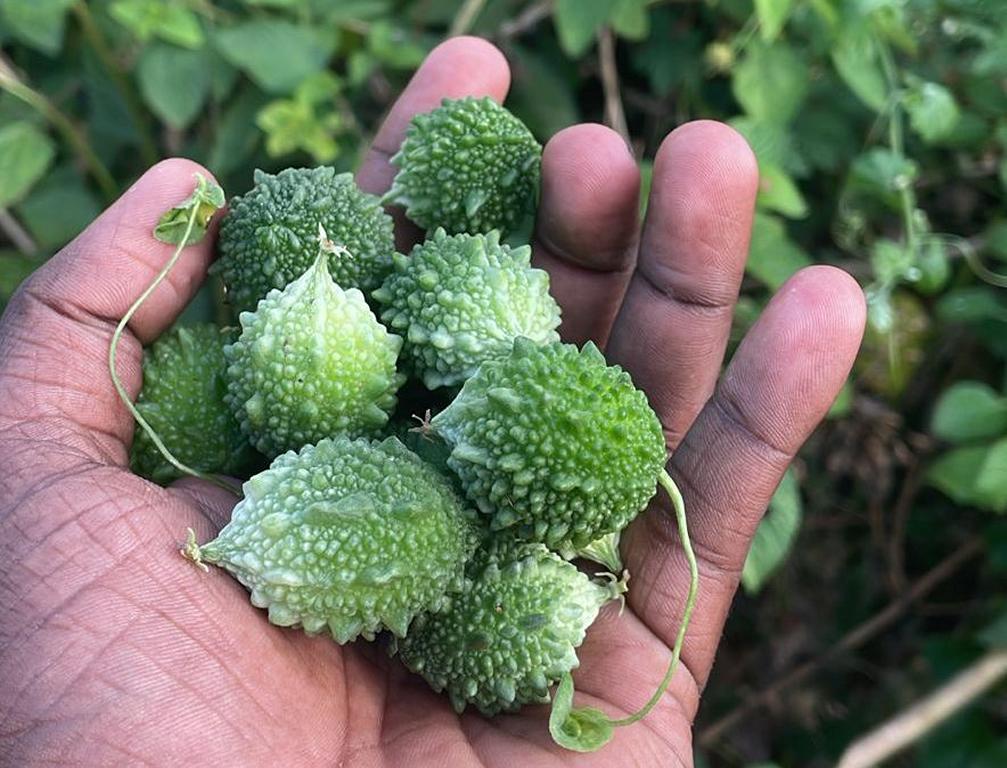
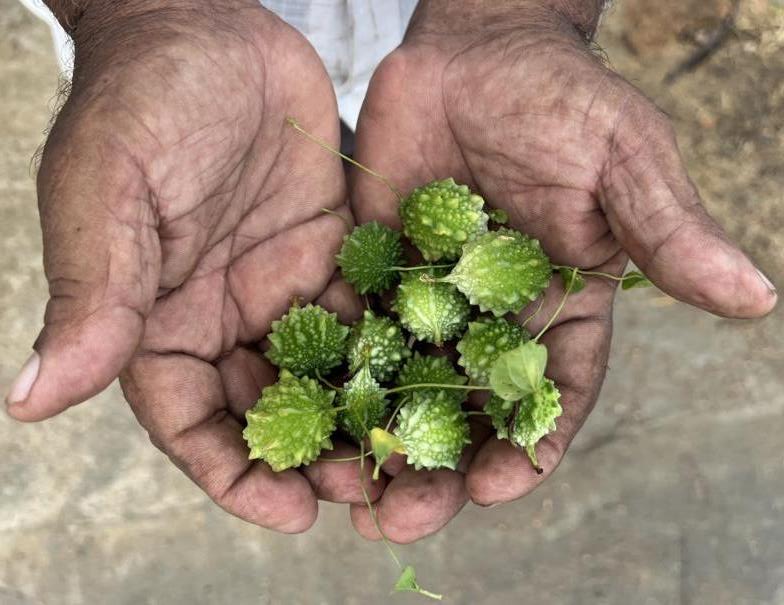
The fruits are small, measuring 3-5 cm (1.2-2 inches) in diameter and have a rounded to slightly egg-shaped outline. Botanists would call them globose to ovoid. They are covered with short, stout conical tubercles, from which their variety name of muricata (muricate = rough, warty) derives. The size and shape of fruits and spines clearly distinguish them from the cultivated form M. charantia and from wild species such as M. dioica. At the lower, pointed end of the immature fruit, the color often turns from green to a whitish color.
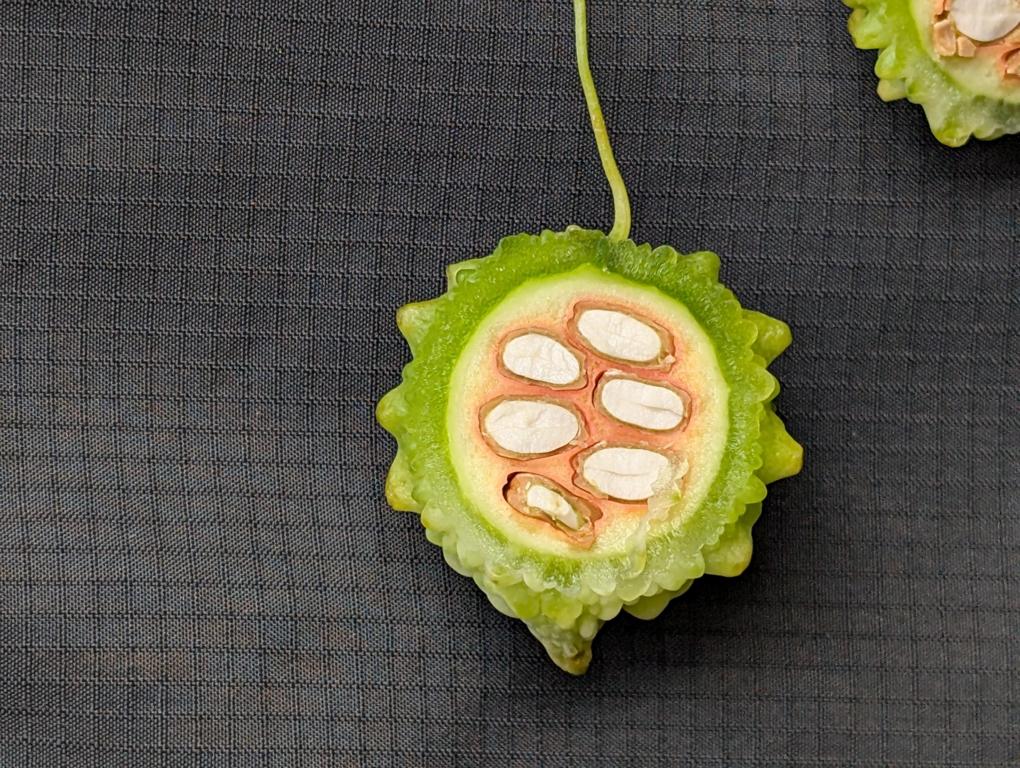
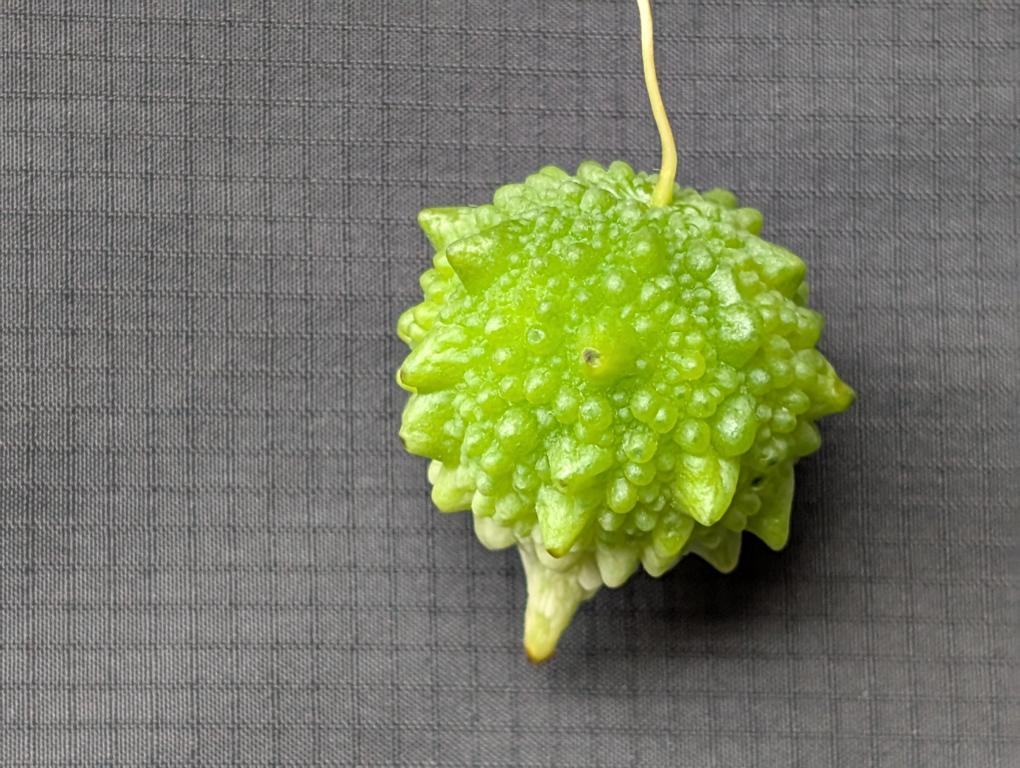
Local people eagerly collect the fruits on hedges, along fences, in scrubland, or near cultivated areas when they are still immature and green. Within the green outer rind, the light brown seeds are embedded in a whitish, spongy matter that turns reddish towards the seed itself. The seed morphology is similar to that of M. charantia. They are covered by a thin but hard beige skin that protects the oil-rich kernel inside.
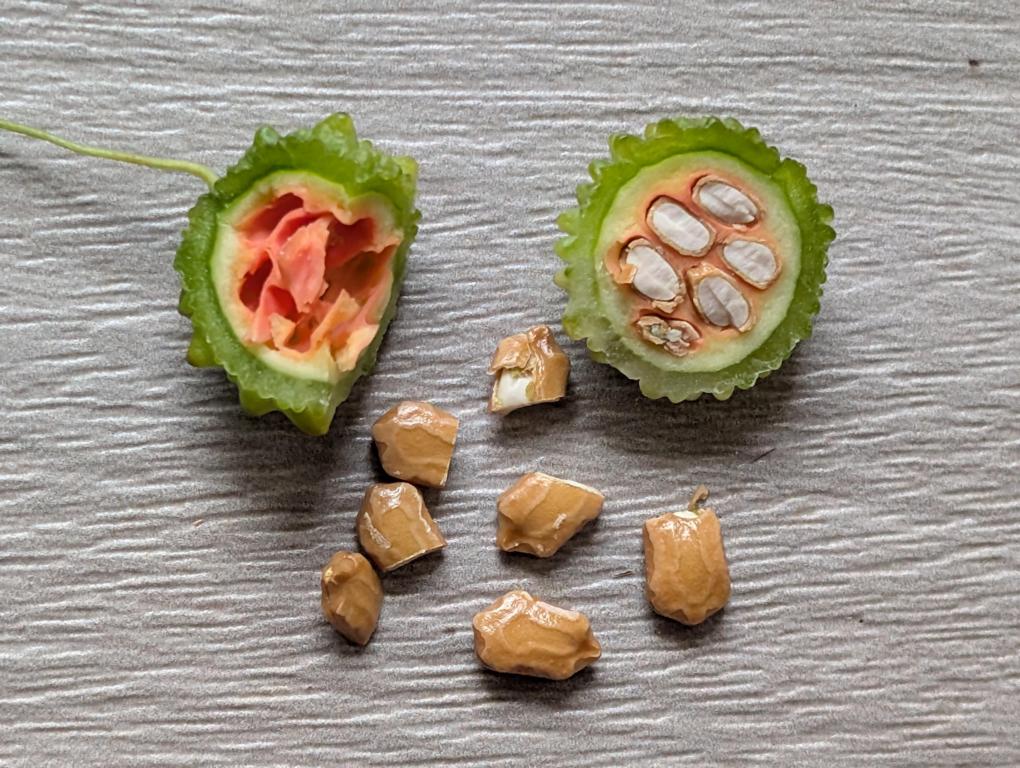
At maturity, the whole fruit turns yellow–orange and splits up into three valves. At that stage, it will no longer be eaten.
Distribution
In the literature, it is difficult to find the correct geographical distribution of Momordica charantia var. muricata (Willd.) Chakrav, as it is a local interbreeding variation between M. charantia and other wild bitter gourd species. Many botanists consider it a feral or primitive landrace of bitter gourd rather than a true wild species.However, the species is found in Sri Lanka, Inda and Bangladesh. If M. charantia var. muricata (Willd) Chakrav also occurs in other areas, is currently unknown.
Uses
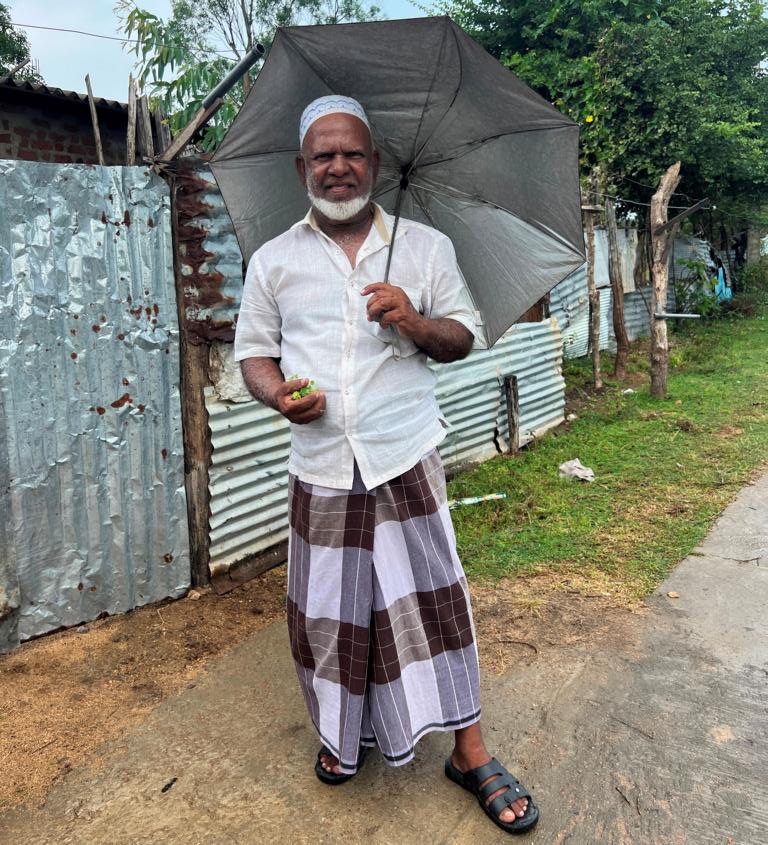
The local population in Sri Lanka eagerly collects the green fruits to prepare a kind of vegetable curry. We saw a young man at a bus stop who quickly ripped some fruit from the gourd vines before entering the bus. There were also two young men who plucked them from a fence. Then we met an older gentleman, who came out of his dwelling to fetch some of these gourds from within a scrubland bush for his lunch and showed them to us. And when we asked our landlord to prepare them in their typical local way for us, he said that he could find many of them in the deserted field next to his house.
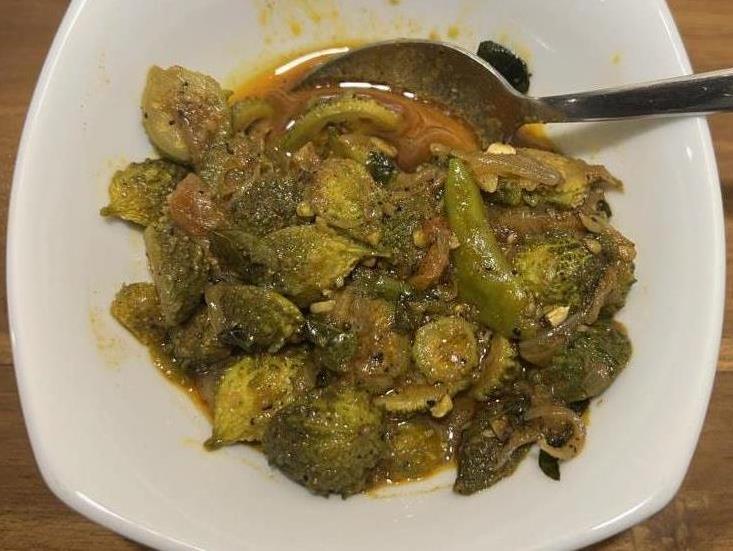
Our collected patch of these bitter gourds was chopped into thick pieces, and the seeds were not removed. Together with onions, tomatoes, vegetable chilies, curry leaves, and lots of masala spice, they were simmered in the resulting broth. The taste of this dish was bitter but very complex, and all in all, highly delicious.
Nutritional value
Only the nutritional values of Momordica charantia, the cultivated type of bitter gourd, are known; for the semi-wild version, such values do not currently exist.
M. charantia is a low-calorie vegetable with notable micronutrients and bioactive compounds. Its nutritional value, for the 100g raw, edible portion without seeds, is:
- Calories: ~17–20 kcal
- Water: ~93–94 g
- Carbohydrates: ~3.5–4 g
- Protein: ~0.8–1 g
- Fat: ~0.2 g
It is very high in vitamin C (80-90 mg), potassium, magnesium, and calcium. There are various bioactive compounds that can be obtained in more detail here and there.
The seeds of Momordica charantia are relatively rich in oil, containing approximately 30–40% oil by weight. Because of the bioactive compounds, however, the oil is not commonly used as a culinary oil but is studied for medicinal and industrial applications.
Lessons learned about semi-wild bitter gourds in Sri Lanka:
- This species variation of bitter gourds is widely known and distributed in Sri Lanka.
- They are small, warty, and green in color, and contain oil-rich seeds.
- The local population collects them whenever they find them and prepares a vegetable curry from them.
- In a cooked state, they are not so strongly bitter anymore and taste delicious.