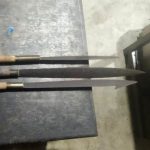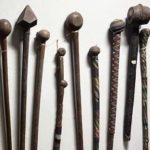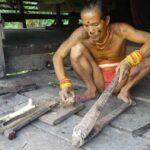
Borneo blowpipes were for generations the primary hunting weapon in the Bornean interior. If we say ‘Borneo’, we mean the whole island, consisting of the two Malaysian provinces of Sabah and Sarawak, the Indonesian province of Kalimantan, and the Sultanate of Brunei. Blowpipes were and are also used in the other provinces of Malaysia (‘Peninsular Malaysia’ or ‘Western Malaysia’), but differ significantly from Borneo blowpipes.
Nowadays (January 2026), however, the use of these weapons is declining and is limited to occasional use by the Penan and other tribes in remote longhouses in the interior of Borneo. According to this source, in 1985, on average in Sarawak, only 29% of families possessed a blowpipe. And even at that time – over 40 years ago – it was rarely used for hunting, except by the Penan people. The above-mentioned source also states that ‘…Penan communities, e.g., on the Silat, Limbang, and Tutoh rivers are still making blowpipes, but the art of their use appears generally to be dying out…’.
What is the difference between the blowpipes in Peninsular Malaysia (Orang Asli people) and Borneo (Dayak/Penan people)?
| Peninsular Malaysia (Orang Asli) | Borneo (Dayak/Penan) | |
| Philosophy | Lightness & Speed: Uses the natural hollow of bamboo. | Weight & Stability: Carves a bore into solid hardwood. |
| Main Material | Buluh Sewor (Long-internode bamboo). | Belian (Borneo Ironwood) and others. |
| Internal Barrel | “Tube-within-a-tube”: A thin inner bamboo sleeve inside a thicker outer case. | One-piece solid bore: A hole drilled through a single solid log. |
| End of Pipe | Simple muzzle. | Integrated Spear: A steel blade lashed to the tip for dual use. |
| Typical Prey | Small canopy animals (monkeys, birds, squirrels). | Large ground animals (wild boar, deer) & canopy prey. |
| Portability | Very light; easy to carry through thick brush. | Heavier; requires more strength but doubles as a walking staff/spear. |
Comparison of blowpipes from Peninsular Malaysia and Borneo.
The Borneo blowpipe design
Borneo blowpipes are locally called Sumpitan, which is very similar to the word used on the Peninsula, where they often omit the ending …an, and call them Sumpit.
The length of a blowpipe depends on the width of the arm’s span (Penan: Depah) of the future owner. In addition to this arm span, one finger span (Penan: Urek) will be added. One Depah is between 150 – 180cm, and one Urek is about 20cm. The total length of blowpipes is therefore between 1.7 and 2 meters (approximately 5.6 – 6.6 feet)
Its outer diameter is between 3 and 3.5cm (1.18 – 1.38 inches) wide, and the inside barrel is 9-12mm (0.35-0.47 inches) wide; the most common is 10mm (0.39’’). The mouthpiece is just a carving at the rear end. At the muzzle, an iron spearhead and a sighting aim will be fixed.
The blowpipe barrel and its manufacturing
Used wood
The barrel will be carved from a single solid piece of Belian/Borneo Ironwood (Eusideroxylon zwageri), or from other heavy hardwoods, such as Tapang (Koompassia excelsa), a Terap tree species (Artocarpus nitidus), Ipil/Borneo teak (Intsia bijuga), Hydnocarpus oil trees (Hydnocarpus anomala), ord others. Most widespread, however, is Belian wood for the blowpipes in Borneo.
For blowpipe production, it is not sufficient to identify the appropriate tree species; it must be the hardest wood of this species, which is the red core wood of the buttress roots.
Clamping device
A straight-grained piece of such wood without any knots or other disturbances in its structure will be split into a 10x10cm (4×4’’) wide log, in the length of the future blowpipe. This log is placed in a scaffold, as shown in the following images. At the top, either a crossbeam or a pipe section is fitted to keep the iron rod in a straight line during drilling. The bottom of the log is not fixed and sits about 5-6 inches above the ground.
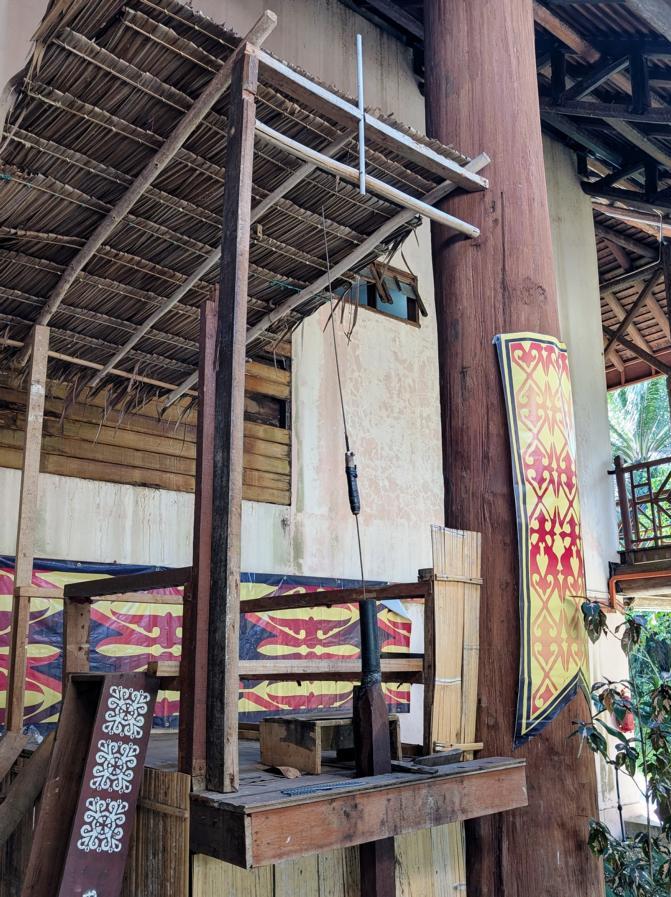
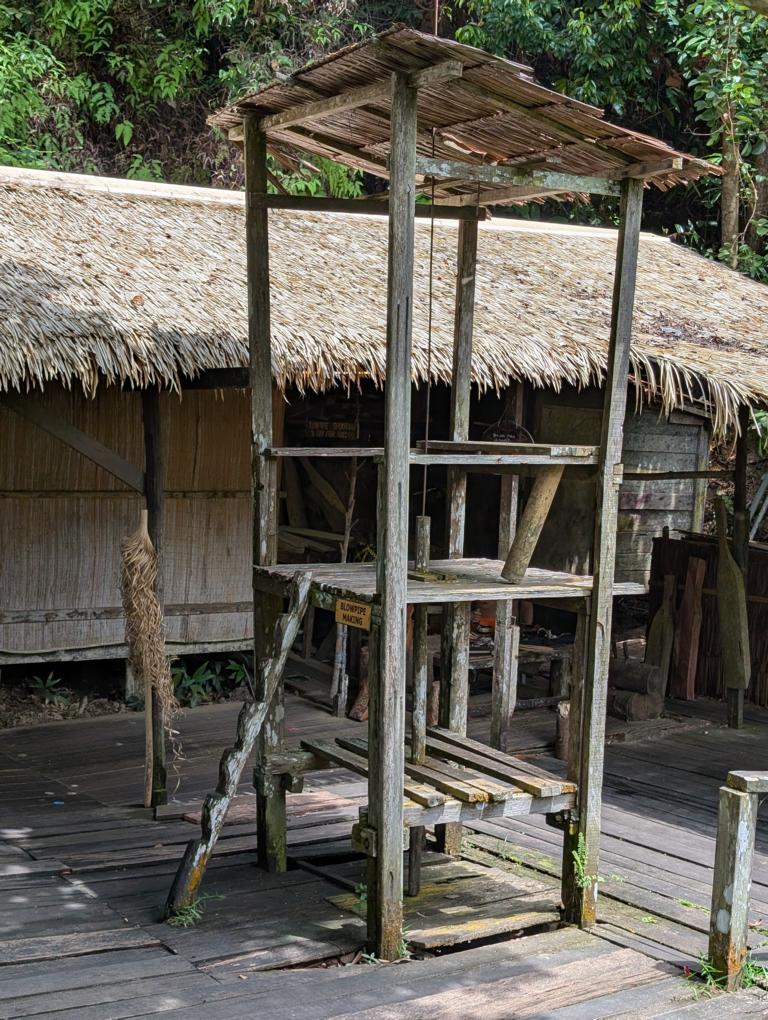
Initially, a shallow hole will be carved right in the center of the log. Then, a long metal rod with a chisel-like tip, slightly smaller than the final hole diameter, is inserted into the initial hole, and the craftsman lifts the rod and allows it to fall into the hole. For easier handling, a movable grip is attached to the rod.
How drilling is done
After each impact, the rod will be rotated by about 1/8 of its circumference. In this way, the bottom of the hole will be uniformly chipped. The wooden chips are theoretically removed by pouring water into the hole. Thereafter, the slurry of wood dust and water is forced out of the top of the hole by the vertical pumping action of the iron rod.
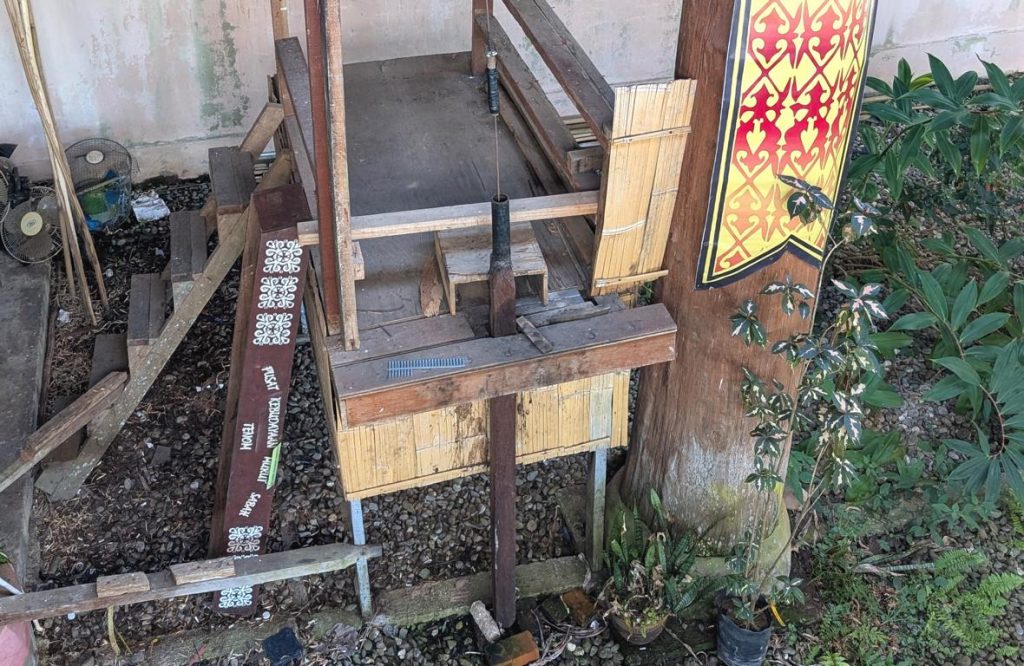
This working principle, however, is very inefficient and time-intensive. The reason is not the wood’s hardness, as often claimed in the literature, but rather the inefficient chip removal. The USDA Forest Service published the following statement for Borneo Ironwood (Belian): ‘…In spite of its high density, the wood can be sawn without difficulty, blunting of cutters is only moderate; machines cleanly…’.
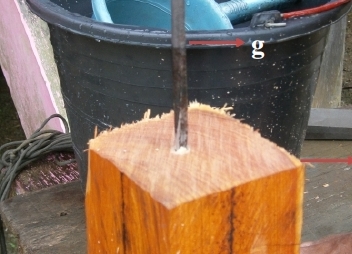
Inefficient chip removal
The problem is that the flat-forged chisel heads lack enough clearance angle. It is nearly as wide at the chisel end as on the whole rod. There is no way for the chips to move upward between the rod and the cut hole.
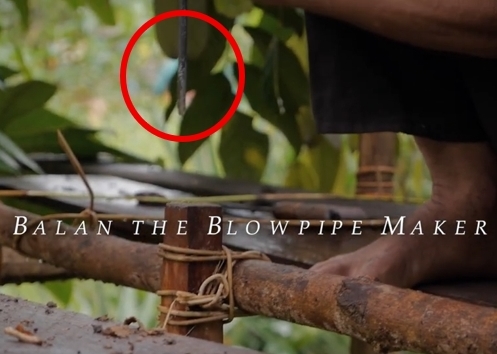
This is clearly evident in the video link above. The wood chips were crushed into wood dust, and only when the rod was retracted was the dust slurry removed by hand. It is clear that this is a time-consuming process. The clearance angle, however, cannot be widened, as at a hole diameter of about 10mm, the rod thickness would have to be reduced to about 6mm or less, which is insufficient for a stiff rod that will maintain its direction. The compromise is to accept an extended working time for a long, thin, and straight hole.
To maintain the straightness of the hole during drilling, the strokes of the iron rod have to be long so that gravity can take effect. Additionally, the clamped log will be rotated periodically to mitigate minor hand leans. Experienced craftsmen can also “hear” if the drill is going off-center by the resonance of the iron rod against the hardwood.
Due to the inefficient process, it will take approximately 10 hours of continuous chipping to drill a straight hole approximately 2 meters long.
This first part described the rough production of Bornean blowpipes. In the following second article, we will describe how to finish it and the design elements of the Borneo blowpipes, including their use.