Borneo blowpipe darts are very similar to those of the Orang Asli people on the Peninsula. The main difference is that they also use strings as tail-end material, sometimes use fletches for higher accuracy at longer distances, and use tiny broadheads for larger game.
Description of Borneo blowpipe darts
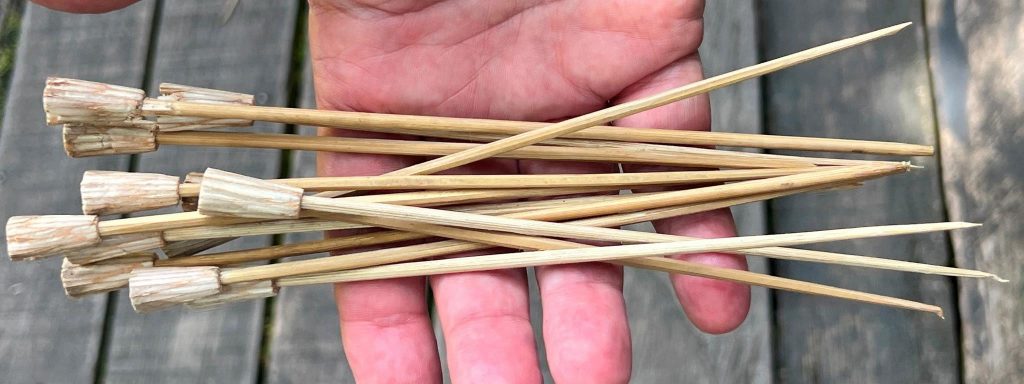
The darts consist of two parts: a wooden, needle-like shaft and a conical and compressible tail end. They are about 10 inches (25.4cm) long, very thin, and light. But in general, blowpipe darts in Borneo are slightly larger than their counterparts in Peninsular Malaysia.
Shaft material
The shaft is often made from the leaf stalks (petioles) of various palm species or from bamboo stems.
- Wild sugar palm (Arenga undulatifolia), Jaka in the Penan language, and commonly known as Aren Gelora in Bahasa Malaysia.
- Nibong (Oncosperma tigillarium) palm.
- True sago (Metroxylon sagu) palm.
- Buloh Temiang (Schizostachyum jaculans), this long-knotted bamboo species, also used for making blowpipes by the Orang Asli people, is used for the shafts.
- As well as various other bamboo species are used.
- In old literature for shaft material, the wood of Apeng trees and leaves of Mudor trees were mentioned. But even a knowledgeable friend in this field, living in Sarawak, did not know the Bahasa or scientific names of these two local expressions.
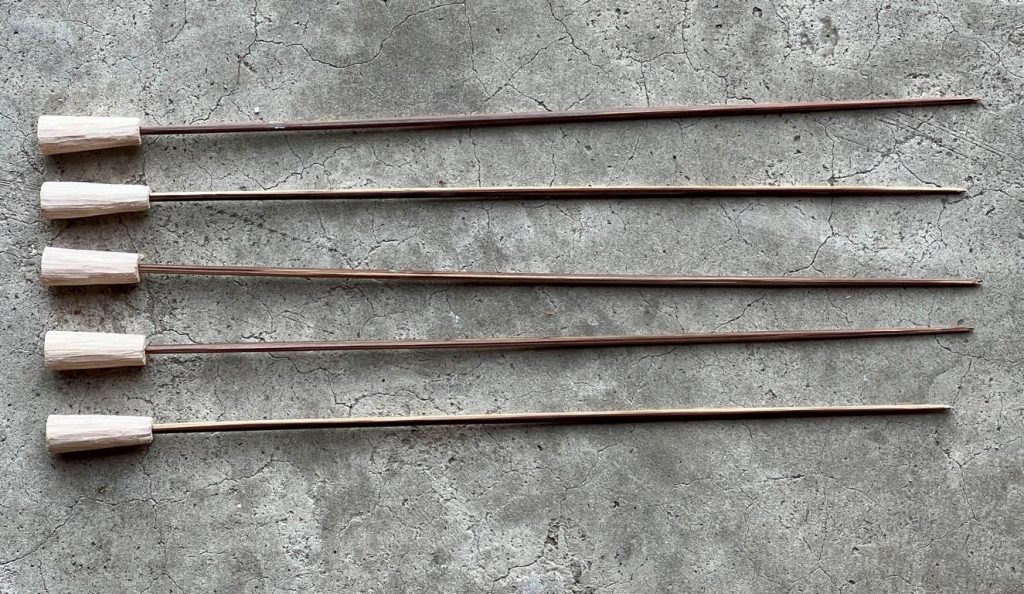
When using the petioles of Wild sugar palm, Nibong, or Sago palms, these petioles will be cut from the end of the leaf sheath to the first leaflet, which results in a petiole stick. The upper surface of this stick will be split off from the remaining material. Only a sliver of this surface material is tough enough for the future darts and tends to fly straight. The whole surface sliver will now be cut into sections of double final dart length and sliced into thin sticks. These will be bundled and dried over slow embers before finally carving into dart shafts.
Tail-end material
The tail end is commonly made from either a spongy, cork-like plant pith material or a bundle of strings. When using corky material, it is often obtained from the tissue region between the epidermis and the vascular bundles (petiole cortex) of plants.
- The favorite palm species among the Penan people in Borneo for this application is Eugeissona utilis, commonly known as the Arau tree (Bahasa Malaysia) or the Stilt-Root palm (common English name).
- Also, the True sago palm (Metroxylon sagu) pith is commonly used.
- As well as Tebu (Saccharum officinarum), the inside of sugar cane stalks.
- The same piece of literature (Sarawak Gazette, Jun 5, 1907) as mentioned before, described that ‘…Pabong, the root of the Akar Plai…’, and ‘…Joran, a very thorny plant found in abundance in the jungle…’ is commonly used for the cone pith. Also, the scientific names of these local expressions are currently unknown.
Procedures of handling the tail-end material
After removing the epidermis from Arau or sago palm petioles, the soft cortex material is cut into sticks and dried over a fire. After drying, these sticks will be cut into about 1-inch (2.54cm) long sections. To make these small pieces easier to handle, the Penan people use a wooden stick with a nail attached, called Beturan.

Onto this nail, the raw piece of corky wood will be fastened, and the outer diameter of the wooden handle correlates with the borehole diameter. This way, the cones can be easily carved in the right dimensions.
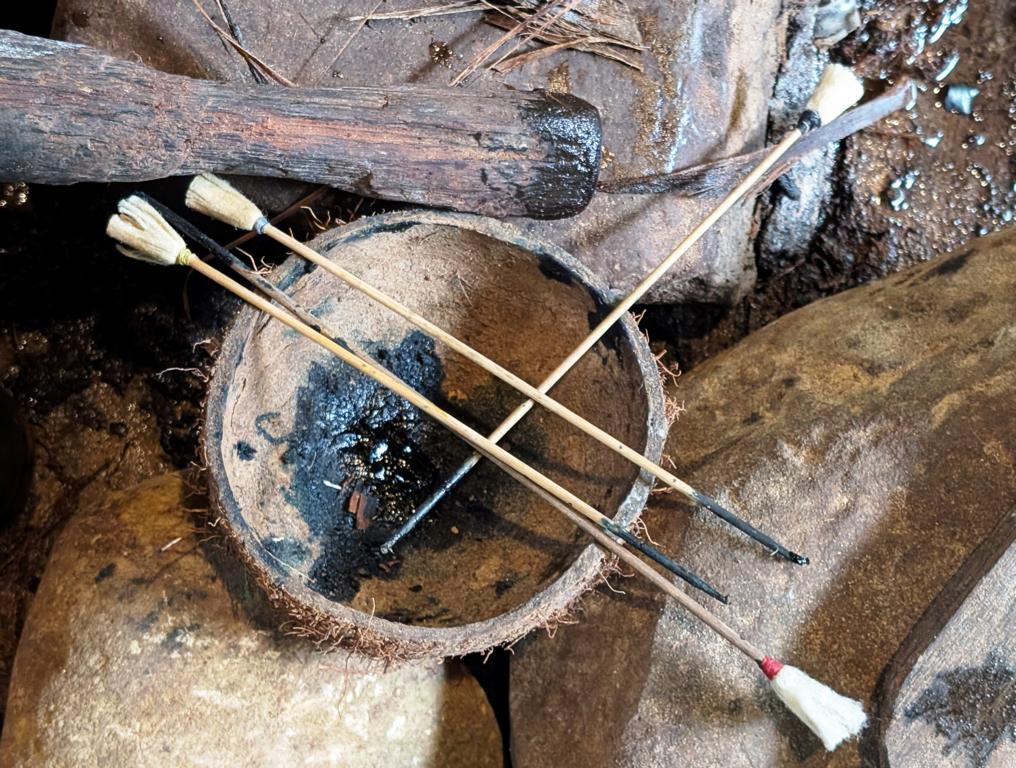
Besides plant material cones, string bundles are also used to seal the air from the mouth to the dart’s tail-end.
A unique feature of Borneo blowpipe darts used by the Penan and various Dayak tribes is the leaf fletch. For heavy Belat darts, they cut small vanes from dried leaves or modern materials and affix them to tiny slits at the end of the shaft to improve stability over long distances.
Types of darts used
Dart with a pointed wooden tip
The most common Borneo blowpipe darts have a fine, needle-like point and are not poisoned. They are called Tahad in the Penang language. Before using these darts, their tips will be hardened by holding them briefly over a glowing ember from the fire. These darts create deep wounds and are used for training and shooting squirrels and other small game.
Dart with a pointed wooden tip, notched and poisoned.
Dart poison is applied to Tahad darts when shooting monkeys, mouse deer, palm civets, and other mid-sized game. First, the tips of these darts will be slightly grooved to improve the poison’s retention. After hardening the grooved tip over hot embers, either two notches on the opposite side or a circular notch will be cut into the shaft. Thereafter, at least 1 inch (2.54cm) of the grooved tip will be coated with poison. Due to the notches behind the poisoned area, the tip will break off in the wound and remain there.
Dart with a metal broadhead, notched and poisoned.
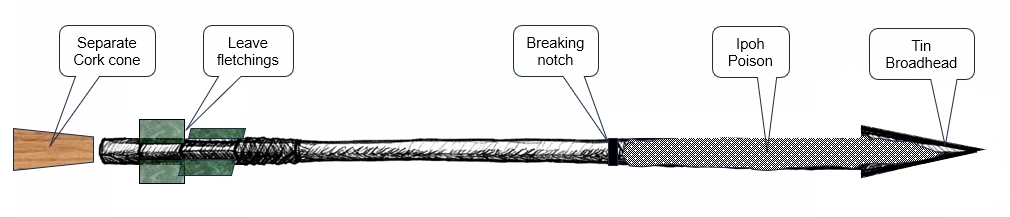
When shooting animals with tough skin, such as sambar deer or wild boar, a small, barbed broadhead will be affixed to a slightly heavier shaft than that used for monkeys. The barb is usually a small, sharply ground metal triangle cut from a tin. Such a dart is called Belat by the Penan people. It will be grooved along the whole upper third of the dart and notched behind that area. The whole upper one-third length of the dart will be heavily poisoned.
Two small rectangular cut leaves will be added crosswise at the rear, which serve as vanes. And the ubiquitous cone will not be fixed to the dart, but only loosely laid behind the wooden shaft of the dart at the rear end of the pipe. The broadhead and fletchings will center the dart within the barrel, and will be driven by the cork cone and a ball of wad material for air-tight sealing. After impact, the barbed head will remain in the target’s body. Such a dart was also described by Bruno Manser in his Diary #4, Page 12.
Other projectiles
When shooting passerine birds, the Penan people seldom use their valuable darts; instead, they apply fire-hardened clay pellets. These are easy to make and equally effective.
Shooting the darts
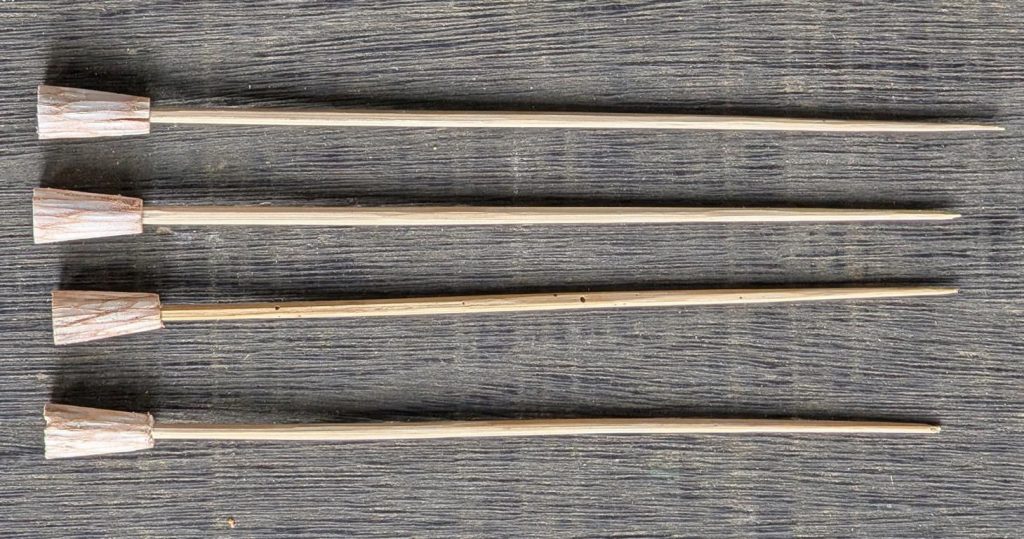
A dart is put into the barrel at the mouthpiece end, a wad is added, and the blowpipe is lifted to the mouth. With an explosive breath, the dart is driven out. Up to twenty-five yards, Penan people shoot with accuracy, but though the darts can be sent fifty yards or more, at any distance greater than twenty-five yards, their aim is uncertain.
Blowpipe dart quivers
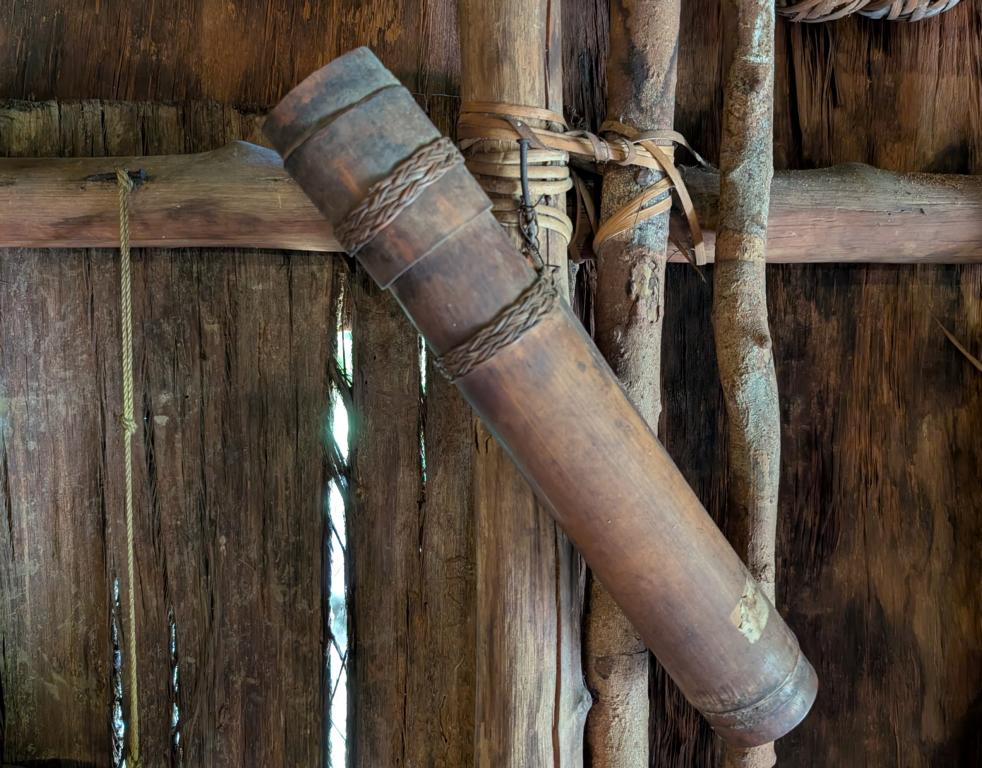
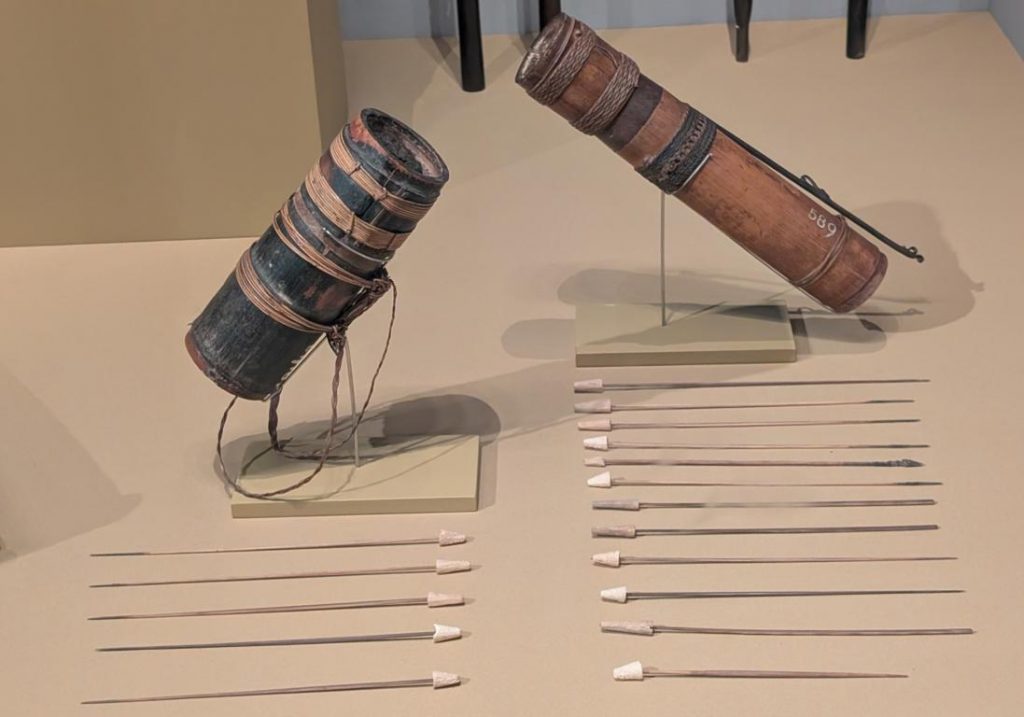
Borneo blowpipe darts will be stored in bamboo quivers and attached to the belt with a wooden fork, which is an integral part of the quiver.
Lessons learned about Borneo blowpipe darts
- Penan and Dayak people in Borneo use slim wooden darts, which are either poisoned or not, for shooting small and mid-sized animals.
- For large animals, poisoned broadheads with vanes on sturdier darts are applied.
- Song birds are targeted with clay pellets.