
Food from Plants
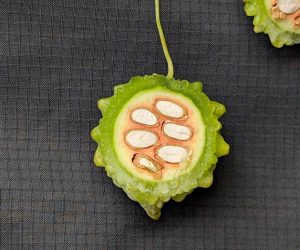
Discover Katu Karavila: Sri Lanka’s Wild Bitter Gourd
In Sri Lanka, a variety of cultivated and wild bitter gourds occur. The most commonly collected wild bitter gourd (Momordica charantia var. muricata (Willd.) Chakrav.) is, in fact, only a semi-wild one. It is locally called කටු කරවිල (Katu Karavila), and the English common name is – confusingly – ‘Wild Bitter Gourd’. Momordica charantia var. muricata is a botanical variety of bitter gourds that sits taxonomically and morphologically between the cultivated bitter gourd and truly wild Momordica species. It is often a source of confusion because it shares traits with M. charantia (the cultivated form) as well as with M.…
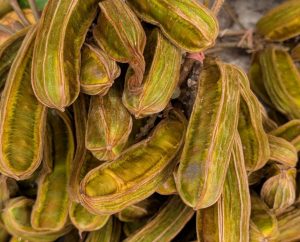
Inga edulis, the Ice Cream Bean
Inga edulis, the Ice Cream Bean, is also known as Snow fruit; and it has various other common names, like ‘Snow-white’ in Indonesia. We found these fruits at a wet market in Bedugul, above Danau Bratan, in the central highlands of Bali. From there, we searched for the trees on which these fruits were growing and found them between Tamblingan and Munduk. Only later were we informed that this is not an endemic fruit. Distribution As shown in the map above, the Ice Cream Bean is native to Central and South America and is widely distributed across these regions. It…
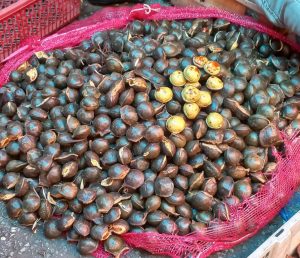
Jengkol seeds
Jengkol (Archidendron jiringa) is a tropical tree that grows up to 20 meters high in the rainforests of Southeast Asia. The seeds are mainly eaten in Indonesia, but also in Malaysia, Thailand, Cambodia, and Myanmar. These seeds are called stink bean or dog fruit in English, which outlines their smell. Description and comments Archidendron pauciflorum is closely related to Archidendron jiringa. They are often considered synonyms or variants of the same species, depending on the taxonomic source. However, some botanists differentiate between them based on morphology, geographical distribution, and local usage. Which further blurs the picture of which species is…
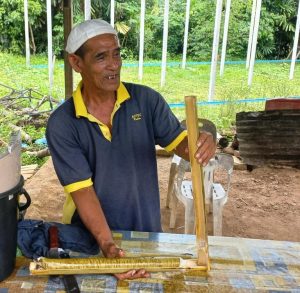
Cooking Rice in Bamboo Tubes: A Southeast Asian Method
Bamboo is a highly versatile plant that can be used for various applications, including cooking rice in sections of its culms. Near Gerak, in Perak State, Malaysia, I met a street vendor who was traditionally cooking rice. Similar vendors can also be found in most other Southeast Asian countries. In the following, I would like to describe how he cooked the rice. However, there are many ways to skin a cat. His approach can be either more simplified (e.g., when staying in the forests) or more refined (e.g., for a private party). But it serves as a good starting point.…
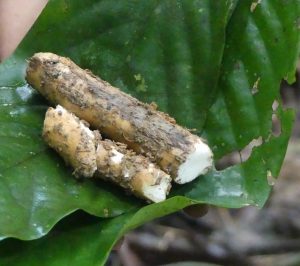
Wild yam in Perak’s forests
When walking with Orang Asli people from the Jahai tribe in the forests near the Royal Belum State Park in Perak, Malaysia, they showed me their traditional favorite staple food source: wild yam tubers. These tubers can be eaten without any detoxification. Their only drawback is that they are long and slender and grow deep in the soil. It is therefore a laborious task to extract them, and often only pieces of tubers can be retrieved. Which species of wild yam did we harvest? Siti Nursyadiq Anuar researched the use of wild tubers among the Bateq people, who, like the…
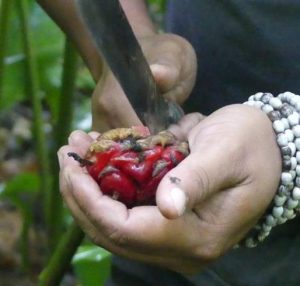
Red torch ginger fruits
Red torch ginger (Etlingera elatior) fruits are commonly eaten by Jahai Orang Asli people in the forests of the northern State of Perak in Malaysia. These fruits are not only consumed by the forest dwellers of Perak State, but also widely over Southeast Asia. They are gathered and sold on markets at least in parts of Peninsular Malaysia, and all over Borneo and the Indonesian archipelago. Due to this wide distribution, there are various common names, like Buah Kantan, Buah Kecombrang, Ketimba, and many other local names. Plant description and distribution The circumpolar distribution in tropical countries of Etlingera elatior…
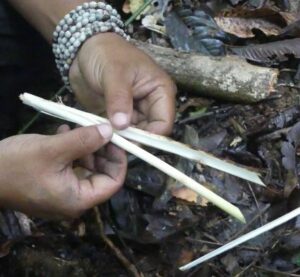
Rattan Palm Hearts: A Jungle Snack of the Jahai in Malaysia
When walking with Jahai Orang Asli people near the Royal Belum State Park in Perak, Malaysia, they showed me some of their plant food sources in the forests. One of them was young rattan palm shoots. For the Jahai people, it was not important which exact rattan species it was, but the young rattan shoots had to have thumb-thick stems. Plant description The stems of the rattan palm shoots develop from rhizomes underground. Therefore, often, more than one stem develops from such a rhizome. The stems are heavily thorned, and additionally, flagella develop from these stems and will grab with…
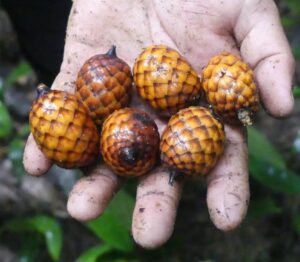
Rattan palm fruits in Perak’s jungles
Rattan palm fruits are available from most of the 70 species of the Calamus genus in Malaysia. But also species of Daemonorps and Korthalsia rattan genera often carry edible fruits. We went with the Jahai Orang Asli people into the forests near Royal Belum State Park in Perak, and collected rattan palm fruits from two different species. One species seemed to be Calamus ornatus, and the other one resembled Calamus manan. All articles on this website are not the result of scientific research projects, but should explain in a popular-scientific way practical knowledge for simple living and survival situations. It…

Wild Ginger Stalks: Food and Remedy of the Jahai in Malaysia
When walking with the Orang Asli people of the Jahai tribe near the Royal Belum State Park in northern Malaysia, they showed me various edible plants in the rainforest that they ate regularly. One of them was a Zingiberaceae (Ginger) species, which they called ‘Lebek’. The names ‘Lebek’ or ‘Labek’ are used by them for various wild ginger species, which either provide rhizomes used medicinally or edible shoots and fruits. Plant description The large, alternate leaves of the plant shown grew in two ranks from a pseudostem, which is typical for gingers. The stalks were thick and upright, reaching heights…
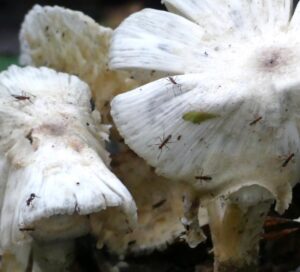
Moon mushrooms at the Royal Belum State Park in Malaysia
Moon mushrooms (Gymnopus sp.) are one group of edible mushrooms found in the forests of Malaysia, and are locally called ‘Jamur bulan’. The other groups of edible mushrooms are colloquially known as wood ear mushrooms, oyster mushrooms, and shiitake mushrooms. This is a stark simplification, on which every mycologist will cringe, but it describes in practical and simple terms which mushrooms can often be eaten. When walking with Orang Asli people of the Jahai tribe in the forests of the Royal Belum State Park in Perak, Malaysia, they showed me these mushrooms as one of their food sources. Although this…
Fruits eaten by Mentawai people
The fruits eaten by Mentawai people in the forests are various species of bananas, coconuts, durians, and fruits from the rattan palm. Other fruits are also harvested, of which some grow wild, while others are planted and cultivated. Fruits are by far more seasonal than staples and vegetables, and there is a higher variety of fruits available compared to staples and vegetables. Wild fruits gathered by Mentawai people Besides rattan palm fruits, various other fruit species grow wild in the forests. These are the fruits of the Marang tree, Torch ginger, Helmstedtia, Pianggu, and the Wild Cranesbill bush. Black Rattan…
Mentawai Vegetables: Wild, Semi-Cultivated and Cultivated
Cassava (Manihot utilissima) leaves and Fiddlehead ferns are the most essential vegetables for the Mentawai people living in the forests of Siberut Island. Both vegetables were discussed in separate articles on this webpage. Details about Cassava leaves can be found at the provided link, and about Fiddlehead ferns (Diplazium esculentum) and (Diplazium polypodioides) here. Besides these two vegetables, Torch ginger flowers (Etlingera elatior), which are used both as a vegetable and a spice, were discussed in the linked article. However, these are not the only vegetables eaten by the remote Mentawais; a wide variety of other vegetables are available. Some…
Staple foods of the Mentawai: Sago, Taro and Bananas
Three of the four most essential food plants for Mentawai people on Siberut Island in Indonesia are carbohydrate sources. Notably, sago is a key provider, with an average composition of approximately 94% carbohydrates, about 7% moisture, and negligible other components. Besides sago, taro, and bananas/plantains, other starchy foods are grown, as seen in the following table. Due to the forest conditions, rice is not traditionally planted in Siberut, but it is sometimes obtained through trade or as gifts from relatives in the villages. According to Pradipta (2019), in the 1980s, governmental reforms were implemented throughout Siberut, aiming to replace sago…

Edible Ferns of Papua New Guinea
Some times ferns are eaten in large quantities. At highland pig kills, ferns are one of the most common edible greens. Some ferns are only eaten with meat. Some other ferns are eaten more regularly and are very much liked. Ferns used as edible greens in Papua New Guinea The ferns marked with an asterix * are probably the ones most commonly used. Other ferns as well are used. Most of these ferns are not planted but are left when clearing land and are maintained and sometimes transplanted. Normally they are eaten with meat. In some areas they are eaten…
Origin of Bananas
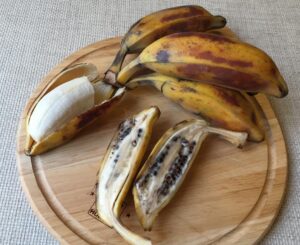
Most areas of Papua New Guinea have bananas. Some people have them as their main staple food while in other areas they are just a snack food. There is a very large amount of variation within the banana varieties in Papua New Guinea. It is important to understand something about these types of bananas. Within some of these groups, Papua New Guinea has more varieties than any other country in the world. Within the banana group of plants there are several wild ones. In Bougainville the rainforest has many wild inedible bananas. But this article is about the main group…
Tu-Lip trees in Papua New Guinea
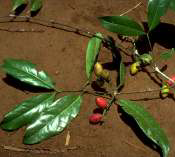
Tok Pisin: Tu lip; Scientific name: Gnetum gnemon What does a tu-lip tree look like? It is a small tree often only 8-10 metres high. It is a fairly straight tree with one trunk that has branches spread out along its length. The branches are not very long so that the tree does not spread out very wide. The tu-lip tree In Tok Pisin this small tree is called tu-lip. As people in Holland and other countries grow a flower called tulip, we need to point out that the two plants, or their names have nothing in common. The “tu-lip”…

Ambarella fruit in the Mekong Delta
Ambarella fruit (Spondias dulcis Parkinson; syn.: Spondias cytherea) is native to Melanesia and Polynesia and was introduced worldwide throughout the tropics. Its other common English names are Jew plum and Golden apple. In the Mekong Delta, it is omnipresent in orchards and gardens. Its Vietnamese name there is cóc [kawp̚˧˦]. Depending on its ripeness, the fruit tastes pleasantly sweet-sour with a hint of Mango, and its texture is like an apple’s. The only setback is its pit, which is very hard and spiny. It reaches deep into the surrounding fruit flesh, and the fruit is, therefore, difficult to eat. Description…

Ginger flowers add zest to food
Ginger flowers are eaten in many Southeast-Asian cultures. In Indonesia, most ginger varieties are known from Siberut Island. The native population of this island has utilized the flowers of Torch Ginger (Etlingera elatior (Jack) R.M. Sm.) since ancient times for medical and culinary purposes. These plants are also known under Red Ginger Lily and other local names. The Mentawai people call them ‘Tairatti’. Brief description These flowers have elongated buds on tall stalks with green, fleshy, fibrous stems. The buds are oval-shaped and about 10cm long and covered by protective, modified leaf coverings known as bracts. When the flowers are…

Young Cassava Leaves provide protein and micronutrients
Young cassava leaves are a regularly eaten side dish for Mentawai people. Cassava (Manihot esculenta, Crantz) is endemic to the southern rim of Amazonia in South America. There, it was domesticated around 5000 BC. In the 16th century AC, Spanish and Portuguese explorers brought them to Africa. Only in the 1960s was cassava introduced to Asia. So, it is not a traditional food addition to Mentawais but only a recently adopted one. Mentawai eating habits As mentioned in previous articles, Mentawais’ staple foods are Sago, Taro, and Bananas. These are foods rich in carbohydrates. Protein comes from the field, stream,…

Vegetable ferns are a source of nutrients in Siberut
Vegetable ferns (Diplazium esculentum (Retz.)) are among the few wild vegetables Mentawai people in the forests eat regularly on Siberut Island. By Mentawais, they are called ‘Laipat.’ Other wild vegetables are cassava leaves, ginger flowers, taro stalks, and wild eggplants. In times of hunger, Mentawais also eat shoots of sugar palms. But generally speaking, all these wild vegetables are just an irregular addition to the regular diet of sago/taro/bananas and meat. Where do vegetable ferns grow? Vegetable ferns (Diplazium esculentum) prefer to grow at the edge of forests towards cultivated land. However, distinguishing between cultivated and non-cultivated land is often…

Rattan fruits in Siberut jungles
Rattan fruits are available throughout the year in all Southeast Asian rainforests. There are about 600 different species of rattans, and many of them bear edible fruits. However, rattan prickles are a common nuisance when walking in the jungle. Nevertheless, the usefulness of the rattan plants is weighing up this disadvantage. Rattan fruits can be eaten, and young rattan stems contain an edible core. And there is no stronger and more flexible binding material than from some rattan species. For the Mentawai people, rattan palms are necessary for binding and construction materials, food additions, and coconut grating devices. Rattan as…

Taro – another staple food of the Mentawai people
Taro (Colocasia esculenta (L.) Schott) is one of the three staple food items of the Mentawai people on Siberut Island in Indonesia. The other two are sago and bananas. In many other countries, taro leaves and corms are eaten. Mentawais prefer just eating corms and eat leaves only occasionally. Before imported tobacco arrived, dried taro leaves were rolled into cigars and used as a stimulant. Taro plants on Siberut Island. Two types of taro cultivars exist: Colocasia sp and Xhantosoma sp. At Siberut Island, most taro types are Colocasia species with one bulb. Mentawais cultivate taro in dedicated patches of…

Roasted Sago sticks on Siberut Island
Roasted sago starch is the staple food for Mentawai people living in the moist, tropical forests of Siberut Island, off the coast of Western Sumatra in Indonesia. On the other hand, sago, boiled to porridge, is eaten as a staple food in areas of Papua New Guinea and the Pacific Islands, where rice farming is not possible. Sago Palms Sago palms have already been discussed on our website. A summary of the most important essential information about sago palms can be summarized as follows: After cutting down a harvestable sago tree, there are always small saplings in the vicinity that…

Mangrove apples at the Mekong Delta
Mangrove apples are the fruits of Sonneratia sp. trees, one of the important genera of trees in the Mangrove forests of Southeast Asia. All species of Sonneratia will develop edible Mangrove apples. The various Sonneratia species differ slightly in shape, orientation of calyx leaves, and direction of style (long, slender stalk in female flowers). Description of Sonneratia sp. For this article, I took pictures of trees and fruits of Sonneratia caseolaris, which, together with S. alba, is the most widely distributed Sonneratia species from Eastern Africa via Southeast Asia to Micronesia. See the distribution map below. Sonneratia trees grow directly…

Fongaar: The Coastal Morning Glory That Feeds Papua New Guinea’s Drylands.
When people talk about traditional root crops in the Pacific and Papua New Guinea, yams, taro, and sweet potatoes usually steal the spotlight. Yet tucked away in the drier coastal woodlands and sandy lowlands of southern Papua New Guinea is a lesser-known sweet potato relative that plays a vital role in local food security: Fongaar (Ipomoea macrantha). Known in other parts of the tropical Pacific as beach moonflower, this vigorous climbing vine produces massive, starchy underground storage roots that bridge the gap between harvests and store remarkably well in traditional yam houses. Understanding how local communities identify, cultivate, and preserve…

Pitpit – Edible grasses in Papua New Guinea
Three types of pitpit grow in Papua New Guinea: Coastal pitpit The pitpit plant looks like sugarcane to which it is related. Normally the stalk is thinner than sugarcane. It can grow up to 3 metres high and produces suckers near the base so that normally a clump is produced. At one season of the year, it produces a seed head or flower that remains inside the top of the plant and is the part that is eaten. Where is coastal pitpit grown? Coastal pitpit is grown throughout Papua New Guinea from the sea level up to about 1700 metres…

Wild Karuka and another pandanus fruit species
The Pandanaceae botanical family comprises the following six species in Papua New Guinea: ‘Karuka’ and ‘Marita’ were already discussed on this website in two former articles. ‘Karuka’, see here, and ‘Marita’ see there. In the following, ‘Wild Karuka’ and Pandanus antaresensis will be presented. Wild Karuka (Pandanus brosimos) Tok Pisin: Karuka The wild Karuka plant. The wild Karuka plant looks a lot like the cultivated Karuka. The leaves are bigger and normally they point straight up instead of bending over at the top. The trunk of the tree is straight like a palm, but it can have some branches near…

Karuka – cultivated pandanus fruits and nuts
Tok Pisin: Karuka Scientific name: Pandanus jiulianettii Two species of pandanus are commonly used for the nuts that are eaten. They are Karuka (Pandanus jiulianettii Martelli) and wild Karuka (Pandanus brosimos Merr & Perry). At least 3 other species of pandanus are used occasionally in Papua New Guinea for edible nuts and marita pandanus is used for the long red fruits. The leaves of many other pandanus species are used for rain capes, sleeping mats, canoe sails etc. This article is about cultivated Karuka. The Karuka plant The Karuka tree is a tall palm like tree with a straight trunk…

Giant Taro – a plant with a giant root
English: Giant taro; Scientific name: Alocasia macrorrhiza (L.) Schott; Synonyms: Alocasia indica (Lour.) Spach; Plant family: Araceae Description of Giant Taro plants A very large herb of the taro family. It has a stout erect trunk up to 4 m tall. This has upright leaves which are arrow-shaped. The leaves have round lobes at the bottom. The leaves are leathery and are often wavy around the edge. The secondary veins are not prominent. The leaf blade can be 1.0 – 1.2 m long. The leafy structure around the flower is yellow in the upper section. It forms a hood and…

Marita – a lesser known pandanus fruit
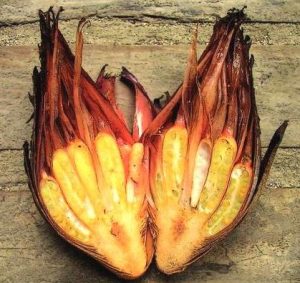
English names: Marita or ‘Red Fruit’ Tok pisin name: Marita Bahasa Indonesia name: Buah Merah Scientific name: Pandanus conoideus Lamarck The marita pandanus plant A short much branched screw pine with many prop roots. The prop roots have prickles. Trees may have up to 8 or 10 main branches. Trees grow up to about 5 metres tall. There are many short sharp spikes on the trunk and branches. The leaves are between 1 and 2 metres long and about 10cm wide. The leaves grow opposite each other but are twisted to look like a spiral. There are thorns along the…

Yam varieties in Papua New Guinea
Four species of yam are commonly grown and used for food in Papua New Guinea – but often naming in villages and naming by scientists do not agree. Many village people regard potato yam and 5-leaflet yam as varieties of greater yam. All yams have long creeping vines that wind around sticks. Tok Pisin language: Yam tru; Mami. Scientific names: Greater yam The greater yam has a stem with wings on the sides making it square. The heart-shaped leaves are in pairs along the vine. Under the ground, it normally produces one fairly large tuber. These tubers can be many…

Solomon’s Sago Palm: How it differs from True Sago
How is this sago different? The Solomon’s sago palm that occurs in the North Solomon province and the Solomon Islands is quite different from the sago that grows in other areas of Papua New Guinea. It has a different scientific name. The scientific name is Metroxylon salomonense. Originally, the sago in North Solomon Province was called Metroxylon bougainvillense, but now that name is not correct as the plant is the same as the one in the Solomon Islands. How is it different? The leaves or fronds of this sago palm are much larger than those of the other Papua New…

Sago – staple food in parts of Papua New Guinea
There are two Sago palm species in Papua New Guinea. Metroxylon sagu Rottb. and the other one occurs in North Solomons Province and the Solomon Islands. Its scientific name is Metroxylon salomonense. The sago palm plant The sago palm grows up to 10 or 25 m tall and is nearly a meter across the trunk. It produces suckers around the base. After about 15 years the main trunk produces a very large flower at the top and then the trunk dies. The center of the trunk is filled with starch. The plant also produces useful building materials. The fronds are…

Harvesting Bamboo Shoots at the Red River near Hanoi
With more than 70 bamboo species throughout the country, we can easily find bamboo thickets anywhere in Vietnam. Many could nurture one of the most popular and favored vegetarian foods for Vietnamese people, bamboo shoot harvesting. Two main types of bamboo along the Red River bank near Hanoi Bamboo appeared hundreds of years ago along the Red River’s left bank near Hanoi. They help protect the bank from erosion and other destructive acts. There are two main types of bamboo along the left bank: the spiny bamboo or thorny bamboo (Bambusa blumeana; Vietnamese name: tre gai) – this type of…
Indochina Dragon Plums from Hanoi streets
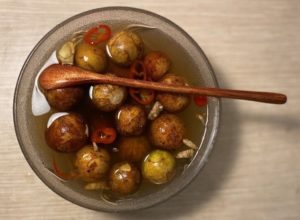
The Indochina Dragon Plum (Dracontomelon duperreanum) is a genus of flowering plants in the family Anacardiaceae. In Vietnamese, it is called chi sấu). Dragon Plums are one of the most popular trees on the side of Hanoi streets. The fruits of the trees are also famous for being used by Hanoi gourmets. However, the fruits are usually harvested and used when green. Let’s see how the ripe dragon plums could also become one of the most unforgettable flavors of Hanoi. Harvest the ripe dragon plum. The best time to harvest ripe dragon plums is early autumn, in August or September.…

Marang fruits in Southeast-Asian Rainforests
There are several local names for the tree and fruits of Artocarpus odoratissimus. In English, it is simply called ‘Marang’, which is based on the Philippines’ common name for this fruit. Originally endemic to the region around Mindanao, Sarawak, Kalimantan, and Palawan, it is nowadays cultivated in many Southeast-Asian countries, and it can grow wild in areas 15 degrees north and south of the equator. Marangs are related to Breadfruits (Artocarpus altilis) and Jackfruits (Artocarpus heterophyllus); all three of them belong to the same genera Artocarpus. Size wise they are right in the middle between smaller breadfruits and larger jackfruits.…

Cashew apples and -nuts in Goa, India
Cashew trees (Anacardium occidentale) are native to areas around Northeastern Brazil. Portuguese colonists brought them around 1560 to Goa, India, from where they spread to Southeast Asia and Africa. Therefore, cashew products already have a long history in Goa and are considered a local food item. Currently, Cote d’Ivoire, India, and Vietnam are the primary producers of cashew nuts. In 2020, India produced 18% of the world’s cashew nuts. Cashew harvesting season is in Goa from about March to mid-May each year. The cashew fruit, as a whole, consists of the cashew apple and the cashew nut. The cashew apple…

Jujube trees at Ayutthaya in Thailand
The Ayutthaya Historical Park covers the ruins of the old city, which was founded by the Khmer in 850 AD and named after the Hindu holy city of Ajodhya. The city was destroyed by the Burmese in 1767 and has been a UNESCO World Heritage site since 1991. It is also famous for its Jujube trees. History of Jujube trees at Ayutthaya King Naresuan (1556-1605) had his residency at Ayutthaya, and after a battle with the Burmese, he ordered to plant hundreds of Jujube trees (Ziziphus jujuba) all over the palace. At a decisive battle with the Burmese, his elephant…

Chanterelle mushrooms in Thailand
Thai chanterelles, specifically Cantharellus minor, live in symbiosis with Gurjun trees (Dipterocarpus tuberculatus) in semi-deciduous Southeast-Asian forests. These trees are easily identified due to their double-winged (di-ptero) fruits with big seeds. Besides Cantharellus minor, other species of chanterelle mushrooms are native to Southeast-Asian forests. They are fragrant and tasty and differ mainly in size and shape. Where to find and get chanterelles in Thailand Areas under Dipterocarpus trees are often burned for agricultural purposes in northern Thailand, and the mushroom mycelium normally survives the fires, as the heat is not intense enough to kill it off. As long as the…

Harvesting and opening Nipa Palm fruits
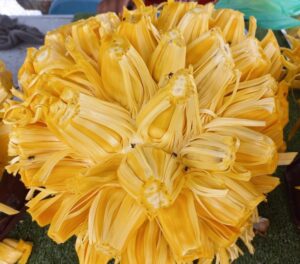
Nipa palms (Nypa fruticans) are a species of palms especially adapted to muddy environments of slow-moving tidal waters and mangrove forests. They occur in Asia-Pacific tropical climates. Nipa palm fruits are delicious to eat. Both the fruits and wooden parts float in water, which facilitates the distribution of its nuts and can be utilized for floating devices. The endosperm within the kernel, the sap of the flowering stem, and young shoots can be used for human consumption. In this post, we will focus on the kernel. Nipa palm fruits Throughout the year, there is no specific time when fruit-bunches are…

Morning glory – a valuable wild vegetable in Asia
Swamp morning glory or Water spinach (Ipomoea aquatica) has various common names, like ‘Kangkong’ in Southeast Asia or ‘Kung Shin Tsai’ in China. It is a staple vegetable food throughout the Asia-Pacific region. It is deficient in calories (19 cal/100 g) but high in vitamins (Vit. C, Vit. A, and others), minerals, and antioxidants. The taste is slightly sweetish; the texture of the leaves is succulent, and the stems are hollow, a bit mucilaginous, and crunchy. It is used for salads, stir-fries, or – best for my taste – braised with garlic. An in-depth description of this vegetable can be…

Heavenly Durian
The fruit Durian (Durio zibethinus) is named after the Malay word ‘Duri’ for ‘Thorn’, referring to the thorny skin, and ‘zibethinus’ obviously refers to its smell. And the most sought-after variety in Malaysia is ‘Musang King’, where ‘Musang’ means ‘Palm civet’. There seems to be some relationship. Every country in Southeast Asia pretends to have the best-tasting Durians. Therefore, every traveler should be aware of when to talk and when to be quiet on the topic of Durans. There are generally some topics that cannot be discussed without emotion. In Southeast Asian countries, this not only concerns politics and religion…