
Tools & Gear
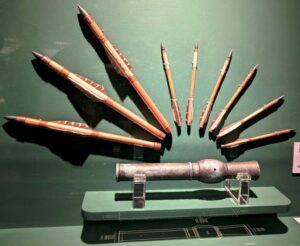
Hwatong – A Korean hand-held arrow fire tube
When we examine traditional hunting and projectile tools around the world—from Hadza wooden bows in Tanzania to spring-pole traps in Sumatra—we usually see a clear separation between muscle-powered weapons and gunpowder firearms. In medieval Korea, however, engineers bridged both technologies in a compact bronze tube known as a Hwatong (火筒) (literally “fire tube”). Rather than firing round lead musket balls, these early hand-held cannons were designed primarily to launch heavy, fletched arrows using the explosive force of black powder. Hwatong – A Combination of Bow & Arrows and Black Powder At first glance, shooting an arrow out of a metal…
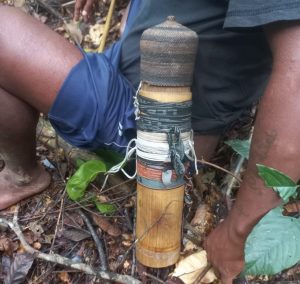
Blowpipe Dart Quivers of the Orang Asli
The blowpipe dart is a precise and fragile object. Its shaft is only about 3 mm thick, its pith cone must remain undamaged to function, and its tip carries a poison that acts within seconds of entering the bloodstream. Carrying ten to twenty such darts through dense, humid rainforest demands a container that protects the darts from physical damage and keeps the poisoned tips isolated from the hunter’s hands. That container is the quiver, known in various Orang Asli dialects as the tembung or tabung. We have handled and examined quivers from several Orang Asli communities in Peninsular Malaysia, and…
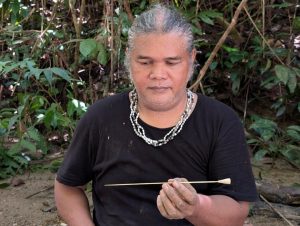
Blowpipe darts of the Orang Asli people
A blowpipe without a dart is nothing more than a tube. It is the dart — the damak — that carries the outcome of the hunt. Among the Orang Asli of Peninsular Malaysia, dart-making is considered a craft that draws on specific forest materials and a refined understanding of physics honed over generations. The result is a projectile of exceptional simplicity and precision: typically, 20 to 30 cm long, weighing only a few grams, and capable of reaching speeds of up to 180 km/h when launched from the blowpipe. We have handled and examined darts from Jahai, Semai, and Temiar…

Orang Asli Bamboo Blowpipes: 5 Traditional Examples from My Collection
For many years, I’ve been teaching junglecraft and survival skills in the Malaysian jungles. In turn, I learned these skills and knowledge from close Orang Asli friends. For stealth hunting, their primary weapon is the blowpipe, but they also place considerable emphasis on trapping. Over the years, I acquired various blowpipes from the Semai, Jahai, and Temiar tribes, and I also manufactured them using traditional materials and methods. In the following, I will briefly present five blowpipes from my collection. Measurements of five blowpipes Inner pipe Outer pipeBlowpipe #Tribal originAcquisition yearTotal length (cm/feet)Outer diameter (mm/inch)Blowhole dia Mouthpiece (mm/inch)Blowhole dia Muzzle (mm/inch)Connection…
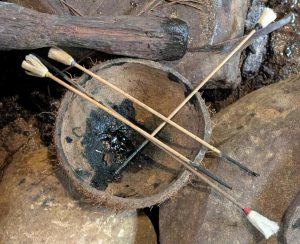
Borneo Blowpipe Darts: Penan Traditional Poisoned Designs, Materials & Hunting Uses
Borneo blowpipe darts are very similar to those of the Orang Asli people on the Peninsula. The main difference is that they also use strings as tail-end material, sometimes use fletches for higher accuracy at longer distances, and use tiny broadheads for larger game. Description of Borneo blowpipe darts The darts consist of two parts: a wooden, needle-like shaft and a conical and compressible tail end. They are about 10 inches (25.4cm) long, very thin, and light. But in general, blowpipe darts in Borneo are slightly larger than their counterparts in Peninsular Malaysia. Shaft material The shaft is often made…
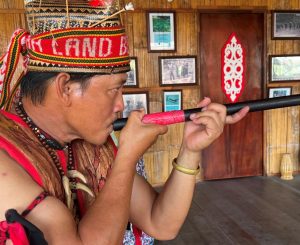
Borneo Blowpipes Part 2: From Rough Bore to Deadly Weapon – Spear Tips, Aiming Sights & Traditional Use
The first part of this article concentrated on the production of the rough blowpipe. The second part describes how to finish it and the design elements of the Borneo blowpipes, including their use. Finishing the barrel The metal rod used to bore the hardwood is called kerajang. After the iron rod bored through the log, the inside of the barrel is rough from the action of the chisel. To smooth the bore, near seashores, shark or ray skin is secured to a cord and often pulled through the barrel. In landlocked areas, another steel rod, called syok, with a sliver…
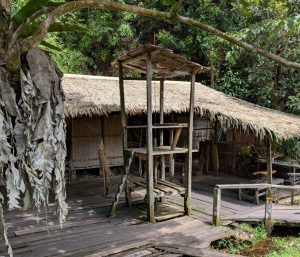
Borneo Blowpipes Part 1: Hand-Drilling a Deadly Sumpitan from Ironwood
Borneo blowpipes were for generations the primary hunting weapon in the Bornean interior. If we say ‘Borneo’, we mean the whole island, consisting of the two Malaysian provinces of Sabah and Sarawak, the Indonesian province of Kalimantan, and the Sultanate of Brunei. Blowpipes were and are also used in the other provinces of Malaysia (‘Peninsular Malaysia’ or ‘Western Malaysia’), but differ significantly from Borneo blowpipes. Nowadays (January 2026), however, the use of these weapons is declining and is limited to occasional use by the Penan and other tribes in remote longhouses in the interior of Borneo. According to this source,…
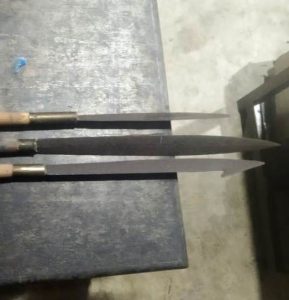
Mentawai spears
When hunting with a pack of dogs for deer, wild boars, or monkeys, three types of weapons can be used to finish off the cornered game. One is a bow and arrow, which, however, is not safe for dogs during the commotion that usually occurs. The other one is the machete (Lugguk), with which the hunter tries to sever the animal’s spine. Which also has its disadvantages. The safest and fastest method to kill the cornered game is the use of a spear as a lance. This method is the same worldwide, including among the Mentawai. Another application for a…
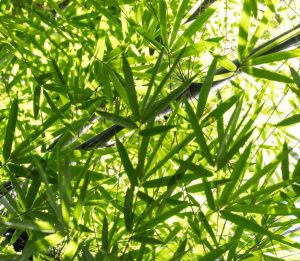
Bamboo: The Orang Asli’s natural toolkit
If rattan is the skeleton of Orang Asli junglecraft, bamboo is the toolkit. From riverbanks to misty hill slopes, clusters of bamboo mark places where people have worked, cooked, travelled, and sheltered for countless generations. To an untrained eye, most bamboos look alike: tall, hollow, and green. But for Orang Asli communities in Peninsular Malaysia, each species is a different tool waiting to be used in the right way and at the right time. Mapping bamboo to the landscape Around 70 native bamboo species occur in Malaysia. The most important genera for junglecraft include Gigantochloa, Schizostachyum, and Dendrocalamus. Orang Asli…
Rattan: Flexible raw material from the forests
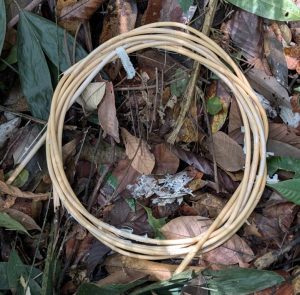
Deep in the lowland dipterocarp forests of Peninsular Malaysia, long before you see rattan, you feel it. Hooks catch on shirt sleeves, flagella tug gently at your backpack, and the forest floor is littered with the thorny sheaths of climbing palms. For the Orang Asli, these plants are not a nuisance. They are one of the most important raw materials of their junglecraft: rattan. Where most outsiders just see “Rotan”, Orang Asli see a whole toolbox of distinct species, each with its own character, strengths, and proper use. Over generations, they have learned to read the forest like a catalogue…
Improvised firearms of the Orang Rimba people
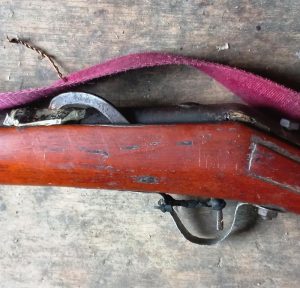
Improvised firearms are the new hunting weapon of choice for the wild living Orang Rimba people in Jambi province, Indonesia. In one of the following articles, I will present their traditional hunting techniques and typical hunting weapons. Here, I will focus on improvised firearms, known as Gobok in Bahasa Indonesia. At the end of 2023, I already visited this family clan, and now, at the end of 2025, I met the same band again. Profound changes occurred within these two years, which include their hunting techniques and the availability of weapons. In 2023, only the clan leader had an improvised…

Mentawai Carrying Baskets for Farm and Forest produce
Mentawai people use five types of carrying baskets, which they call Opa, Tuku, Jarakjak, O’orek, and Bolokbok. Opa – the standard-sized carrying baskets. Opa are the most popular type of carrying baskets. They are entirely woven from Calamus javensis rattan vines collected from the surrounding forests. Primarily, men use them as their ‘standard backpack’ to carry small fruits, other agricultural produce, and lightweight items. These baskets are about 70 cm (28’’) high with an inner diameter of about 40 cm (16’’). Carrying straps are made from the bark of the Baikho tree (Artocarpus elasticus). That is the same material used for bark loincloths or…

Cutting- and chopping tools at Siberut Island
The cutting- and chopping tools used by forest dwellers include adzes, axes, machetes, and a specialized knife. All of these tools have a strong historical background and are still in use today. Axes People primarily use axes (Oggut) to fell sago and other palms. The handle of the observed axe was carved from Arenga pinnata wood. It was so old that nobody at the Uma could recall when the steelhead was purchased or how long the handle had lasted. Combined Adze and Axe The cutting edge of an axe is parallel to the handle, whereas the cutting edge of an adze…

Rattan Leaf Stalks: The Mentawai Coconut Grater
Rattan leaf stalks have been, since immortal times, the tools with which Mentawai people have been grating coconuts. These long-lasting tools grate the coconuts into the required size of flakes. When worn out or broken, a new one will be found and cut in the surrounding forest within half an hour. Interestingly, no reference can be found in literature and the internet for using these leaf stalks for grating coconuts, even not here. Which species of rattan is used for grating stalks? The following characteristics of the preferred type of rattan were observed: Due to a recognizable nose-shaped leaf sheath…

Mentawai arrow poison
The Mentawai people use poison on their arrows to hunt game. In previous articles on this website, we discussed the Mentawai people’s hunting methods. Then, we presented an actual hunt for Flying foxes. We then discussed the longbows used on these hunts, the arrows used for different animals, and quivers. In the following section, we will discuss the manufacture of Mentawai arrow poison. Before starting this article, one important fact has to be remembered. The Mentawai people don’t have a written language and only communicate orally. Therefore, a variety of different transcriptions of this vernacular language exist. I wrote the…

Hunting arrows and quivers of the Mentawai people
Bows and arrows are the primary hunting weapons used by the Mentawai people. Their bows were already described here. This article will explain the different types of arrows used for these bows and give an insight into the quivers used. Another article described arrow poison and its manufacture. Arrow shapes and designs Three types of arrows are used: one designed primarily for monkey hunting, another for wild pig hunting, and one for bird hunting. Arrows for monkey hunting This is the most common arrow type. It is used for hunting monkeys and all other small game that can be penetrated with a…

Mentawai Hunting bows
Hunting bows are the primary hunting weapon for the Mentawai people and are very personal items for a hunter. They have excellent skills in using them and practice shooting from childhood onwards. During my stay with the Mentawais, I looked closely at two of these bows and will describe them in the following. Bow #1 was the hunting bow of Aman Aru and was used to shoot a Flying fox, as described in this article on this website. Bow #2 was the hunting bow of the grandson of Aman Kuki and was also in regular use. The Longbow itself Both…

Crafting a bamboo fish trap in Thailand
Learning the craft of bamboo fish trap weaving The correct English wording for a ‘Lop’ in Thai would be ‘Horizontal cylinder trap with entry cone’. It is used to catch various freshwater fish and crustaceans, including small snakeheads, catfish, shrimp, swamp eels, etc. Traditionally, bamboo and rattan vines were used for fish trap weaving. Nowadays, fish traps are also made of a steel wire skeleton and covered by nylon netting. The intention was to learn to weave bamboo fish traps and use nylon string for binding. One of our company employees in Bangkok had an uncle in the upcountry. He…
Spear shafts from grass tree stalks
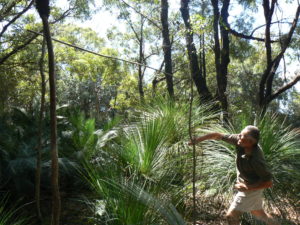
Grass trees (Xanthorrhoea sp.) and grass tree stalks are endemic to Australia. They are locally called ‘Black Boys’ due to their appearance after bushfires. They need a certain number of regular fires for their survival and are well protected against them. Xanthorrhoeas were utilized historically intensively for a very long time by First Nations people. And for a very short time also by non-Aboriginals. During these abt. 10 years in the 1920s, non-Aboriginal people eradicated these plants in many environments where they were once common. Currently, grass trees are only protected in National Parks, although three species are already ‘Endangered’.…