
Hunting
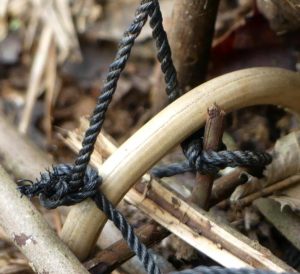
Orang Rimba spring pole snare traps
When we were visiting a band of primitive living Orang Rimba (Kubu) people in Jambi province, Sumatra, Indonesia, each of their shelters had a spring pole snare trap nearby, which was set when they left for a walkabout. The working principle of these traps was very similar to that of any other hunter-gatherer tribe worldwide. This Orang Rimba band was only accessible after a long boat ride; over land, it would have taken us many days walking to reach them. None of them was a registered citizen of Indonesia, and they were very shy. What are the target animals? These…

Bamboo rat for dinner
Bamboo rats are a common rodent in bamboo thickets in mountainous areas of northern Vietnam. Hmong tribal people in remote regions still hunt them regularly for food. Although hunting bamboo rats is officially prohibited, the practice is still widespread. To document this practice, the following will describe how they are hunted for food. And we also bought a rat from a licensed Bamboo rat farmer for culinary purposes. Animal description In Vietnam, three species of bamboo rats are known: The Hmong population in the area we visited hunted Large bamboo rats. This bamboo rat species can grow to 50 cm/…

Blowpipe hunting with Orang Asli people in Malaysia
Blowpipe hunting is still prevalent in many Orang Asli communities in Malaysia. Although the government strictly enforces hunting rules and regulations, it is practically impossible to supervise all the remote small hamlets and villages. On the other hand, it is also practically impossible for the Orang Asli people to travel outside villages to buy meat. There are often no roads, only waterways, and the people are very poor. They, therefore, resort to what they have done since eternal times: they live from the products of forest and waters. A Malay friend of mine was, in turn, a friend of a…

Scissor Traps of Thái Đen tribals in Vietnam
Scissor traps are universal traps that can catch all kinds of small rodents. They are easy to produce from bamboo but need one item to be sourced in the villages. These are strips of bicycle tubes, which are not easy to come by in these remote areas. Therefore, deadfall traps and bow traps are more common. Target animals These scissor traps are used for catching small rodents, from Sikkim rats, field rats, mice, and shrews down to the tiniest voles. Asiatic brush-tailed porcupines are common in this area and are also rodents, but they are already too big for these…

Bow Traps of Thái Đen tribals in Vietnam
Bow traps are used by Black Thai tribal people in Northern Vietnam to catch small rodents. These ingenious devices are carved from pieces of bamboo and some strings. The closing force of the scissor comes from a bow-like structure above the shearing bar. Although this trap’s structure appears quite complicated, locals prefer it over the simpler-designed deadfall- and scissor traps. Target animals The primary targets of bow traps are: Rats are only by-catches, as their movement behavior is different from mice, voles, and shrews. The working principle of this bow trap The material used is unspecified bamboo with long sections…

Deadfall Traps of Thái Đen tribals in Vietnam
Deadfall traps with a Figure-4 trigger are essential knowledge for survivalists and bushcrafters worldwide. Thái Đen (Black Thai) tribal people at Pù Luông Nature Reserve in Northern Vietnam use these traps and the Figure-4 trigger in a modified version. Modifications include the type of deadfall weight, the trigger material, and the trigger design itself. Target animals Two species of rats are the target animals for this deadfall trap. One is called Chuột rừng, or Sikkim rat in English (Rattus andamanensis). The other is called Chuột cống, or Field rat (Rattus rattus). The Sikkim rat is brownish on the upper side with…

Flying fox hunting
Flying fox hunting remains a prevalent activity in Indonesia, particularly in Sumatra. Aceh, the northernmost province, is the epicenter of the trade in Flying fox meat. Locals believe that this meat possesses qualities to alleviate asthma, although this claim lacks medical substantiation. Despite this, it perseveres within the local perception. The ‘large flying fox’ (Pteropus vampyrus) is also known as the Greater Flying Fox, Malaysian Flying Fox, Large Fruit Bat, or Kalong. Its description and ecology can be found under this link. The author was on Siberut island, off the coast of Padang in West Sumatra province in Indonesia, with…

Hunting methods of Mentawai people
The hunting methods of the Mentawai people have developed over about 3000 years. Their ancestors were of a Mongolian race that migrated from Taiwan via the Philippines to modern-day Indonesia. They arrived around 1000 BC at Siberut island in West Sumatra province in Indonesia. These people primarily rely on Sago and Taro as their main food sources. Chickens and pigs are mainly reserved for ceremonial occasions. Consequently, wild animals become essential for protein needs. Despite this, the Mentawai people are selective in their eating habits. They avoid arthropods such as insects, arachnids, centipedes, and animals they deem dirty, like reptiles…