
Fishing
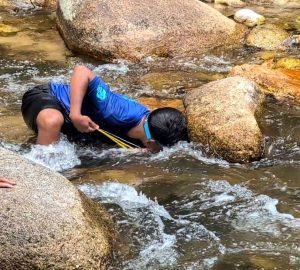
Traditional Pole Spear Fishing with the Temiar Orang Asli in Perak
Besides angling and cast netting, as described in an earlier article on this website, mid-sized fish are also caught with pole spears in the fast-flowing waters of the Perak rainforests. Together with Shaik Reismann, I spent time with the Temiar Orang Asli people and learned a variety of bushcraft techniques from them. Pole spear fishing near Kampung Orang Asli Beswok at Pos Yum was one of them. Kampung Beswok is the uppermost village of the Yum Creek valley; beyond, only dense rainforest stretches with no further permanent human habitation. Location and fish species caught with pole spears The mountain creeks…
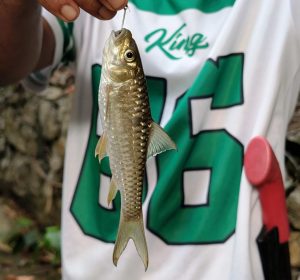
Fishing for Copper Mahseer (Tengas) in the Malaysian rainforest
Description of the location My friend, Shaik Reismann, and I visited Kampung Yum in Perak state, Malaysia, to learn from the Temiar Orang Asli people’s traditional junglecraft skills and knowledge. Shaik himself also serves as the junglecraft trainer for the Community Rangers (Renjer Komuniti) of the RIMAU NGO, which specializes in preserving and protecting the last remaining Malayan tigers. And one of his Community Rangers is Bakri, our point of contact at Kampung Yum. This village (Kampung) is part of Pos Yum, which is about a one-hour drive from Sungai Siput in the Malaysian state of Perak. Within the eight…
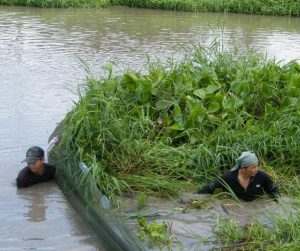
How to Catch Fish in Khlongs: The Surrounding-Water-Plant Netting Method
Most Thai waterways, khlongs (canals), and streams are clogged with aquatic plants, predominantly Common Water Hyacinth (Eichhornia crassipes), commonly known as Phak Top Chawa in Thai. This invasive species was introduced in 1901 by Thai Royalty from Indonesia and was intended for eradication under the Water Hyacinth Disposal Act of 1913, but it had no effect. Currently, a substantial effort is required to partially remove them from navigable rivers. The only known uses of this plant are to produce biofuel and as an alternative weaving material for bags and handicrafts. Fishermen often don’t like Eichhornia crassipes, as it hinders angling…
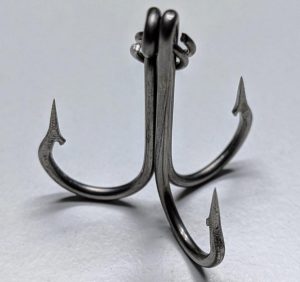
Hand-made fishing hooks from Bali
While travelling to the northern coast of Bali/Indonesia, we met the owner of a general store at the Banyuasri Singaraja Market, whose employee was hammering fishing hooks on a makeshift anvil outside. The owner, Pak (Mr.) Gede Suarka, nicknamed “Lolak,” was an exceptionally friendly man who showed us his products and how he and his employee produced them. When younger, Pak Lolak was a traditional fisherman whose problem was that high-carbon steel fishing hooks rusted rapidly in seawater, requiring frequent replacements, which was costly. He therefore started about 30 years ago to produce hooks himself from stainless steel wire. Initially,…
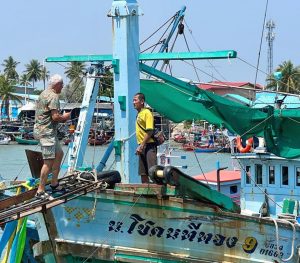
Conch Traplines for Octopus in the Gulf of Thailand
In the following, we will describe the catching operation of octopuses from a fishing vessel with the help of conch traplines. This is the high-end operation of catching these cephalopods, and, based on catching weight, the primary one. But the same technique of catching Marbled octopuses in Thailand is also used by artisanal fishermen, who are often alone on a boat, or only with one helper. These fishermen just use one conch trapline, and often, the distances between each conch shell are larger compared to those on fishing vessels. They operate close to the shore and bring in the catch…
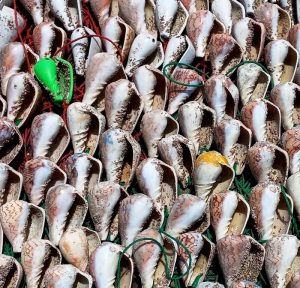
Octopus Traps Made from Conch Shells
Marbled octopuses like to hide in small caves at the seafloor. Fisherfolk use this behavior and offer artificial caves, which they populate. Even while retrieving, the octopuses will not leave their shelter and can be easily caught. Since ancient times, Noble volute conch shells have been used as artificial hiding places due to their easy availability and robustness. Before using these shells, however, they have to be prepared and optimized for the task, which will be described in the following article. Which octopus species is targeted? The primary target of this cephalopod trapping method is the Marbled octopuses (Amphioctopus aegina),…
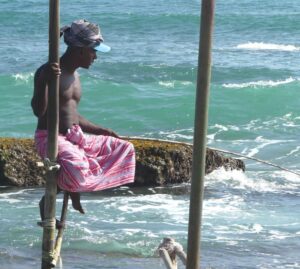
Stilt fishing in Sri Lanka
Stilt fishing, locally known as ‘Riti Panna’, was an essential and unique fishing technique on the southern coast of Sri Lanka between World War II and the 2004 tsunami. After this period, this coast was developed into a major tourist area, and stilt fishing was turned into a photo-op activity, romanticizing stilt fishermen against a sunset backdrop. History of stilt fishing During World War II, food shortages occurred on the south coast of Sri Lanka due to the influx of British troops and overfishing. Some innovative fishermen sought additional ways to fish and used the wreckage of capsized ships and…
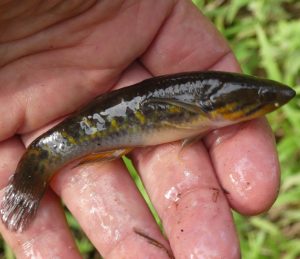
Freshwater fishing at Siberut Island
Depending on the location of the longhouse of a Mentawai family, fishing is conducted in any permanent water structure large enough to hold fish, gastropods, or crustaceans. In general, fishing is regarded as the work of men; women fish only with hand nets in terrestrial water bodies, or with scissor nets in the sea. Fishing methods Hand net fishing Hand net fishing is often practiced in the island’s interior. It is typically done by women who wade up to their hips in slow-moving streams or channels. With a hand net, they try to catch freshwater prawns, crabs, frogs, and small…

Bottom fish traps of the Urak Lawoi people
The following information was gathered from a Urak Lawoi man who has lived in the Rawai Beach Sea-Gypsy Village for 27 years. He was 57 years old and only had one tooth (incisor) left in the middle of his upper jaw. This friendly person spoke good English, was a fisherman, and had his longtail boat. He has caught two Black Marlins in his life. One was 27 kg heavy, and the other one was 41 kg. I questioned him about the Bottom fish traps being built everywhere on Rawai Beach. His information was recorded in the following. If somebody is…

Rectangular squid traps in Thailand
Rectangular squid traps are used in the Gulf of Thailand and along the coastline of the Andaman Sea in the same way as semi-circular traps. Both types are used mainly for catching Bigfin reef squid (Sepioteuthis lessoniana) but will also catch Pharaoh cuttlefish (Sepia pharaonic) and various finfish species. For more details, see our article about semi-circular squid traps on our website here. Trap design The physical outer dimensions of these traps are roughly 0.8×0.6×1 m / 2.6x2x3.3 ft. The wooden sticks used to build the trap are often shoots and sticks of various mangrove species. Sequence of building the…

Trapping eels in Northern Vietnam
Trapping eels is a simple way for rice farmers in the catchment area of the Red River in North Vietnam to provide themselves with animal protein. No special skills are required, as with angling or net fishing. The activity is not time-consuming, and the traps can be quickly and cheaply made. In contrast to fishermen and rice farmers in Cambodia and Thailand, bamboo tubes and modern materials such as plastic tubes are often used for eel trapping in North Vietnam. Which devices are used for trapping eels? Like South Vietnam, Cambodia, Laos, and Thailand, eel tubes are used with a…

Trapping Snakeskin Gourami in the Mekong Delta
Trapping Snakeskin Gourami fish (Trichopodus pectoralis) is commonly done all over Southeast Asia. However, a specific trap for catching them was developed in the Mekong Delta in Vietnam. Its simple principle could be easily applied to many other areas of this fish species distribution. A detailed description of Snakeskin Gourami can be found here. Snakeskin Gourami fish and their nesting behavior Snakehead Gourami fish spawn in rice fields, canals, ditches, or ponds with many aquatic plants from April to October. They can live in low-oxygenized water. They pair up and find a place to nest and lay eggs. Female fish…

Neolithic Fishhooks in Korea: Hook and Sinker in One
During the Neolithic Age (8000 BCE—1400 BCE), people across various regions began to adapt to the evolving natural environment following the Ice Age. This era is characterized by the emergence of earthenware artifacts and groundstone tools and the establishment of the earliest settlements. A consistent supply of food resources, primarily shellfish and a diverse range of finned fish, made the establishment of these settlements feasible. Notably, in Korea, archaeological evidence has unveiled the oldest stone sinkers designed for nets. According to current knowledge, these findings suggest that this fishing technique was fine-honed during this period. Even in contemporary times, fishing…
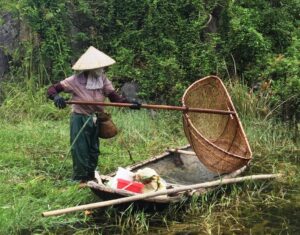
Using a stomping basket to catch fish in Vietnam
Fishing with a stomping basket has been a traditional craft in Vietnam for centuries. Postcards from the French colonial era depict this unique fishing method as a typical way for locals to catch fish. While similar techniques exist in other Southeast Asian countries, they have not gained the same popularity as in Vietnam. The favorable conditions of the Red River basin, particularly in the Northern Delta, have made it the primary area where stomping basket fishing is practiced. In contrast, the Mekong Delta, which constitutes the Southern Delta, does not widely use this fishing technique. However, it is important to…

Giant Snakehead fishing in Thailand
The Giant Snakehead fish (Channa micropeltes) is a highly aggressive and predatory freshwater fish. Its diet mainly consists of smaller fish, frogs, crustaceans, and aquatic prey. In Malaysia, Singapore, and Indonesia, this fish is known as the ‘Toman’ and, along with the Hampala Barb (Hampala macrolepidota), it is the most coveted freshwater gamefish in these countries. However, the situation differs in Myanmar, Thailand, Cambodia, and Vietnam. Fishing for sport is only minimally developed in these regions, and most fishing activities are geared towards subsistence purposes. Description Giant Snakehead fish can grow up to 1.3 meters long and weigh up to…

Description of a speargun for freshwater fishing
In the following, we will briefly describe a specific speargun for freshwater fishing, which I bought from a fisherman in the northern suburbs of Bangkok, Thailand. It is neither as primitive as many of these guns are, nor is it too over-sophisticated. Besides the reel, everything was made locally by himself and just for the practical purpose of catching fish for his family’s table. General description With a total length of 186cm / 6 ft 1.23’’ (73 ¹⁵/₆₄’’), this is a pretty long piece of equipment. But it can be easily handled from an elevated position over water, where there…

Mechanically propelled darts for freshwater fishing
Mechanically propelled darts for freshwater fishing are commonly used all over Thailand. Many craft these devices themselves, so there is a wide variety of principles, styles, and designs. Besides homemade spearguns, where every piece is unique, industrial manufacturing is also in place. Some individuals produce many spearguns, e.g., ten at once, and sell them locally and on the Internet. Technological stages of mechanically propelled darts The simplest fishing guns consist of a rubber band held by hand, which propels an iron rod forward. The next technological step forward is a small pipe length with a rubber band at its backside.…

Traditional fishing at Inle lake in Myanmar
Traditional fishing at Inle Lake is endemic and specific to this local environment. Inle Lake is the second largest lake in Myanmar, approximately 50 square miles (abt. 116 km2). During the dry season, the average water depth is only 7 feet (2.1 m). During the rainy season, the average depth increases to 12 feet (3,6 m). It is, therefore, a large and shallow lake. Aquatic floating plants cover large lake areas; the water is warm, clear, and slightly alkaline. These conditions support a rich fauna within and outside its waters. Fish species caught at Inle Lake. Research by Kyushu University…
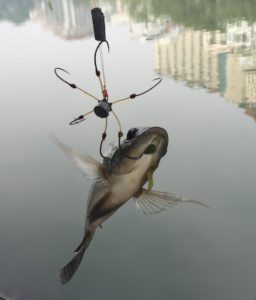
Fish ripping in Hanoi, Vietnam
A typical fishing technique in Vietnam is ripping a weighted hook with multiple side arms through still water and hoping to hook unsuspecting fish somewhere on their body. Hooking a fish at the lips with the correct size and style of hook—as in conventional angling—will highly likely hold the fish on the line, whereas getting randomly hooked somewhere on the body will often result in heavily injured fish by ripping out the hook(s) from soft flesh. Fishing equipment for ripping There are two main styles of hooks used. One is a spider-like contraption that holds six unbarbed hooks via thick,…
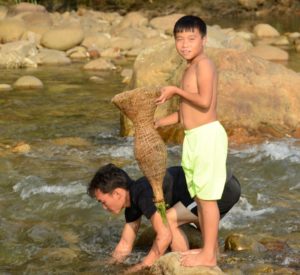
Fish trapping at a fast-flowing brook in Vietnam
Trapping fish in bamboo traps in Southeast Asia is normally a static affair. These fishing traps are used in still waters with or without bait inside and checked at least once daily. It was a new experience to see somebody trapping fish with bamboo traps on the go in fast-flowing waters. Sa Pa is a town in the far north of Vietnam, within the Hoang Lien So mountains. Its elevation is 1600 m above sea level. I observed fish trapping in the Cau May brook. This brook was, on average, about 20 meters wide and fast-flowing. The whole brook was…

Cormorant fishing at Li Jiang River in China
Cormorant fishing is an ancient art that dates back at least 1300 years. Today, it is only practiced in the southwestern provinces of China. However, some fishermen are attempting to revive this fishing technique for tourists in water villages around the Shanghai and Suzhou areas. This technique is so iconic in China that it is even depicted on the 20 Yuan note. The cormorant species predominantly used in China for fishing is the Black cormorant (Phalacrocorax carbo). One of the most popular locations for cormorant fishing is the Li Jiang River, stretching from Guilin to Yangshuo. This river is a…

Semi-circular squid traps in Thailand
Squid is a main source of income for many fishermen in villages around the Gulf of Thailand and the Andaman Sea. Because fish are becoming increasingly rare, whereas Cephalopods maintain their population. Only certain types of finfish are sold profitably, and the rest are processed into fish sauce or fishmeal. On the other hand, squid of all sizes are always in demand. Which kind of animals are caught in those squid traps? SEAFDEC, the Southeast Asian Fisheries Development Center, presented a study in which it was found that in Rayong province, 94% of animals caught in squid traps were Bigfin…

How to Hold a Live Eel: The Finger-Hook Method
The Asian swamp eel (Monopterus albus), called Pla Lai in Thailand, is used as a food source and for offering to the spirit deities. When still slim and young, eels are sold to the Buddhist local population for doing a good deed by releasing them (the dealers catching them thereafter again). When they are mature, thick, and long, they are a preferred roasted snack for local male villagers around a bottle of moonshine. Both holding live eels and selling them is tricky. Catching swamp eels in the wild Catching Pla Lai is relatively easy. They occur in swampy areas with…

Hand lifting net (Yor lek) in Thailand
Small lift net for catching daily meals of freshwater prawns and fish ‘Yor lek’ is a hand-lifting net; in Thai, it means something like a ‘small lift net. ‘ ‘Yor’ means ‘lift net’ and ‘lek’ means ‘small’. Its big brothers are called ‘Yor yai’, permanently installed on large water channels. Yor lek is a typical family fishing device that does not need much attention and delivers daily meals. Every permanent water body in Thailand contains a variety of fish, crabs, gastropods, and freshwater prawns/shrimps. In small and shallow water bodies, various species of Gourami fish (Trichogaster sp., and various others) live.…

Cast Net Throwing Technique: Step-by-Step Guide to Mastering the Throw in Thailand
Description of cast nets used in Thailand Cast nets in Thailand are available in different radius models. I prefer one with a radius of 3.5 meters, which is from the center of the net to the outer axial rim chain, which acts as a sinker. Before using the net, pockets on the outer rim must be created. The sinker chain is knotted about 0.5 meters into the net, creating pockets at the rim that are about 25 cm deep. How to set up a large cast net for throwing It isn’t easy to describe the complex technique of preparing such…
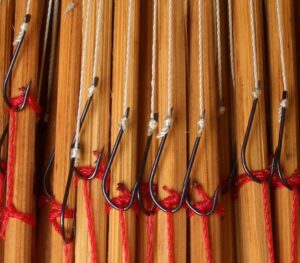
Bank Line Fishing with Small Poles in Southeast Asia
The term ‘Bank line’ used in English to refer to a string of poles along a water bank is virtually unknown in Southeast Asia. Instead, this fishing method and its equipment are referred to by different names in the region. In Thailand, it is called รอบแบ่ง (pronounced ‘Raw Baed’); in Cambodia, it is known as សន្តុចបងគៃ (pronounced ‘Santouch Bong Kai’), in Laos, it is called ໄກ່ຂົ້ມ (pronounced ‘Kai Khom’), and in Vietnam, it is referred to as ‘Cần câu múc’. Target fish- and frog species The primary target fish species for Bank line fishing during wintertime (September to January) are…

Bamboo Fence Fish traps on Tonlé Sap Lake, Cambodia
In many areas of the biggest Cambodian lake, its tributary river, and the Mekong flood plains, permanent bamboo fence fish traps, or, more appropriately, catching structures, are erected and operated. The leader fence, which guides fish into the trap’s inner compartments, can be up to 500 meters long. The inner compartments consist of one or more pre-catching rooms, leading to one or more heart-shaped catching rooms. At the end of the last catching room, a horizontal bamboo fish-holding chamber is located, and it will be cleaned out regularly. Such bamboo fence traps catch fish and water snakes, complicating fish removal.…