
Coastal Foraging
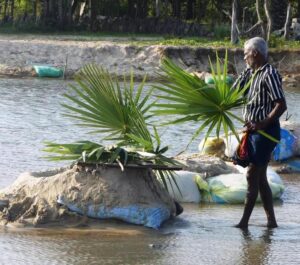
Shrimp pit traps on Sri Lanka’s east coast
Fish, crabs, and shrimp provide the livelihood of small-scale and artisanal fishermen on the east coast of Sri Lanka. Due to specific local conditions, various fishing and gathering techniques have evolved, including the use of shrimp pit traps. Tidal situation at Pottuvil lagoon Pottuvil is located on Sri Lanka’s southeastern coastline. North of the town is Pottuvil lagoon, which is fed by freshwater from inland and saltwater from a long and narrow channel connecting the lagoon to the Indian Ocean. All incoming waves towards the lagoon will be broken first by the surrounding rocks and another rock in the middle…

How to Find Venus Clams on Sandy Beaches
Venus clams (Meretrix meretrix), correctly named ‘Asiatic hard clams’, are one of Thailand’s most sought-after clams for food. They occur both in the Gulf of Thailand and on the coasts of the Andaman Sea. Fully grown species are large; their length can exceed 64 mm / 2 ½ ’’. They exhibit significant variations in coloration but are stable in form and proportions. The pallial sinus line inside the shell is always curved inwards. See the following picture. Venus clams prefer long, open coastlines with sandy beaches or sandy beaches with mixed mud. Completely muddy beach bottoms are not to their…
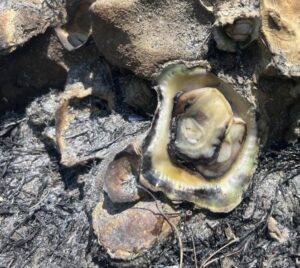
Smoked Rock Oysters: A Bardi Method from the Dampier Peninsula
In the spring of 2025, I traveled to Western Australia to document local survival techniques used by Indigenous people. Across Australia, Indigenous groups are generally categorized into three main types: the so-called ‘Saltwater mobs,’ who live along the coast; the ‘Desert mobs,’ who inhabit the arid inland regions; and the ‘Freshwater mobs,’ who settle along major rivers. My teacher I had the opportunity to meet members of three different ‘Saltwater mobs’ and was fortunate to go on a foraging trip with Terry Hunter, a Bardi man, at the remote northern tip of the Dampier Peninsula. Terry had worked for many…
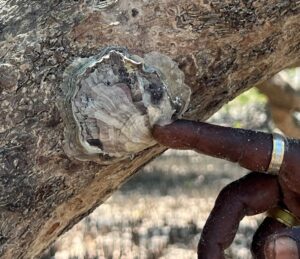
An oyster species growing on Mangrove trees
Mangrove oysters (Isognomon ephippium) are the species most commonly found growing on mangrove trees in Northern Australia. Its other common English name is ‘Saddle tree oyster.’ These oysters are one species eagerly collected and eaten by Bardi people at the northern tip of Dampier Peninsular, north of Broome in Western Australia. A member of the Bardi tribe showed us how to find and collect these bivalve mollusks. Description and behavior The shape of Mangrove oysters is nearly circular, and its valves are flattened. The dorsal margin is slightly convex, bulging slightly outwards. Its anterior margin (valve on the right side)…
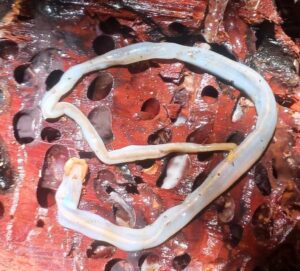
Harvesting Shipworms in a Thai Mangrove Forest
Edible shipworms, in this case Bactronophorus thoracites, are also known as Naked clams, Priyang talay (เพรียงทะเล), and various other common names throughout the region where they occur. They bore into wood immersed in salt water and are a major hassle for wooden ships, piers, and docks. Besides their habit of boring into wood, they are well-liked to be eaten by most Indigenous people within their distribution range in the Asia-Pacific, especially in Southeast Asia. What are shipworms? Shipworms belong to the phylum Mollusca and the class Bivalvia. Their two small shells only circumvent their anterior end and are used to…

Collecting Pipi clams at Rawai Beach
Pipi clams (Donax deltoides) are also known as Surf clams, Sandy Donax, and a wide range of other common names. In Thailand, they can be found on most beaches in the Gulf of Thailand and the Andaman Sea. They are called ‘Surf clams’ because they prefer sandy beaches with good surf. Description and Distribution These mollusks are small edible saltwater clams with shell widths between 15 and 25mm / 0.6 and 1 ’’. The outer shell surface is smooth with distinctive growth rings. The shells are robust and rugged, which has led to many shell middens on Australian coasts. Their…
Collecting Bibi worms on Koh Lanta
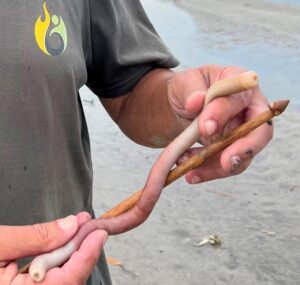
Bibi worms (Sipunculus nudus Linnaeus, 1776) belong to the Peanut worm phylum. They can be dug up at the intertidal zone of flat, sandy beaches on temperate and tropical beaches. These worms are primarily used as top fishing bait. At least in Southern China and Southeast Asia, they are also used for human consumption. Global distribution Bibi worms occur circumpolar on temperate and tropical sandy beaches, as seen by the Computer simulation below of this species’ native habitats. Preferred habitat Bibi worms occur from intertidal zones to sea beds down to great depths. We caught them in southern Thailand’s Koh…

Catching Octopuses by Sea-Gypsies
Sea-Gypsies – Urak Lawoi, Moklen, and Moken – traditionally catch octopuses along the Andaman Sea’s rocky shores, which they call โวยวาย in the Thai language. Using a metal skewer and baited bamboo stick, they locate octopuses in holes with foam or clean pebbles. Patiently baiting them, they impale octopuses with the metal skewer, preventing contact to avoid their tentacles’ suction. This traditional method includes finding, baiting, and safely handling octopuses for sustenance. General Catching octopuses is a common pastime for Sea-Gypsies. These tribes migrated from the Myanmar archipelago on the Andaman Sea towards Thailand. The Thai government settled most of…

Catching Ghost crabs by digging
Ghost crabs (genus Ocypode) comprise 22 different species, and they are commonly also called `Sand crabs.` The scientific name Ocypode has Greek origin and means swift-footed. Ghost crabs are semi-terrestrial crabs that dig deep burrows in intertidal zones of sand. They can be found in all subtropical and tropical regions worldwide. Ghost crab comes from their swift movements over the sand during darkness and their whitish-colored claws. Appearance of Ghost crabs The following three characteristics characterize all species of Ghost crabs: Additionally, Ghost crabs can adapt their whole body coloring to the surrounding sand colors and the time of the day,…

Seashore Survival: Where Your Salt Intake Comes From
The salt intake of a human in case of an actual survival situation or when living from the provisions of a shoreline by purpose is of utmost importance to its health. If too much salt is consumed, the body has adverse short-term effects, like dehydration, swelling, and kidney damage. Salt (Sodium chloride, NaCl) attracts water and holds it in human cells. It disrupts osmosis, which causes dehydration and symptoms such as headache, fatigue, and muscle cramps. Retaining body fluid also causes swelling in feet, ankles, and legs. Adverse long-term effects are high blood pressure, osteoporosis, and possibly stomach cancer. Health…

How to Catch Beach Crabs with a simple snare
An advanced, industrially manufactured crab snare usually consists of a bait cage with about six wire snares around it. This setup is used on a fishing line and rod, or is just hung down from a boat to the sea bottom. This type of crab snaring is shown in this article. On tropical beaches, locals use a by far simpler set-up. They just collect a string from the flotsam on the beach, form a snare, and add a wooden stick. Beach flotsam provides the materials Beach flotsam will be found on nearly any beach in Southeast Asia, as the plastic pollution…

Catching Razor Clams with Quicklime at Don Hoi Lot, Thailand
A mudflat full of razor clams ‘Don Hoi Lot’ is a mudflat in the Thai Province of Samut Songkhram with a size of about 15 km2 (about 9 square miles). ‘Don’ means ‘mudflat’ in English. ‘Hoi’ means ‘clam’, and ‘Hoi Lot’ are razor clams (Solen regulars). This razor clam species is endemic to the Gulf of Thailand, and the largest concentration of this species of clams exists at Don Hoi Lot. An extensive description of this mudflat and its razor clams can be found here. Bangkokians like to catch some of them on a family outing and have a feast…

Mudskippers for food
In Thailand, four mudskipper species can be found. These are the Giant mudskipper (Periophthalmodon schlosseri), Blue-spotted mudskipper (Boleophthalmus boddarti), Gold-spotted mudskipper (Periophthalmus chrysospilos) and the Indian Dwarf mudskipper (Periophthalmus novemradiatus). The Giant- and Blue-spotted mudskippers live at the Andaman Sea- and Gulf of Thailand coastline. The Gold-spotted mudskipper is restricted to the Andaman Sea and the northernmost coast of the Gulf of Thailand. The Indian Dwarf mudskipper settles around the Ranong area. They are all amphibious fish living in muddy estuaries and tidal brackish river zones around Asia-Pacific. They live in about 40 cm deep holes in the mud and…